Transcontinental Railroad: Maps, Facts, Completion
Last revised: September 2, 2026
By: Adam Burns
The first transcontinental railroad was not one company. It was a federal statute, two construction armies, and about 1,776 to 1,779 miles of new track between Sacramento, California, and Omaha, Nebraska, laid in six years almost entirely by hand. The Central Pacific came east from the Sacramento waterfront. The Union Pacific went west from the Missouri. They met at Promontory Summit on Monday, May 10, 1869.
Mike Del Vecchio was right, in Railroads Across America, that no other single event in American railroading quite matches it. Cross-country travel fell from months by wagon or clipper to about a week. That is the legend, and the legend is mostly true. What the ceremony did not do is put a through rail from the Atlantic to the Pacific. The Missouri River still had no bridge at Omaha. The Central Pacific still had to reach tidewater on San Francisco Bay. The men who actually moved the last rail that morning were Chinese, and Andrew J. Russell’s famous handshake photograph does not show them.
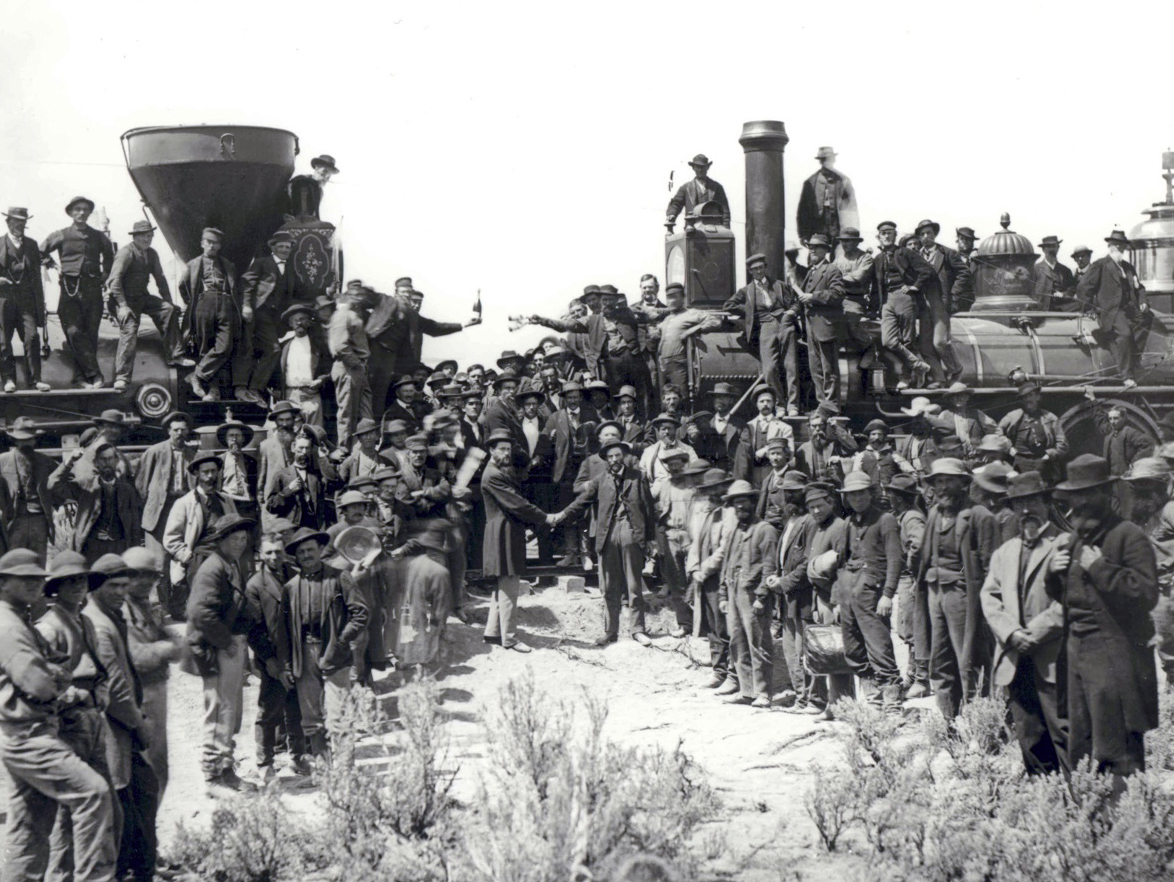
Andrew J. Russell, “East and West Shaking Hands at Laying of Last Rail,” Promontory Summit, May 10, 1869. Central Pacific chief engineer Samuel S. Montague (left) and Union Pacific chief engineer Grenville M. Dodge shake over the last rail, with Jupiter and No. 119 nearly coupler to coupler. The champagne bottles on the pilots are why railroad people still call this the champagne photo. Library of Congress / American-Rails.com collection.
On this page: At a glance · Pacific surveys · The 1862 and 1864 acts · Central Pacific · Sierra tunnels · Union Pacific · Map · The Utah race · Ten miles in one day · May 10, 1869 · After the spike · Lucin Cutoff · The park today
At a glance
| Item | Detail |
|---|---|
| What it was | The Pacific Railroad: Central Pacific east from Sacramento, Union Pacific west from the Missouri, joined at Promontory Summit, Utah Territory |
| Sacramento–Omaha mileage | About 1,776–1,779 miles as built. Period Official Guide (June 1870) and later chainages differ by a few miles depending on how the Ogden transfer is counted |
| Central Pacific | About 690 miles, Sacramento to Promontory. Incorporated June 28, 1861. Ground broken January 8, 1863, Sacramento |
| Union Pacific | About 1,086–1,087 miles, Omaha to Promontory. Created by the 1862 act. Ground broken December 2, 1863, Omaha. First rails July 1865 |
| Pacific Railway Act | Signed by Abraham Lincoln July 1, 1862. Amended July 2, 1864 (land doubled; companies allowed matching first-mortgage bonds) |
| Government bonds | Thirty-year, 6 percent U.S. bonds at $16,000 a mile on easy ground, $32,000 between the ranges, $48,000 in the designated mountain miles. The 1864 act let each company issue its own first-mortgage bonds up to the same amounts, which is how mountain miles can be made to look like $96,000. The government was not paying $96,000 a mile |
| Land grants | 1862: five alternate odd-numbered sections per mile on each side within ten miles (ten sections, about 6,400 acres on paper). 1864: doubled to ten sections per side within twenty miles (about 12,800 acres). Actual patents were less—minerals excepted, settlers already in, surveys late |
| Labor | Central Pacific: Chinese workers the large majority from 1865, on the order of 10,000–12,000 at peak, about 80–90 percent of the force. Union Pacific: Irish and other Civil War veterans, with Mormon graders in Utah |
| Ten-mile day | Central Pacific, April 28, 1869, west of Promontory: 10 miles 56 feet in about twelve hours |
| Last spike | May 10, 1869 (not May 8). Weber Canyon washouts delayed Union Pacific’s special. Golden Spike National Historical Park (redesignated 2019; Historic Site 1965–2019) |
| Missouri River bridge | Omaha–Council Bluffs, opened March 27, 1872. Until then, ferry or ice. Lincoln had set the legal eastern terminus on the Iowa bank |
| Track gauge | 4 ft 8½ in. The 1863 gauge act made the Pacific Railroad standard gauge; that decision is why the West was not built to 5-foot or 6-foot |
Mileage from the June 1870 Travelers’ Official Guide (Vernon), later UP/CP chainages, and the National Park Service. Bond and land figures from the acts of 1862 and 1864 (12 Stat. 489; 13 Stat. 356) and the Pacific Railway Commission. Information compiled September 2, 2026.
A railroad before there was a Union to finish it
Asa Whitney was already lecturing Congress on a Pacific railroad in 1845. The idea was older than the Republican Party and older than the war. What it lacked was a route everyone could live with. In March 1853 Congress directed the Army to survey corridors to the Pacific. Jefferson Davis, as Secretary of War, ran the work. Field parties under Isaac I. Stevens, John W. Gunnison, Amiel Weeks Whipple, John Pope, and others walked the 47th–49th, 41st–42nd, 38th–39th, 35th, and 32nd parallels. The published Pacific Railroad Surveys filled a dozen volumes. They were not eight separate roads. They were five principal belts, north to south, and a political argument wearing surveyors’ boots.
Southern men, Davis included, wanted the 32nd-parallel line—along the Gila, through Texas, to San Diego or thereabouts. Northern men wanted a Platte Valley road from the Missouri. Slavery made a choice impossible. The files sat until the South left the room. Abraham Lincoln was elected November 6, 1860. South Carolina seceded December 20. Fort Sumter was fired on April 12, 1861. With Southern senators gone, the central route was no longer a compromise. It was the remaining option.
Lincoln believed in railroads. That is not folklore. He had failed at a seat in the Illinois legislature at twenty-three and spent the next decades as a lawyer who understood what iron did to a prairie county. He defended the Illinois Central in tax cases. In 1857 he represented the Mississippi & Missouri (later folded into the Rock Island) in the Effie Afton case after a steamboat struck the first bridge across the Mississippi at Rock Island. The river interest wanted the bridge down. Lincoln argued that a railroad had as much right to cross a navigable river as a boat had to use it. The country would live with that answer.
He did not, however, build the Pacific Railroad as a campaign against the Confederacy. The war made a central route politically possible. California gold, a military road, and a mail contract were the Union arguments. Binding the Pacific slope to the remaining United States was the point. The railroad would outlast the war by a century. That was the better reason.
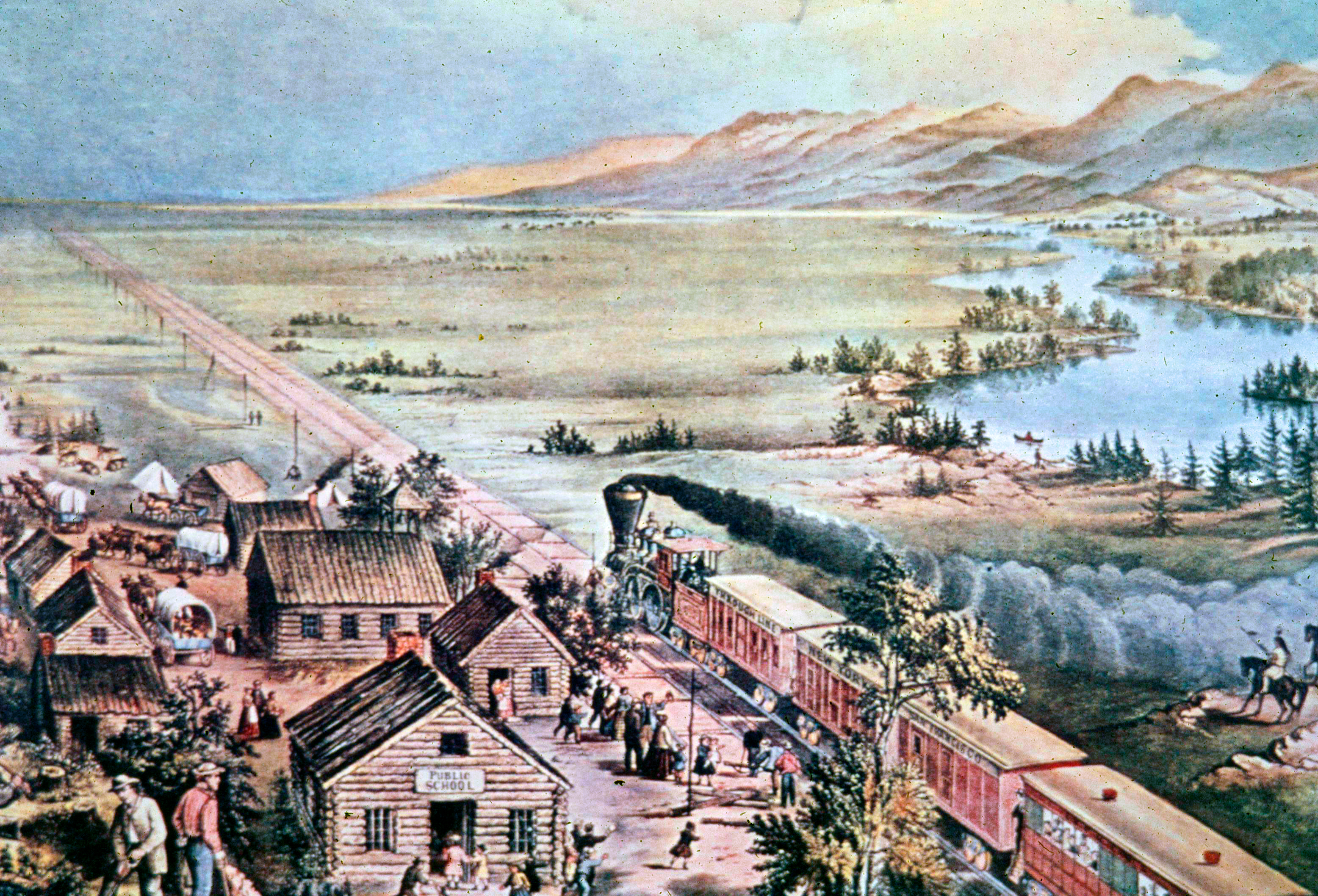
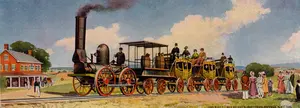
“Westward The Course Of Empire Takes Its Way.” Currier & Ives lithograph of the newly finished Pacific Railroad, 1869. The title is borrowed from Bishop Berkeley; the train is the argument. Author’s collection.
The acts, the land, and the paper
Lincoln signed the Pacific Railway Act on July 1, 1862. It created the Union Pacific Railroad Company as a federal corporation and authorized the already-chartered Central Pacific to build east from the navigable waters of the Sacramento. The road and a telegraph were to run from the Missouri to the Pacific. The President would fix the Iowa end. Right-of-way was 200 feet on each side of the track. Land came in a checkerboard: every alternate odd-numbered section, five per mile on each side, within ten miles of the line. Government bonds, $1,000 each, thirty years at 6 percent, were to be issued at $16,000 a mile on the plains, doubled between the ranges, and trebled for 150 designated mountain miles at each end. Those bonds were a loan, not a gift. They were also, in 1862, a first mortgage. Capitalists would not buy a second-class security behind Uncle Sam. Construction lagged.
The amending act of July 2, 1864 is the one that made the job financeable, and the one that made it notorious. Land was doubled to twenty alternate sections a mile, taken from a twenty-mile belt. More important, the companies were allowed to issue their own first-mortgage bonds up to the same amounts as the government issue. The United States dropped to a second lien. On a mountain mile a promoter could now point to $48,000 in government paper and $48,000 in company paper. That is the $96,000 figure that still wanders through popular accounts. It was a stack of securities, not a Treasury check.
John Stover, in The Routledge Historical Atlas of the American Railroads, put the whole land-grant era in scale: between 1850 and 1871 the government offered railroads on the order of 170 million acres for some eighty projects; about 131 million acres were actually used, building roughly 18,700 miles. The Illinois Central had already shown, in the 1850s, that alternate sections could finance a main line. The Pacific roads were the same idea at continental length. On paper, twenty sections a mile is 12,800 acres. Multiply by 1,779 miles and you can print 22.8 million acres. That arithmetic is not what the General Land Office patented. Mineral land was excepted. Settlers were already on some odd sections. Surveys ran years behind the track. The Pacific Railway Commission later counted more than 26 million acres across the whole bond-aided Pacific system, Union Pacific and Central Pacific plus the Kansas Pacific and the other aided branches.
The same commission tallied about $64.6 million in government bonds issued to those aided Pacific roads. That is not the cost of construction. Construction cost more, and on the Union Pacific side Crédit Mobilier made sure the billed cost was higher still. In the 1898–99 settlements the companies repaid the principal and a great deal of interest. The government got its money. It did not get it cheap, and it did not get it on time.
Central Pacific: Judah, the Big Four, and the Sierra
The western leg was Theodore D. Judah’s railroad before it was anyone else’s. Judah was a civil engineer, Rensselaer-trained, who had already built the Sacramento Valley Railroad, California’s first. He was convinced a railroad could be taken over the Sierra at Donner Pass on grades a locomotive could climb. In 1859 he went to Washington to say so. On January 14, 1860, he opened a “Pacific Railroad Museum” in the Capitol and buttonholed whoever would listen. Congress was slow. He went back to California, ran the line himself, and on November 1, 1860, wrote up a loose incorporation. San Francisco money would not touch it. Sacramento would.
Four merchants put up the cash California law required—$1,000 a mile, $115,000 to start. Collis P. Huntington and Mark Hopkins kept a hardware store. Leland Stanford sold groceries and ran for office. Charles Crocker sold dry goods. They incorporated the Central Pacific Railroad of California on June 28, 1861. Stanford was elected governor that fall. Huntington went east and stayed there, buying iron, locomotives, and influence. Crocker took construction. Hopkins kept the books. They are the Big Four. Judah was the engineer who had made them possible, and they squeezed him out of the decisions.
The company accepted the 1862 act on October 7 and filed with the Interior Department on December 24. Ground was broken at Front and K Streets in Sacramento on January 8, 1863. Only Stanford and Crocker of the founders were there. Huntington was in New York buying material. Judah was in the Sierra. Hopkins did not bother. First rails went down October 26. The company’s first locomotive, the 4-4-0 Governor Stanford, an 1862 Norris product, made its first run over a few hundred feet on November 10. It is at the California State Railroad Museum today. Judah was not there to see it. He had sailed for New York in October to find backers who would buy the Big Four out. He caught yellow fever crossing Panama and died at the Metropolitan Hotel on November 2, 1863, age thirty-seven. The railroad he had located was built on his maps. He never rode it over the summit.
Everything the Central Pacific needed except timber and granite came 15,000 miles around Cape Horn, or across Panama, in ships Huntington kept on the water. Brian Solomon, in Southern Pacific Railroad, notes that real grading did not follow the ceremony for some ten months. On March 25, 1864, the Governor Stanford hauled granite and earned the company its first freight money. Service reached Auburn, at the foot of the Sierra, on May 13, 1865. From there the line followed the North Fork of the American River through Colfax, Dutch Flat, and Emigrant Gap toward Donner.
White labor would not stay in the mountains. James Harvey Strobridge, Crocker’s construction boss, tried fifty Chinese workers in 1865 as an experiment. They stayed. They drilled, they hauled, they laid, they cooked, and they did it for less money than the Irish gangs—commonly $26 to $35 a month against $35 plus board. By 1868 the Central Pacific had on the order of 10,000 to 12,000 Chinese on the payroll, first from California and then by recruitment from Guangdong. They were 80 to 90 percent of the force. Stanford later told the federal government that without them the western half of the national highway could not have been finished. How many died in the Sierra is not known. Hundreds is the cautious floor; some writers have said thousands. The company did not keep a proper count.
Fifteen tunnels and a summit at 7,042 feet
The Sierra is why Central Pacific’s 690 miles were the harder 690. Fifteen tunnels were driven through granite with black powder, hand steel, and, from 1867, nitroglycerin mixed on the work by a Scottish chemist named James Howden. Summit Tunnel (Tunnel 6), at Donner Pass, was 1,659 feet long and 124 feet deep in solid rock. Work began August 27, 1866. The heading holed through in August 1867. Rails were in on November 30. Elevation at the summit is 7,042 feet. Graders had already been sent ahead into Nevada because the bore had stopped the track. Snowsheds eventually covered some thirty-seven to forty miles of the mountain district so the line could run in winter at all.
| Tunnel | Location / later history |
|---|---|
| No. 1 | Grizzly Hill, 514.7 feet. Widened 1913 for double track |
| No. 2 | About one mile east of Emigrant Gap, 271 feet. Daylighted 1923–24 |
| No. 3 | Milepost 180.7, Cisco. Originally 280 feet |
| No. 4 | Milepost 181, near No. 3. Originally 92 feet |
| No. 5 | Milepost 185. Originally 128 feet. Daylighted 1895 |
| No. 6 (Summit) | Donner Pass, 1,659 feet, 7,042 feet elevation. Bypassed 1997 |
| No. 7 | Milepost 194.1, 100 feet. Later daylighted, then a snowshed; abandoned |
| No. 8 | Milepost 194.3, Black Point, 375 feet. Out of service |
| No. 9 | Milepost 194.9, 216 feet. Abandoned |
| No. 10 | Milepost 195.1, 509 feet. Abandoned |
| No. 11 | Milepost 195.4, 577 feet. Abandoned |
| No. 12 | Milepost 195.7, 342 feet. Abandoned |
| No. 13 | Milepost 200.1, Andover. Second-longest at 870 feet |
| No. 14 | Milepost 222, 200 feet. Bypassed in a 1913 line change |
| No. 15 | Milepost 225, Quartz Spur. Originally 96 feet. Daylighted 1895; grade abandoned 1913 |
Once Summit Tunnel had rail, the pace changed. Central Pacific reached Reno on June 18, 1868, 154 miles from Sacramento. From there the Humboldt Desert was a different kind of hard—alkali, heat, and no timber—but it was not granite. The company that had spent years on a hundred mountain miles now had a reason to run.
Union Pacific: Durant, Dey, Dodge, and the plains
The 1862 act created Union Pacific. Commissioners met in Chicago that September. The company was slow to organize and slower to build. Thomas C. Durant, vice president and general manager, was the man who ran it. Peter A. Dey was chief engineer. Samuel B. Reed located and built. Oliver and Oakes Ames of Boston put up money when New York would not. Grenville M. Dodge, the Iowa engineer and Union general who had already walked the Platte, was the man Durant needed and could not yet have. Dodge was still in the Army.
Lincoln fixed the eastern terminus by executive order on November 17, 1863: on the western boundary of Iowa, in the township opposite Omaha. That is Council Bluffs. Durant broke ground anyway on the Nebraska bank. The ceremony was December 2, 1863—not December 1—on the bottoms north of Omaha. Territorial governor Alvin Saunders turned a shovel. There were bands, cannon, and fireworks. There was not yet a rail. Union Pacific laid none of consequence until July 1865. The war, the money, and the Missouri were all in the way.
Durant’s financing vehicle was Crédit Mobilier of America. George Francis Train helped him buy a Pennsylvania charter, the Pennsylvania Fiscal Agency, for $50,000 in March 1864 and rename it. Union Pacific awarded construction to paper intermediaries who assigned the work to Crédit Mobilier. Federal bonds and stock flowed through the construction company. The railroad’s cost on paper was whatever Crédit Mobilier billed. Whether the line paid was secondary. Oakes Ames spread Crédit Mobilier shares among congressmen to keep the subsidies coming. The scandal broke in 1872, during Grant’s reelection. Censure was handed down. Almost no one went to prison. Union Pacific was left with a property that had cost far more to “build” than the iron in the ground.
Dey would not play. By December 1864 he had graded about twenty-three miles west of Omaha. Durant ordered the line bent along Mud Creek to lengthen the mileage and fatten the contract. Dey resigned December 7. Dodge finally came on as chief engineer in the spring of 1866, with the war over and with authority Durant could not easily undercut. He brought Army habits and an army of Irish trackmen. The Casement brothers, Jack and Dan, ran the laying gangs. Reed stayed on construction. Colonel Silas Seymour, Durant’s consulting engineer, had a title and Durant’s ear. Dodge had the railroad.
The Platte was the alignment Dodge had wanted all along: Omaha up the river to North Platte, then Lodgepole Creek into what became Wyoming, around the Laramie Range, over the Medicine Bow, to the Green River and into Utah. It was not the easy railroad of popular memory. The plains were easy only by comparison with Donner. Water, ties, and food all moved with the end of track. Hell on Wheels—the portable town of tents, whiskey, and gambling—followed the Casements from North Platte to Julesburg to Cheyenne to Benton. Pawnee scouts worked with the railroad. West of central Nebraska the Cheyenne and Lakota did not. Surveyors and graders were hit often enough that federal troops had to ride the work. The Plum Creek wreck of August 1867, when Cheyenne derailed a freight in Nebraska, is the incident most often cited. It was not the only one.
Progress, once Dodge was in, was a timetable. By late July 1866 the railhead was at Grand Island, 153 miles out. By October 6 it was 247 miles west of Omaha. By September 21, 1868, Union Pacific was on the Green River, more than 750 miles from the Missouri. Graders sometimes ran 200 miles ahead of the iron. That is how you win a race measured in bonds and sections.
Map
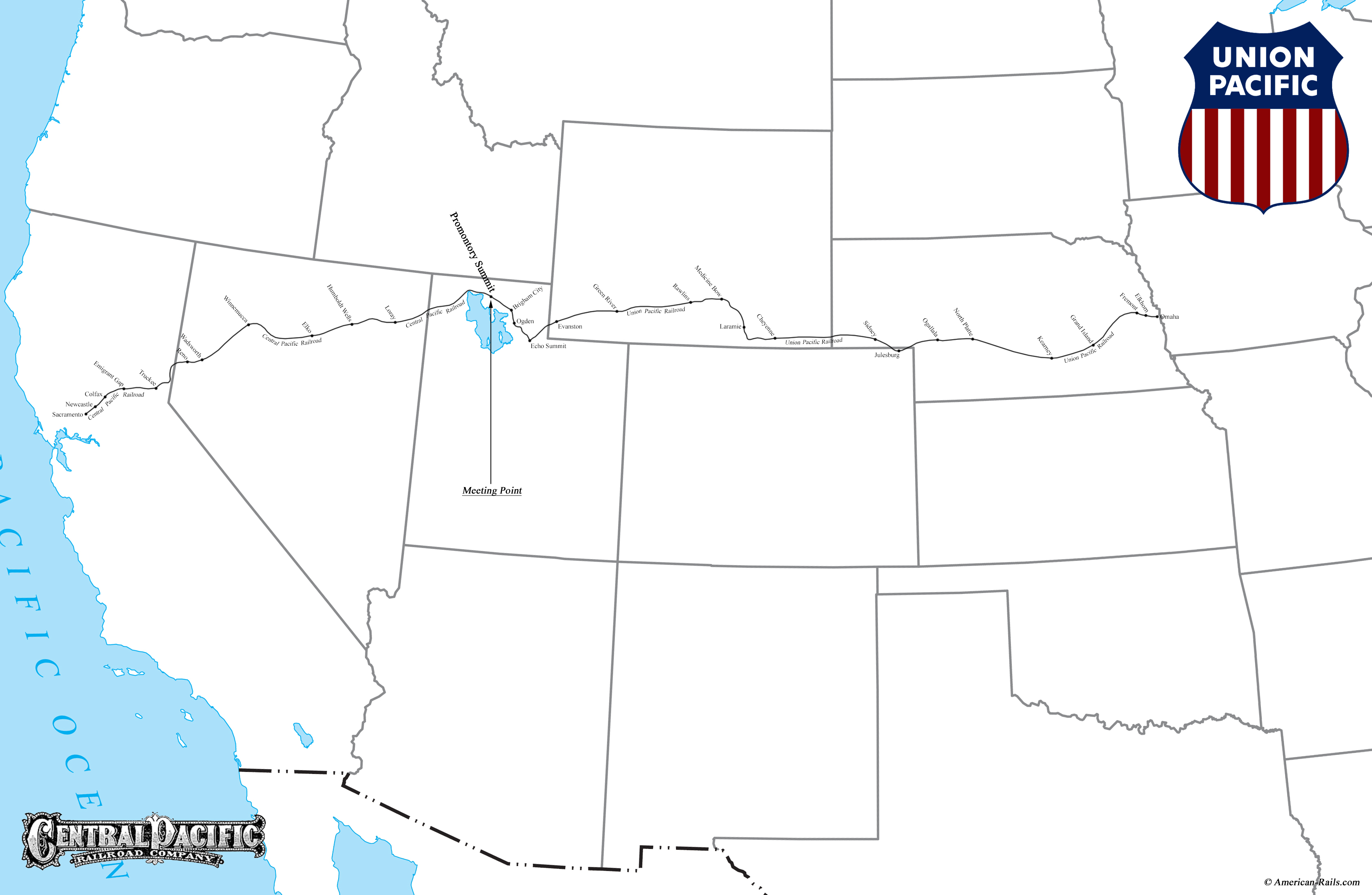
Route of the first transcontinental railroad (not to scale): Union Pacific from Omaha to Promontory Summit, Central Pacific from Sacramento to Promontory. Union Pacific’s longer mileage is the Platte and the Wyoming basins. Central Pacific’s shorter mileage is the Sierra. American-Rails.com collection.
The Utah race
The 1862 act never named a meeting point. Central Pacific was to reach the eastern boundary of California. Union Pacific was to build west from the Missouri. After that it was whoever laid more miles. By late 1868 both companies were in Utah with graders well beyond their own railheads. Central Pacific surveyed as far east as Echo Canyon. Union Pacific surveyed as far west as Humboldt Wells, Nevada. Parallel grades still sit on the Promontory peninsula where the two outfits worked within shouting distance, each hoping Congress would pay for its line and not the other’s.
Brigham Young took grading contracts for both companies. Mormon crews cut and filled in Weber Canyon and around Ogden. Union Pacific reached Ogden on March 7, 1869, 1,028 miles from Omaha. Central Pacific was at Monument Point on April 17, more than 672 miles from Sacramento and about twenty miles west of the summit. The waste was obvious. On April 9, 1869, Dodge and Huntington met in Washington and agreed to join at Promontory Summit. Congress confirmed it by joint resolution the next day. As part of the settlement Central Pacific bought Union Pacific’s track from a point five miles west of Ogden to Promontory—about fifty miles—for roughly $2.6 million, and leased the remaining five miles into Ogden. Ogden, not the spike site, became the operating junction. President Grant’s administration had also stopped writing bonds for duplicate grade. The race was over on paper. The last weeks of track were not.
Ten miles in one day
Union Pacific had put down a long day’s track in Wyoming and talked about it. Charles Crocker waited until the remaining gap was too short for Durant to answer, then bet he could lay ten miles in a day. On April 27 a work train derailed after two miles and he called it off. On April 28, 1869, with Jack Casement, Sam Reed, and other Union Pacific men as witnesses, Crocker started at dawn. Eight Irish rail handlers and several thousand Chinese laborers put down 10 miles and 56 feet between about 5 a.m. and 7 p.m. The Stanford Chinese Railroad Workers Project has the material list: 25,800 ties, 3,520 rails, 55,080 spikes, 14,050 bolts, some 4.5 million pounds of iron and wood. They stopped for lunch at Camp Victory, later the station of Rozel. A locomotive ran the new track in forty minutes to prove it was not a stunt grade. The record still stands. Central Pacific’s railhead was then about four miles from the summit.
May 10, 1869
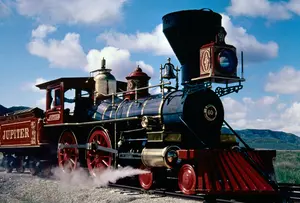
The ceremony was set for May 8. Durant’s special was held in Weber Canyon by washouts, and by workers who wanted to be paid before they would let the vice president’s car roll. The date slipped to Monday, May 10. Leland Stanford came on Central Pacific’s 4-4-0 No. 60, Jupiter, Schenectady class of 1868, engineer George Booth, fireman R.A. Murphy, conductor Eli Dennison. Union Pacific’s assigned engine had been damaged; No. 119, a Rogers 4-4-0 of November 1868 sitting at Ogden, was sent instead, engineer Sam Bradford, fireman Cyrus Sweet, conductor Benjamin Mallory. Neither locomotive had been built for a photograph. They were what was in steam.
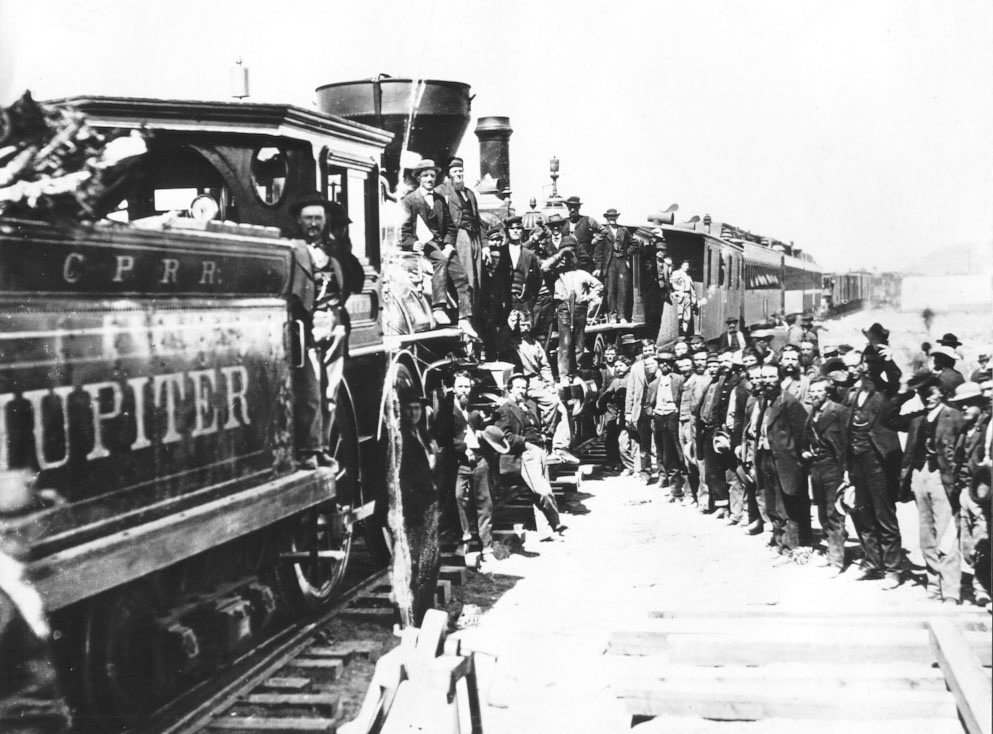
Central Pacific 4-4-0 No. 60, Jupiter, at Promontory in May 1869. The tender lettering is CPRR. This is the engine that brought Stanford to the spike. American-Rails.com collection.
About a thousand people stood in the alkali: railroad officers, a Chinese contingent from Central Pacific, five companies of the 21st U.S. Infantry, reporters, and anyone who could walk or ride in from Corinne. Stanford and Durant were there. So were Strobridge, Dodge, John Duff, Sidney Dillon of Crédit Mobilier, Reed, Herbert M. Hoxie, the Casements, and Seymour. David Hewes of San Francisco had commissioned the gold spike that gave the day its name—about six inches long, 17.6-karat gold, now at the Cantor Arts Center at Stanford University. Nevada sent silver. Arizona sent a spike of iron, silver, and gold. A laurel tie and a silver-headed maul were part of the stage set. The ceremonial spikes were tapped and pulled. A regular iron spike did the work. Stanford swung and missed. The telegraph wire lashed to the maul still carried the blows. W.N. Shilling sent the word DONE east and west. It was just after noon, local.
Eight Chinese men had placed the last rail. They were then moved aside. Russell’s champagne photograph, the image everyone knows, shows Montague and Dodge shaking hands between Jupiter and 119, with a crowd of white workers and officers on the locomotives. The men who had taken Central Pacific through the Sierra are not in the frame. That omission is now part of the history, not a footnote to it.
The original Jupiter was later renumbered and scrapped in 1901. No. 119 was scrapped about 1903. Ordinary engines, ordinary ends. Chadwell O’Connor’s O’Connor Engineering Laboratories in Costa Mesa, California, built the replicas from an 1870 design handbook and scaled 1869 photographs. They reached Promontory in 1979 and still steam at the park.
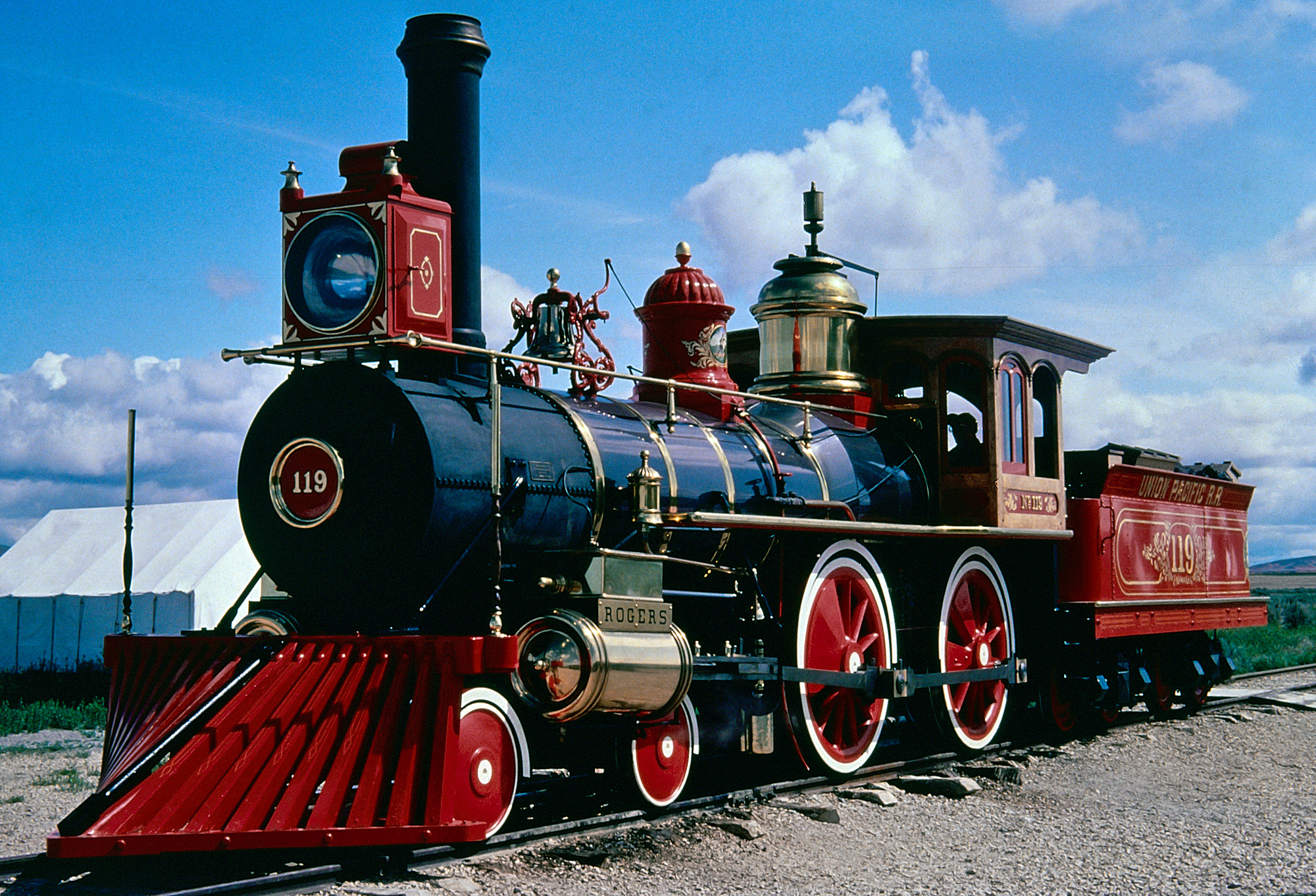
Union Pacific 4-4-0 No. 119 replica at Promontory Summit, circa 1982. O’Connor Engineering completed the pair for the National Park Service; they arrived in 1979. The original 119 was a Rogers locomotive of 1868. American-Rails.com collection.
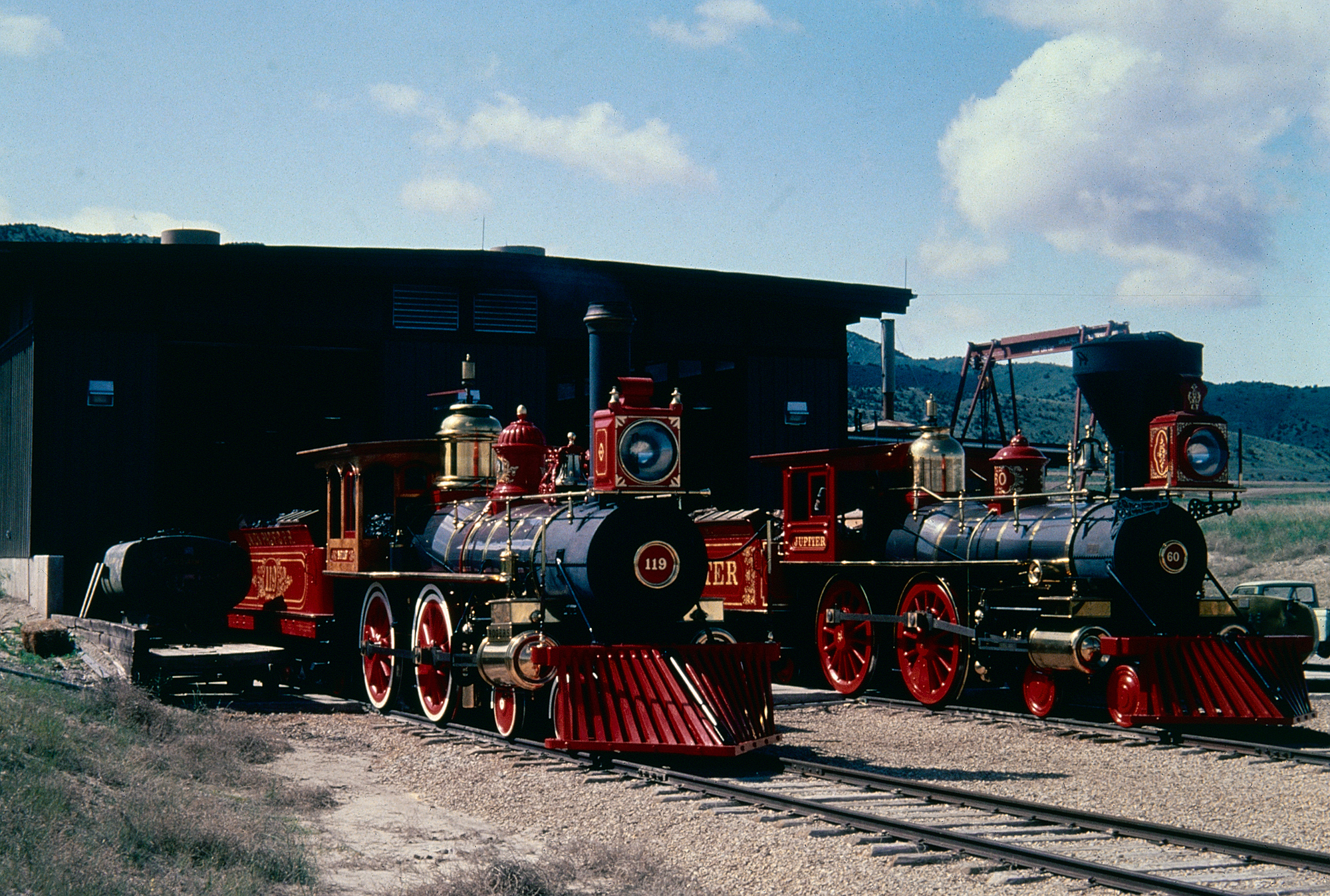
The replicas of Union Pacific 119 and Central Pacific 60, Jupiter, nose to nose at Promontory, circa 1982. The original Jupiter was Schenectady, 1868. American-Rails.com collection.
What the spike did not finish
May 10 joined two construction railroads in the Utah desert. It did not open a continuous iron from New York to San Francisco. Lincoln’s eastern terminus was still on the Iowa bank, and there was no bridge. Passengers and cars crossed the Missouri by ferry, or on rails laid over ice in winter. The Union Pacific Transfer Company ran that business from 1866. The first Omaha–Council Bluffs railroad bridge, eleven spans of 250 feet on iron piers, opened March 27, 1872. Until then the Pacific Railroad began, for practical purposes, at Omaha. The Supreme Court later confirmed Milepost 0 at Council Bluffs. Both towns lived off the argument.
At the other end, the 1862 act had allowed a Western Pacific Railroad of California—not the twentieth-century Gould road of the same name—to finish the line from Sacramento to San Francisco Bay. That subsidiary put Central Pacific into Oakland. Through cars and a seven-day advertising schedule followed. The country that had taken a season to cross could now be crossed in a week, more or less, if the Missouri was behaving and the Sierra sheds were standing.
Dodge had looked at a causeway across the Great Salt Lake as Union Pacific came into Ogden and decided the water was too high and the money too short. The line went around the north end, over Promontory, because that is where the race ended. The lake would be crossed later, by a different company with a different balance sheet.
The Lucin Cutoff and the death of Promontory
Edward H. Harriman took Southern Pacific, which had absorbed Central Pacific, and ordered the obvious improvement Dodge had passed on. The Ogden & Lucin Railroad was the paper company. Work on the Lucin Cutoff began in 1902 under SP chief engineer William Hood. A twelve-mile trestle crossed the lake; earthen approaches filled the rest. Last rail was in November 1903. Freight used the cutoff from March 8, 1904; passengers from September 18. The official opening was January 1, 1905. Forty-four miles and a mountain of curvature came out of the Overland Route. Promontory became a branch.
The Promontory Branch lingered for local livestock and as a storm detour. Southern Pacific got ICC permission to abandon Lucin–Corinne on June 11, 1942. The rails went to the war. On September 8, 1942, two modern steam locomotives faced each other at the summit and a spike was pulled, a deliberate reverse of 1869. A new earthen causeway replaced the 1904 trestle in 1959. Union Pacific still crosses the lake on that fill. Nothing scheduled has crossed Promontory Summit in eighty years.
Golden Spike National Historical Park
Congress authorized Golden Spike National Historic Site on July 30, 1965. The John D. Dingell Jr. Conservation, Management, and Recreation Act, March 12, 2019, redesignated it Golden Spike National Historical Park. The park holds the summit, the east and west grades, unfinished cuts, camp sites, and the sign where the ten-mile day ended. The Jupiter and 119 replicas steam for visitors. The landscape is still empty enough to make the 1869 photographs intelligible.
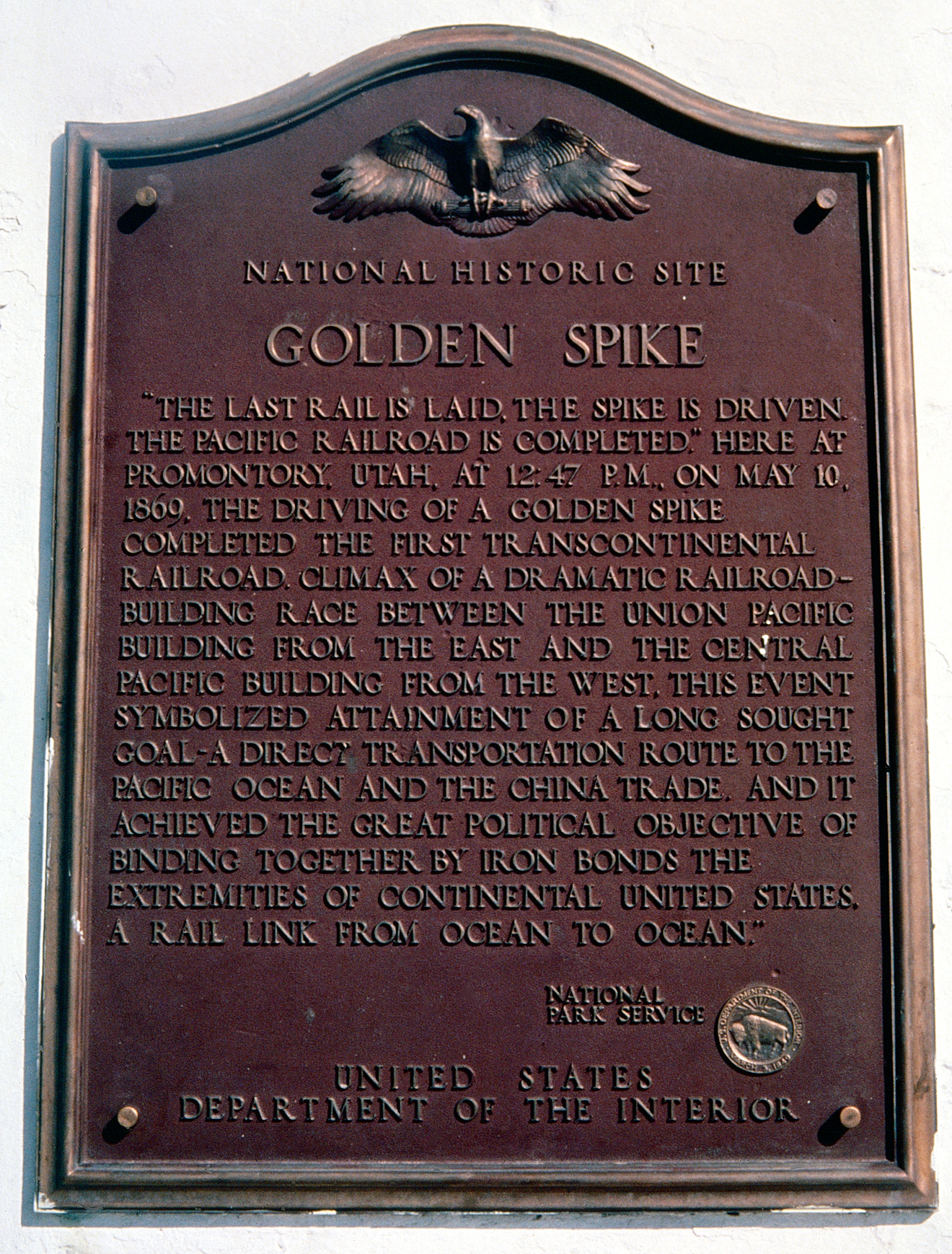
The Golden Spike plaque at Promontory Summit. The unit is Golden Spike National Historical Park; the National Park Service ran it as a Historic Site from 1965 until the 2019 redesignation. American-Rails.com collection.
The Hewes gold spike is at Stanford. Another ceremonial spike is at the California State Railroad Museum. The iron that actually held the last rail was ordinary. The railroad that actually held the country together was not. Later transcontinentals—Kansas Pacific, Santa Fe, Southern Pacific’s Sunset, Northern Pacific in 1883, Great Northern in 1893, the Milwaukee Road’s Pacific Extension in 1909—filled other parallels. This was the first. The Overland Route it created is still a Union Pacific main line, from the Missouri to the Sierra, except for the twelve miles of desert where two locomotives once touched pilots and a telegrapher sent a four-letter word to a waiting country.
Railroads and the Big Four
Union Pacific · Central Pacific · Southern Pacific · Collis P. Huntington · Charles Crocker · Leland Stanford · Mark Hopkins
Related Reading on American-Rails.com
- U.S. railroad history
- Civil War railroads
- Union Pacific
- Central Pacific
- Southern Pacific
- Collis P. Huntington
- Charles Crocker
- Leland Stanford
- Mark Hopkins
- Donner Pass
- Railroad tycoons
- California State Railroad Museum
- C.P. Huntington 4-2-4T
- 4-4-0 Americans
Sources
- Pacific Railway Act, July 1, 1862, 12 Stat. 489
- Pacific Railway Act amendatory, July 2, 1864, 13 Stat. 356
- Report of the Commission and of the Minority Commissioner of the United States Pacific Railway Commission (Washington, 1887)
- Edward Vernon, Travelers’ Official Guide of the Railways, June 1870 (Union Pacific, p. 215; Western Pacific and Central Pacific, p. 216)
- David Haward Bain, Empire Express: Building the First Transcontinental Railroad (New York: Viking, 1999)
- Maury Klein, Union Pacific: The Birth of a Railroad, 1862–1893 (Garden City: Doubleday, 1987)
- Wesley S. Griswold, A Work of Giants: Building the First Transcontinental Railroad (New York: McGraw-Hill, 1962)
- John Debo Galloway, The First Transcontinental Railroad (New York: Simmons-Boardman, 1950)
- John F. Stover, The Routledge Historical Atlas of the American Railroads (New York: Routledge, 1999)
- Brian Solomon, Southern Pacific Railroad (St. Paul: Voyageur Press, 2007)
- Joe Welsh and Kevin Holland, Union Pacific Railroad (Minneapolis: Voyageur Press, 2009)
- Mike Del Vecchio, Railroads Across America (Osceola: MBI, 1998)
- Stephen E. Ambrose, Nothing Like It in the World (New York: Simon & Schuster, 2000)
- Stanford University, Chinese Railroad Workers in North America Project
- National Park Service, Golden Spike National Historical Park (Russell’s champagne photograph, Jupiter and No. 119, Chinese labor)
- Charles R. Wood, The Northern Pacific, Main Street of the Northwest (Seattle: Superior, 1968), for the 1853 survey background
Recent Articles


-
Canadian National Railway: Map, Logo, History, Photos
Sep 16, 26 12:27 AM
 Canadian National—name Dec 20 1918, incorporated June 6 1919, Grand Trunk Jan 20 1923. Crown corporation, IPO Nov 17 1995. IC, Wisconsin Central, BC Rail, EJ&E. Class I, mark CN.
 -
Buffalo, Rochester and Pittsburgh Railway: "Safety and Service"
Sep 16, 26 12:12 AM
 Buffalo, Rochester & Pittsburgh—Rochester & State Line 1869, BR&P March 12 1887. Pennsylvania coal to Buffalo and Rochester. B&O January 1 1932. All-time steam roster, LL 2-6-6-2s, XX…
 -
Buffalo Creek & Gauley Railroad: Map, Roster, Logo, Photos
Sep 15, 26 11:55 PM
 Buffalo Creek & Gauley—Elk River Coal & Lumber, April 1 1904, Dundon–Widen. Last all-steam WV coal road, February 27 1965. All-time steam roster, #4 Baldwin 59472, Majestic and Elk River diesels…
 -
Buffalo and Susquehanna Railroad: Map & History
Sep 15, 26 11:42 PM
 Buffalo & Susquehanna—Goodyear hemlock railroad, Sinnemahoning Valley December 14 1885, 1893 merger, coal to Sagamore, Buffalo extension, bankruptcy May 6 1910, B&O 1932, WAG 1956.
 -
WMSR Allegheny Mountain Dinner Train (2026): Dates & Tickets
Sep 15, 26 11:36 PM
 2026 Western Maryland Scenic Allegheny Mountain Dinner Train—Cumberland, 3 hours, 21+, Saturday 7 p.m. Confirm on wmsr.com.
 -
Boston and Albany Railroad: Map & History
Sep 15, 26 11:28 PM
 Boston & Albany Railroad—Boston & Worcester June 23 1831, Western Railroad across the Berkshires, merger 1867–70. NYC 99-year lease July 1 1900. Berkshires, New England States, CSX and MBTA today.
 -
Grand Bellevue Dinner Train (2026): Portsmouth, Rhode Island
Sep 15, 26 11:14 PM
 2026 Grand Bellevue Rail Dining in Portsmouth, RI—2.5-hour seated dinner on Narragansett Bay. Fall/winter TBA after Aug. 29. Confirm on thegrandbell.com.
 -
The "John Bull": The C&A's First Locomotive (1831)
Sep 15, 26 11:01 PM
 John Bull locomotive—Stephenson Planet-type 0-4-0, 1831. Dripps assembly, 4-2-0 rebuild, cowcatcher. Specs, Camden & Amboy career, Smithsonian 1884, 1981 steam-up, 1939 replica.
 -
Napa Valley Wine Train Dining (2026): Lunch, Dinner & Vista Dome
Sep 15, 26 10:56 PM
 2026 Napa Valley Wine Train dining—downtown Napa, 36-mile round trip, gourmet lunch and dinner, Vista Dome. Confirm packages on winetrain.com.
 -
My Old Kentucky Dinner Train (2026): Dates, Tickets & What to Expect
Sep 15, 26 10:50 PM
 2026 My Old Kentucky Dinner Train in Bardstown—2.5 hours, 35-mile round trip, four-course dinner from $116. Confirm on kydinnertrain.com.
 -
LaSalle Street Station: One Of Chicago's Great Terminals
Sep 15, 26 10:42 PM
 LaSalle Street Station—Rock Island October 10, 1852. Frost & Granger July 1, 1903. 20th Century Limited, Rockets, Golden State. Headhouse razed 1981. Metra Rock Island District today.
 -
Charlie Russell Chew Choo (2026): Montana Dinner Train from Lewistown
Sep 15, 26 10:39 PM
 2026 Charlie Russell Chew Choo dinner train—Hanover/Lewistown, 4.5 hours, 56-mile round trip, prime rib. Adult $151. Remaining listed dates sold out. Confirm on montanadinnertrain.com.
 -
Central Pacific Railroad: Map, History, Facts, Logo
Sep 15, 26 10:30 PM
 Central Pacific—Judah, Big Four, June 28 1861. Sierra, Chinese labor, Donner Summit Tunnel. Ten-mile day April 28 1869. Promontory May 10. Southern Pacific lease April 1 1885. Dissolved June 30 1959…
 -
Bessemer & Lake Erie Railroad: "The Bessemer Road"
Sep 15, 26 05:20 PM
 Bessemer & Lake Erie—Bear Creek 1865, Carnegie 1897, U.S. Steel 1901. Ore south from Conneaut, coal north. 2-10-4s, Missabe sister road. CN May 10, 2004. Complete corporate history.
 -
Bangor and Aroostook Railroad: "Serving Northern Maine"
Sep 15, 26 05:05 PM
 Bangor & Aroostook—chartered February 13, 1891, first trains January 1, 1894. Potatoes, paper, Searsport, State of Maine reefers. MM&A 2003, Lac-Mégantic 2013, CP 2020, CPKC today. Complete co…
 -
Baltimore & Ohio Chicago Terminal Railroad: Map and History
Sep 15, 26 03:11 PM
 B&OCT—formed January 6, 1910 to buy Chicago Terminal Transfer. Grand Central, Barr Yard, 78 route-miles. Assigned B&O steam. Complete diesel roster. CSX paper subsidiary, mark BOCT.
 -
The "Alphabet Route" (Railroad): Photos and History
Sep 15, 26 02:53 PM
 Alphabet Route—eight railroads, not one company. P&WV to Connellsville February 11, 1931. Alpha Jets Chicago/St. Louis–New York/Boston. NKP, W&LE, P&WV, WM, Reading, CNJ, L&HR, New Hav…
 -
Milwaukee Road Livestock Operations: Cattle, Dakotas & Montana
Sep 15, 26 02:36 PM
 Milwaukee Road livestock traffic—Dakota and Montana cattle, Iowa hogs, Chicago markets, 28-hour law, head-end stock cars. By 1974 mostly Montana. Rick Burn’s Helena speech. Operations history, not the…
 -
Spirit of Jasper Ride & Dine (2026): Season Pause
Sep 15, 26 02:29 PM
 Spirit of Jasper Ride & Dine in Jasper, Indiana—seated meal on board. Operator: not running public trains for 2026. Depot remains open as a rental. Confirm on spiritofjaspertrain.com.
 -
South Carolina Canal & Rail Road Company: Map and History
Sep 15, 26 01:59 PM
 South Carolina Canal & Rail Road—chartered December 19, 1827. Best Friend of Charleston, 136 miles Charleston–Hamburg October 1833, Aiken inclined plane. South Carolina Railroad 1844, Southern 189…
 -
The Practice of Double-Heading: The Steam Era
Sep 15, 26 01:43 PM
 Doubleheading—two locomotives on the point, each with its own steam crew. Not a rear helper, not diesel MU. How it worked, PRR 1877, mountain grades, and what MU ended.
 -
Mohawk and Hudson Railroad: Map, Pictures, Locomotives
Sep 15, 26 01:20 PM
 Mohawk & Hudson Railroad—New York’s first railroad, chartered April 17, 1826. DeWitt Clinton, inclined planes, Albany & Schenectady 1847, first New York Central May 17, 1853. Complete corporat…
 -
Essex Clipper Dinner Train (2026): Dates, Tickets & What to Expect
Sep 15, 26 01:09 PM
 2026 Essex Clipper Dinner Train in Essex, CT—2.5 hours, four-course meal $129.99, 18+. Fall dates through Oct. 25. Confirm on essexsteamtrain.com.
 -
Camden & Amboy Railroad: Map, History, Photos
Sep 15, 26 12:53 PM
 Camden & Amboy Railroad—chartered February 4, 1830. Joint Companies monopoly with the Delaware & Raritan Canal, John Bull, T-rail. United New Jersey 1872, PRR 999-year lease 1871. Complete corpora…
 -
Cafe Lafayette Dinner Train (2026): Dates, Tickets & What to Expect
Sep 15, 26 12:47 PM
2026 Cafe Lafayette Dinner Train in North Woodstock, NH—2 hours, 20 miles, five-course meal from $125. May–October. Confirm on nhdinnertrain.com. -
Christmas Train Ride Locations (2026): A Complete Guide
Sep 15, 26 10:47 AM
 2026 Christmas train rides by state—Santa, North Pole Express, and holiday trains. Not Polar Express. State guides and product pages. Confirm dates on each railroad.
 -
Baltimore & Ohio Railroad: Linking 13 Great States With The Nation
Sep 15, 26 10:22 AM
 Baltimore & Ohio Railroad—first U.S. common carrier, chartered February 28, 1827. Wheeling 1853, Chicago 1874, C&O control 1963, Chessie 1973, into CSX April 30, 1987. Complete corporate history.
 -
Delaware & Hudson Railway: The Bridge Line
Sep 15, 26 09:59 AM
 Delaware & Hudson Railway—Wurts brothers canal 1823, gravity railroad 1829, Stourbridge Lion, Bridge Line to Montreal. Guilford 1984, CP 1991, NS south line 2015, CPKC north.
 -
Delaware & Hudson Diesel Roster (All-Time)
Sep 15, 26 12:17 AM
 All-time Delaware & Hudson diesel roster—Alco S-2s through C-628s and PA-4s, GE U-boats, Baldwin RF-16s, EMD SD45s and GP38-2/GP39-2s. Serials, dates, dispositions.
 -
Granite Railway, Our Country's First Railroad
Sep 14, 26 11:28 PM
 Granite Railway of Quincy, Massachusetts—chartered March 4, 1826, opened October 7, 1826. Gridley Bryant, 5-foot gauge, horses, Bunker Hill Monument stone. First commercial U.S. railroad.
 -
Milwaukee Road Skytop Lounges: History, Specs & Floor Plans
Sep 14, 26 11:09 PM
 Milwaukee Road Skytop observation cars—Brooks Stevens, 1948. Four Rapids parlor-lounges from Milwaukee Shops, six Creek sleeper-lounges from Pullman-Standard. Floor plans, roster, preservation.
 -
West Virginia Christmas Train Rides (2026): A Complete Guide
Sep 14, 26 11:02 PM
2026 West Virginia Christmas trains—Potomac Eagle North Pole Express in Romney and Christmas at Cass. Not Polar Express. Elkins Polar is not listed for 2026. -
Railroads Of Today: Class I Map, PSR & the 2026 Industry
Sep 14, 26 10:30 PM
 U.S. freight rail in 2026—six Class I railroads on a nearly 140,000-mile network. PSR as everyday practice, how the STB works, traffic mix, short lines and regionals.
 -
Railroad History (USA): Timeline, Facts & How the Network Was Built
Sep 14, 26 10:03 PM
 Full U.S. railroad history hub—origins and inventors, Golden Age peak mileage, Civil War and transcontinental, streamliners, ICC regulation, Penn Central and Conrail, Staggers Act, PSR, and today’s Cl…
 -
Railroads In The 2020s: CPKC, East Palestine & the UP–NS Case
Sep 14, 26 09:51 PM
 U.S. railroads 2020–2026—Class I mileage 91,773 in 2020. COVID traffic drop, CPKC April 14 2023, East Palestine Feb. 3 2023, UP–NS $85 billion case still before the STB.
 -
Railroads In The 2010s: PSR, Coal’s Decline & Positive Train Control
Sep 14, 26 03:51 PM
 U.S. railroads 2010–2020—Class I mileage 95,573 to 91,773. Buffett closed BNSF Feb. 12 2010, Harrison at CP June 29 2012 and CSX 2017, PTC deadline Dec. 31 2018.
 -
Virginia Christmas Train Rides (2026): A Complete Guide
Sep 14, 26 03:46 PM
 2026 Virginia Christmas trains—Virginia Scenic Railway Santa Express from Staunton, about 60 minutes. Confirm dates. Not Polar Express.
 -
MARC Train: Maryland Commuter Rail History, Lines & Roster
Sep 14, 26 01:16 PM
 MARC Train history—Maryland Rail Commuter 1984, B&O and PRR corridors, Penn/Camden/Brunswick lines, Silver Spring 1996, all-time locomotive roster.
 -
Railroads In The 2000s: Merger Freeze, Wisconsin Central & Buffett
Sep 13, 26 07:57 AM
 U.S. railroads 2000–2010—Class I mileage 99,250 to 95,573. STB merger freeze March 17 2000, CN–WC Oct. 9 2001, BNSF Railway Jan. 24 2005, Buffett Nov. 3 2009.
 -
Railroads In The 1990s: Mega-Mergers, Conrail’s Split & the STB
Sep 13, 26 12:13 AM
 U.S. railroads 1990–2000—Class I mileage 119,758 to 99,250. BNSF Sept. 22 1995, UP–SP Sept. 11 1996, Conrail split June 1 1999, ICC Termination Dec. 29 1995.
 -
Railroads In The 1980s: Staggers, Mega-Mergers & Conrail’s IPO
Sep 12, 26 11:12 PM
 U.S. railroads 1980–1990—Class I mileage 164,822 to 119,758. Staggers Oct. 14 1980, CSX and Norfolk Southern, UP–Missouri Pacific–Western Pacific, Conrail IPO March 26 1987.
 -
Wabash Class O-1 4-8-4s: History, Roster & Specifications
Sep 12, 26 11:01 PM
 Wabash Class O-1 4-8-4s—Baldwin 1930–31, twenty-five engines 2900–2924. Fast freight, complete roster, specifications. None preserved.
 -
Staggers Rail Act of 1980: Statute, Contract Rates & the ICC
Sep 10, 26 11:23 PM
 Staggers Rail Act, Pub. L. 96-448, signed October 14, 1980. Harley Staggers, S.1946, contract rates, 180% variable-cost test, abandonments, short lines.
 -
Rock Island E8A 652: Bicentennial Independence Paint & History
Sep 10, 26 10:42 PM
 Rock Island E8A 652—EMD March 1952, serial 15199. 20th Century Railroad Club Independence bicentennial scheme, Peoria and Quad Cities Rockets, Midland Railway, Manly Junction Museum.
 -
Vermont Christmas Train Rides (2026): A Complete Guide
Sep 10, 26 10:37 PM
2026 Vermont Christmas trains—Okemo Valley Holiday Express from Chester Depot Dec. 19–20. Polar is Burlington Dec. 5–6 only. -
Railroads In The 1970s: Penn Central, Amtrak & Conrail
Sep 10, 26 10:18 AM
 U.S. railroads 1970–1980—196,479 miles at the decade’s start. Penn Central bankruptcy June 21 1970, Amtrak May 1 1971, 3R/4R Acts, Conrail April 1 1976, Rock Island 1975, Milwaukee 1977.
 -
Railroads In The 1960s: Mergers, Passenger Collapse & Penn Central
Sep 10, 26 10:03 AM
U.S. railroads 1960–1970—207,334 to 196,479 miles. Erie Lackawanna 1960, C&O–B&O 1963, N&W–Nickel Plate 1964, SCL 1967, Penn Central Feb. 1 1968. -
South Carolina Christmas Train Rides (2026): A Complete Guide
Sep 10, 26 08:36 AM
 2026 South Carolina Christmas trains—South Carolina Railroad Museum Santa Train in Winnsboro. Confirm December dates. Not Polar Express. Drop light-festival padding.
 -
Steam Locomotive Feedwater Heaters: Elesco, Coffin & Worthington
Sep 10, 26 08:29 AM
 Steam locomotive feedwater heaters—open Worthington vs closed Elesco and Coffin. How they work, how to identify them on a smokebox, and why not every engine had one.
 -
Oregon Christmas Train Rides (2026): A Complete Guide
Sep 10, 26 08:22 AM
2026 Oregon Christmas trains—Portland Holiday Express, Garibaldi Candy Cane Express, Sumpter Valley Christmas Trains Dec. 11–13. Polar is Mount Hood.