C&O/Chessie 18742: Huntington’s Battery Shop Switcher
Published: September 4, 2026
By: Adam Burns
At the Huntington, West Virginia shops —from the 1950s through the Chessie years and into early CSX—was a single 15-ton General Electric storage-battery locomotive, numbered 18742. It is the oldest locomotive Chessie ever lettered, the only battery unit on that roster, and the only engine on it with a five-digit number. Railfans called it a critter. The B&O Railroad Museum lists it as C&O X-5000, nickname Dinky.
It was not built for the C&O. General Electric turned it out at Erie, Pennsylvania, in October 1917 as a Type LSB-2E12 industrial switcher. GE used it briefly in its own shops, sold it in 1918 to Newport News Shipbuilding & Dry Dock as E-6, and the yard kept it through the Second World War. The C&O picked it up in the 1950s, just as Huntington Shops were converting from steam to diesel, and put it to work moving dead locomotives around the house without filling the building with exhaust.
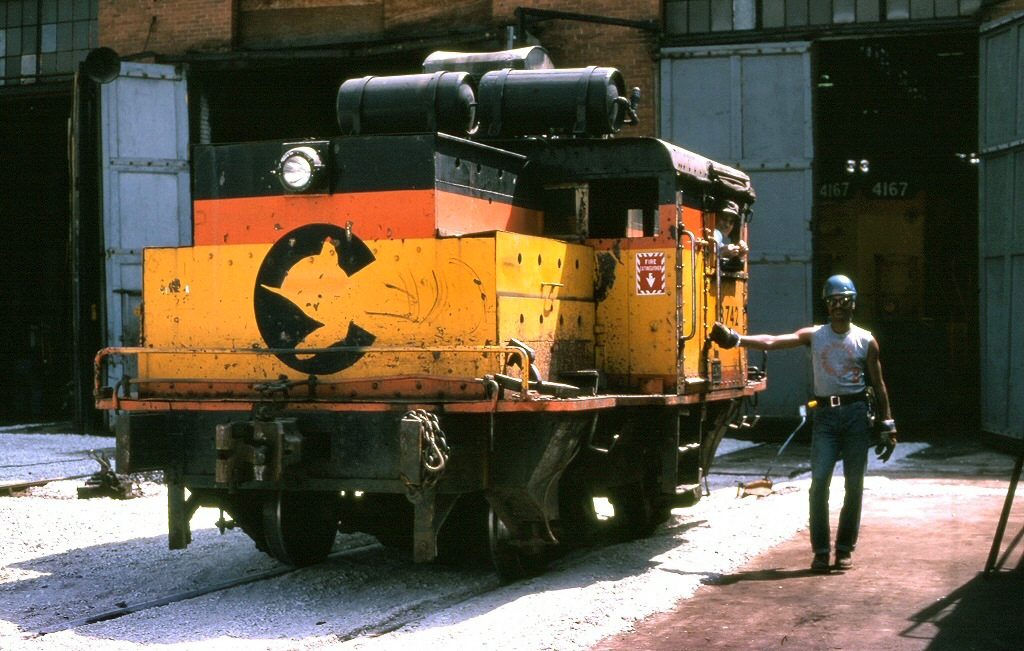
Chessie System battery shop switcher 18742 at the Huntington Shops, Huntington, West Virginia, May 1984. The Chessie employee posing with the locomotive and the hostler in the cab are both not identified. Rob Kitchen photo.
On this page: At a glance · Erie and Newport News · C&O, X-5000, 18742 · The Huntington job · Blue, Chessie, CSX · Donation and where it sits · Specifications · Related reading · Sources
At a glance
| Item | Detail |
|---|---|
| Railroad | Chesapeake & Ohio, then Chessie System, then CSX Transportation |
| Road numbers | C&O X-5000 (1950s); 18742 (1950s/60s on). Photographed as CSXT 18742 in 1988 |
| Nickname | Dinky (museum listing); critter (railfan) |
| Builder / type | General Electric, Erie, Pa. Type LSB-2E12 storage-battery locomotive, 15 ton |
| Built | October 1917. Museum listing sometimes reads 1918—the year it left GE for the shipyard |
| First owners | GE Erie shops (briefly); Newport News Shipbuilding & Dry Dock E-6, 1918 through World War II |
| C&O | Acquired in the 1950s. Huntington, W.Va., locomotive shops for the rest of its working life |
| Wheel arrangement | Four-wheel industrial (AAR B / Whyte 0-4-0). Two axles, no guiding trucks |
| Why battery | Move dead and under-repair locomotives inside the shop without diesel exhaust |
| Chessie oddities | Oldest unit; only battery; only five-digit number; Ches-C on both ends; no road initials stacked with the number |
| Last documented at Huntington | July 27, 1988 (Wade H. Massie), already in CSX paint |
| Disposition | CSX donated it to the B&O Railroad Museum. Not a regular roundhouse exhibit. See preservation notes below |
Type, dates, and number history follow the standard secondary account of this locomotive (the Chessie 18742 notes on TrainWeb) checked against dated photographs and the museum listing. Information compiled September 4, 2026.
Erie, then Newport News E-6
General Electric cataloged storage-battery industrials under the LSB prefix for mills, mines, and shipyards: two axles, a short frame, a battery box for a body, enough drawbar pull to drag a few cars or a dead locomotive a few hundred feet. A 15-ton unit is on the order of 30,000 pounds. A Chessie GP40-2 on the next track weighed about nine times that.
GE finished this one in October 1917 at Erie and ran it in the builder’s own shops before selling it in 1918 to Newport News Shipbuilding & Dry Dock Company as E-6. That yard is not a random industrial customer. It sits at the C&O’s tidewater coal terminal. Collis P. Huntington had pushed the railroad to the Ohio, named the West Virginia city for himself, and founded the shipyard at the other end of the same coal route. The locomotive worked the yard through the end of the Second World War. How it left the shipyard and reached C&O property in the 1950s is not in a published builder card; the railroad simply shows up as the next owner.
X-5000, then 18742
C&O took the engine in the 1950s and numbered it X-5000. The X- prefix is company-service numbering, not a road-freight slot. Sometime later in that decade or in the 1960s it became 18742. The number is not the GE serial. Why Huntington picked it has not been explained in print. It is the only five-digit locomotive number Chessie ever carried, which is how you find it in a caption index when the paint is too dirty to read.
The B&O Railroad Museum still catalogs the piece as C&O X-5000, Dinky, built by GE in 1918. That 1918 date is the shipyard year. The build month is October 1917.
The Huntington job
Huntington Shops grew up with the town. The C&O reached the Ohio in 1873; the shops opened the same year. The main building sat on 6th Avenue between 23rd and 29th streets—more than two city blocks long. A June 19, 1954, Huntington Advertiser feature, later reprinted by the Herald-Dispatch, described the plant converting from steam to diesel: a new wheel shop, an electrical shop, the roundhouse reduced to paint and storage because a diesel does not have to be turned. Plant superintendent Lester Savage put employment at 1,159. The shops took locomotives and cars from Handley east of Charleston through to the C&O’s western connections; Russell, Kentucky, and Peru, Indiana, still had shops, but a lot of the heavy work still came to Huntington.
That conversion is why a battery goat made sense. A diesel switcher idling inside a repair bay fills the house with exhaust. A 15-ton storage-battery locomotive does not. It did not classify the yard. It did not take a transfer down to the river. It shoved dead Geeps and U-boats from the door to the pit and back. CSX still works locomotives at Huntington; that later hydrogen-and-rebuild program is a different story. 18742 was the in-house battery mule of the C&O/Chessie shop, not a prototype for the 21st-century fleet.
Enchantment Blue, Chessie both ends, CSX stealth
In C&O years it wore standard Enchantment Blue with a safety slogan on the nose: BE CAREFUL. That slogan is the only one reported on a C&O locomotive paint scheme. The blue job also skipped the usual “C&O” stacked with the road number.
Chessie paint came early in the Chessie era—yellow hood, vermilion band, Enchantment Blue roof and frame, kitten-in-C on the end. Kitchen’s 1984 view is that scheme in working dirt, Ches-C facing the camera, 18742 on the cab, a GP40-2 numbered 4167 inside the door behind it. Secondary notes on this locomotive say it was the only Chessie engine with the Ches-C on both ends, and that it again skipped the road initials over the number. The 1977 Huntington photograph already shows worn Chessie paint, which matches an early repaint rather than a 1980s cosmetic.
CSX Transportation began operating the merged Chessie and Seaboard properties on July 1, 1986. 18742 received the early gray-and-blue “stealth” scheme shortly afterward, again without “CSXT” under the number. Wade Massie photographed it that way at the Huntington shop on July 27, 1988, and called it probably the most unusual unit on CSX’s roster. That is the last well-dated in-service view in public photo indexes known to this author. A retirement year is not on a published disposition card.
Donation, the museum list, and later photographs
CSX donated 18742 to the B&O Railroad Museum in Baltimore after it came out of Huntington. The museum’s collection list on this site carries it under the electric locomotives as C&O battery-powered yard switcher X-5000, Dinky, General Electric, 1918. It sits in that list with B&O CE-1 boxcab 10 (GE, 1909) and Pennsylvania GG1 4876.
It is not a regular public exhibit. The museum’s own “on view” locomotive pages do not feature it.
Specifications
Published numbers for this one locomotive are thin. GE did not issue a Class I data card. What follows is the industrial type as identified for 18742, not a claim that every LSB-2 of 1917 matched it inch for inch.
| Specification | Value |
|---|---|
| Builder | General Electric, Erie, Pa. |
| Date | October 1917 |
| Type | LSB-2E12 storage-battery locomotive |
| Weight class | 15 ton |
| Wheel arrangement | B (four-wheel / 0-4-0 industrial) |
| Power | Onboard storage battery; no overhead, no diesel, no trolley pole |
| Service | Shipyard, then railroad shop switching. Not road freight |
| Identities | GE (1917–18); NNS E-6 (1918–c. 1945/50s); C&O X-5000; C&O/Chessie/CSX 18742 |
GE’s period LSB tables listed 15-ton two-motor battery locomotives with hand or straight-air brakes and a few thousand pounds of rated drawbar pull at walking speed. That is shop-goat arithmetic. It is enough to spot a dead road unit on a shop lead. It is not a yard engine.
Related Reading on American-Rails.com
- Chesapeake & Ohio Railway
- Chessie System
- CSX Transportation
- Electric locomotives
- Switcher locomotives
- C&O diesel roster (18742 is not on it)
- B&O Railroad Museum
- West Virginia railroads
- Genset / Green Goat locomotives (later battery-hybrid switchers, not this engine)
- PRR B1 electric switchers
Sources
- Rob Kitchen, RailPictures.net photo 130991: 18742 at Huntington Shops, May 1984, “proud crew”; sent to the B&O Railroad Museum
- Extra 127 South, RailPictures.net photo 451958: C&O 18742 at Huntington Locomotive Shop, November 11, 1977; used to move locomotives undergoing repairs
- Wade H. Massie, RailPictures.net photo 156748: CSXT 18742 at Huntington Locomotive Shop, July 27, 1988
- TrainWeb, “C&O / CSX 18742”: GE October 1917, Type LSB-2E12, 15 ton; GE Erie shops; Newport News Shipbuilding E-6 from 1918 through World War II; C&O X-5000 then 18742 in the 1950s/60s; Huntington assignment; Enchantment Blue “BE CAREFUL”; early Chessie paint, Ches-C both ends, no road initials with the number; CSX stealth; donated to the B&O Railroad Museum, not operable and not on display
- American-Rails.com, B&O Railroad Museum collection list (/borm.html): C&O battery-powered yard switcher X-5000, Dinky, General Electric, 1918
- B&O Railroad Museum, locomotives and rolling stock “on view” pages: 18742 / X-5000 not among featured exhibits
- Huntington Advertiser, June 19, 1954, via Herald-Dispatch “Do you remember?” (September 19, 2011): Huntington Shops conversion from steam to diesel; 6th Avenue between 23rd and 29th; employment 1,159
- Thomas W. Dixon, Jr., Chesapeake & Ohio Railway: A Concise History and Fact Book (C&O Historical Society): Huntington as the C&O’s major locomotive shops
- 2024 visitor videos labeled Lake Shore Railway Museum, North East, Pa. (matching CSX-painted battery switcher in outdoor storage). Not a museum accession statement
- Lake Shore Railway Historical Society, published rolling-stock list: 18742 not named
Recent Articles


-
Dakota, Minnesota & Eastern Railroad: Roster, Map, History
Oct 21, 26 12:26 AM
 Dakota, Minnesota & Eastern Railroad, reporting mark DME. The July 2, 1986 Chicago & North Western sale, 826 miles and 139 miles of trackage rights. Canadian Pacific control October 30, 2008…
-
Detroit and Mackinac Railway: Map, Roster, History
Oct 20, 26 11:58 PM
 Detroit & Mackinac Railway, the Turtle Line. Bay City to Cheboygan along Lake Huron. Incorporated December 29, 1894. Lake State Railway leased the operation in 1992 and bought the lines in 1997. E…
-
Davenport, Rock Island and Northwestern Railroad
Oct 20, 26 11:22 PM
 Davenport, Rock Island and North Western Railway, the DRI Line. Clinton to East Moline across the Crescent Bridge. Burlington and Milwaukee. Merged into the Soo Line on June 29, 1995. Eighteen diesels…
-
Chicago Great Western Steam Roster (Post 1900)
Oct 20, 26 11:17 PM
 Chicago Great Western steam locomotives built or rebuilt since 1900. Drury's class grid. 320 frames, each once. The quantity column prints 376 because a rebuild is listed again. Last steam in the reti…
-
Chicago Great Western Diesel Roster (All-Time)
Oct 20, 26 10:47 PM
 All-time diesel roster of the Chicago Great Western. 157 frames, each counted once. Serials and builder order numbers included. Steam was gone by 1950. The 1963 glance figure of 141 is one year's flee…
-
Chicago Great Western Railway: Map, Photos, History, Rosters
Oct 20, 26 10:43 PM
 The Chicago Great Western, the Corn Belt Route, linked Chicago, the Twin Cities, Omaha, and Kansas City from September 27, 1885, until the Chicago & North Western merger at 12:01 a.m. on July 1, 1968…
-
Chicago, South Shore & South Bend Railroad: "The South Shore Line"
Oct 20, 26 05:48 PM
 Chicago South Shore & South Bend, the South Shore Line, from the 1901 Air Line through Samuel Insull's 1925 rebuild, the orange cars, the 800s, and the railroad NICTD and Anacostia still run.
-
Northwestern Virginia Railroad: Map, History, Timetable
Oct 20, 26 04:18 PM
 Northwestern Virginia Railroad, chartered February 14, 1851, Grafton to Parkersburg, 104 miles. Opened May 1, 1857. Foreclosure sale February 15, 1865, as the Parkersburg Branch. Twenty-three tunnels…
-
"Exposition Flyer" (Train): Consist, Timetable, History
Oct 20, 26 03:29 PM
 Exposition Flyer, Chicago to Oakland, June 10, 1939 to March 20, 1949. Burlington, Rio Grande, and Western Pacific. Heavyweight cars, then diesels and a vista-dome. Replaced by the California Zephyr.
-
Chicago, St. Paul, Minneapolis & Omaha Railway, "The Omaha Road"
Oct 20, 26 02:13 PM
 The Omaha Road, reporting mark CMO. Formed May 26, 1880. North Western management on December 16, 1882. Leased January 1, 1957. Class K-1 No. 183 and the sublettered diesels.
-
Chicago and Western Indiana Railroad: Map, Rosters, History
Oct 20, 26 01:17 PM
 Chicago and Western Indiana, chartered June 5, 1879. Five equal owners, Dearborn Station, and two main lines. Dolton suburban mile 16.6. Fifteen diesels. Railroad service ended in 1994. The Illinois c…
-
Railroad Tell-Tales: Protecting The Brakeman
Oct 20, 26 12:58 PM
 Railroad tell-tales: hanging ropes that warned a man on a freight-car roof of a low bridge or tunnel. The 1897 bridge-warning report, the 1905 Wisconsin statute, retainers, and why the roof walk outla…
-
Chicago & North Western Steam Roster (Post 1900)
Oct 20, 26 12:54 PM
 Chicago & North Western steam locomotives built since 1900, and the Omaha Road list beside it. Drury's parent quantity column sums to 1,445, with four rows left blank. The Omaha Road column sums to 24…
-
Chicago & North Western Diesel Roster (All-Time)
Oct 20, 26 12:49 PM
 All-time diesel roster of the Chicago & North Western. 2,494 frames, each counted once, including Chicago Great Western, Minneapolis & St. Louis, and Omaha Road units that received North Western numbe…
-
Chicago and North Western Railroad: Map, History, Logo
Oct 20, 26 12:37 PM
 The Chicago & North Western, chartered as the Galena & Chicago Union in 1836 and formed in June 1859. Granger railroad of the 400s, the Cowboy Line, and Powder River coal. Union Pacific common control…
-
Chicago & Illinois Midland Steam Roster (Post 1900)
Oct 20, 26 12:30 AM
 Chicago & Illinois Midland steam locomotives built since 1900. Drury's class grid, 57 engines. Twenty-six 2-10-2s, including nine from the Wabash and nine from the Atlantic Coast Line. Last road steam…
-
Chicago & Illinois Midland Diesel Roster (All-Time)
Oct 20, 26 12:20 AM
 All-time diesel roster of the Chicago & Illinois Midland. 28 frames, each counted once. Six SW1200s, five SD9s, the only two RS1325s, two SD18s, six SD38-2s, and four SD20s. Serials included.
-
Chicago and Illinois Midland Railroad: Map, Rosters, History
Oct 20, 26 12:17 AM
 The Chicago & Illinois Midland moved Illinois coal for Commonwealth Edison, Taylorville and Springfield to Pekin, with Peoria over the Peoria & Pekin Union. The 1906 railway began operating February 1…
-
Chicago & Eastern Illinois Diesel Roster (All-Time)
Oct 19, 26 04:23 PM
 All-time diesel roster of the Chicago & Eastern Illinois. 143 frames, each counted once. Switchers, F3s, FP7s, E7s, the BL1, and the GP7s through GP35s. Serials included.
-
Chicago & Eastern Illinois Steam Roster (Post 1900)
Oct 19, 26 04:19 PM
Chicago & Eastern Illinois steam locomotives built or rebuilt since 1900. 146 Consolidations, 60 Mikados, and 24 Pacifics. Drury's class grid. Last steam was Mikado 1944 at Vincennes on May 5, 1950. -
Chicago and Eastern Illinois Railroad: Map, Rosters, History
Oct 19, 26 03:57 PM
 The Chicago & Eastern Illinois ran from Chicago to Evansville, St. Louis, and Thebes. First company of the name, August 28, 1877. The remainder merged into the Missouri Pacific on October 15, 1976. St…
-
Rock Island Diesel Roser: All-Time
Oct 19, 26 11:05 AM
 Chicago, Rock Island and Pacific diesel locomotives, 1,029 frames counted once. Switchers, cab units, road-switchers, two acquired slugs, five RDCs, and bi-power 10000. Serial and order are separate c…
-
Rock Island Steam Roster: Post 1900
Oct 19, 26 11:01 AM
Chicago, Rock Island and Pacific steam locomotives built or rebuilt since 1900. Drury's class grid, 1,482 frames counted once, including 85 4-8-4s. Last revenue steam was July 1953. -
Rock Island Railroad: Map, Pictures, Logo, History
Oct 19, 26 10:51 AM
 The Chicago, Rock Island and Pacific ran from Chicago to the Twin Cities, Denver, Tucumcari, and the Gulf. First train October 10, 1852. Directed service ended March 23, 1980. Steam and diesel rosters…
-
EMD "F7" Locomotives: Cab, Top Speed, Specs, Rosters
Oct 19, 26 12:27 AM
 EMD F7 cab units and boosters, 1,500 horsepower, built February 1949 through December 1953. Gear ratios, specifications, and the production roster by owner, serial, and order.
-
Harlem Transfer Company: An NYC Terminal System
Oct 19, 26 12:01 AM
 Harlem Transfer Company, the Lackawanna's offline freight terminal on the Bronx side of the Harlem River at East 135th Street. Carfloats to Hoboken, boxcab No. 2, and GE 44-tonner 53.
-
Belpre Industrial Parkersburg Railroad: Roster, History, Photos
Oct 18, 26 11:44 PM
 Belpre Industrial Parkersburg Railroad, a Class III short line leasing about 46.9 miles of CSX track at Parkersburg since 2020. The Ohio River bridge, the Marietta Subdivision, and five GP38-3s.
-
Chicago, Peoria & St. Louis Railroad: Map, Timetables, History
Oct 18, 26 10:57 PM
 Chicago, Peoria & St. Louis Railroad, an Illinois line from Pekin and Peoria through Springfield to Madison. Chartered in 1853. Sold in parcels on November 20, 1924. The Pekin line is today the Illino…
-
Chicago, Burlington & Quincy Diesel Roster (All-Time)
Oct 18, 26 10:54 PM
 All-time diesel roster of the Chicago, Burlington & Quincy. 951 parent frames, 72 Colorado & Southern, and 36 Fort Worth & Denver, each counted once. Serials included.
-
Burlington Railroad (CB&Q): Map, History, Rosters, Photos
Oct 18, 26 10:49 PM
 The Chicago, Burlington & Quincy, the Burlington Route, ran from Chicago to Denver, the Twin Cities, and the Gulf. Steam built since 1900 and the diesel fleets are companion rosters. Burlington Northe…
-
Chicago, Burlington & Quincy Steam Roster (Post 1900)
Oct 18, 26 10:33 PM
 Chicago, Burlington & Quincy steam locomotives built or rebuilt since 1900. 429 Prairies, 383 Mikados, the Hudsons, and the O-5 4-8-4s. Drury's class grid.
-
Virginian Railway's 2-6-6-6 Locomotives (Class AG)
Oct 18, 26 01:38 PM
 Virginian Railway class AG. Eight Lima 2-6-6-6s, Nos. 900-907, built in 1945 for the east end. Billed at 753,000 pounds. Scrapped in 1960.
-
Pennsylvania (PRR) Steam Roster: Post 1906
Oct 18, 26 01:05 PM
ennsylvania steam after 1906—H8, H9, and H10 Consolidations, 574 L1s Mikados, 598 I1s Decapods, 425 K4s Pacifics, 301 M1 Mountains. Drury’s grid. Last steam November 30, 1957. -
Chicago, Aurora and Elgin Railroad: The "Roarin' Elgin"
Oct 18, 26 10:54 AM
The Chicago, Aurora & Elgin, the Roarin' Elgin, ran 600-volt third-rail trains from Chicago to Aurora, Batavia, and Elgin. Passenger service ended at noon on July 3, 1957. Freight ended June 11, 1959. -
Algoma Central Railway: Map, Logo, Rosters
Oct 17, 26 10:49 PM
 Algoma Central Railway, Sault Ste. Marie to Hearst. Wisconsin Central on February 1, 1995. Fifty-nine steam locomotives and forty-two diesels.
-
Akron, Canton and Youngstown Railroad: Map, History, Rosters
Oct 17, 26 05:49 PM
 Akron, Canton and Youngstown Railroad, Mogadore to Delphos. The rails never reached Canton or Youngstown. Norfolk & Western control on October 16, 1964. Twenty-six diesels and the historical society's…
-
Georgia Railroad: Map, History, Logo, Rosters
Oct 17, 26 12:59 PM
 Georgia Railroad, the Georgia Railroad and Banking Company, Augusta to Atlanta, with the Athens branch and the Macon Road. Mark GA. The railroad properties were sold on November 4, 1982.
-
West Point Route (Railroad): Map, History, Logo
Oct 16, 26 11:26 PM
 The West Point Route was a trademarked name comprising the Atlanta & West Point and Western Railway of Alabama, which were controlled by the Georgia Railroad.
-
Virginian Railway Diesel Roster (All-Time)
Oct 16, 26 11:11 PM
 All-time diesel roster of the Virginian Railway. 40 Fairbanks-Morse H16-44s, 25 H24-66 Train Masters, and one GE 44-tonner. Serials included.
-
Virginian Railway Steam Roster (Post 1900)
Oct 16, 26 10:55 PM
 Virginian Railway steam locomotives built since 1900. Mikados, 2-8-8-2s, the Triplex, class AE 2-10-10-2s, and the 1945 2-6-6-6s.
-
Virginian Railway: Map, Rosters, History, Electrification
Oct 16, 26 10:51 PM
 Virginian Railway, Deepwater to Norfolk. Combined in 1907 and completed in 1909. Electrified from Roanoke to Elmore. Absorbed by the Norfolk & Western on December 1, 1959.
-
Baldwin "Centipede" Locomotives: Specs, Roster, Photos
Oct 16, 26 03:58 PM
 Baldwin DR-12-8-1500/2 Centipede—2-D+D-2, two 608SC engines, 3,000 hp. SAL 4500 from the 1943 test bed. 54 on the serial list, 52 sold. PRR BP60 then BH50. None preserved.
-
Louisville & Nashville Class M-1 2-8-4s: The Big Emmas
Oct 16, 26 03:52 PM
Louisville & Nashville class M-1, 42 Big Emma 2-8-4s. Baldwin in 1942 and 1944, Lima in 1949. Coal trains from Neon to DeCoursey. No locomotive survives. -
Tennessee, Alabama and Georgia Railway: Map, History, Rosters
Oct 16, 26 03:21 PM
 Tennessee, Alabama and Georgia Railway, Chattanooga to Gadsden. The May 1929 card is 91.7 miles. Southern stock control closed on a January 1, 1971 schedule. Five diesels and Prince's steam list.
-
Railroad Museums In The USA (2026): State Guides & Collections
Oct 16, 26 02:29 PM
 U.S. railroad museums—what they are vs tourist railroads, preservation history (R&LHS, NRHS, IRM, Steamtown), state guides, and destination collections. Confirm hours on each museum’s site.
-
Wyoming Railroad Museums (2026): A Complete Guide
Oct 16, 26 02:26 PM
 Wyoming railroad museums—the Cheyenne Depot, Burlington 5633 at Douglas, Big Boy 4004, and the Laramie depot. Confirm hours and which locomotive is on the property.
-
West Virginia Railroad Museums (2026): A Complete Guide
Oct 16, 26 12:52 PM
 West Virginia railroad museums—Cass Scenic’s geared steam, the Hinton C&O collection, and the Martinsburg B&O roundhouse. Confirm hours and which locomotive is assigned.
-
Washington Railroad Museums (2026): A Complete Guide
Oct 16, 26 12:46 PM
 Washington railroad museums—Snoqualmie, Elbe, Chehalis, Reardan, and the Northern Pacific depot at Toppenish. Confirm hours and which locomotive is assigned.
-
Vermont Railroad Museums (2026): A Complete Guide
Oct 16, 26 12:42 PM
 Vermont railroad museums—the Shelburne Museum’s 1890 station, Central Vermont No. 220, and the private car Grand Isle. Confirm hours on the site.
-
Tennessee Central Railway: Map, Logo, Rosters, History
Oct 16, 26 11:32 AM
 Tennessee Central Railway, Harriman to Hopkinsville. Reorganized January 26, 1922. Last day August 31, 1968. Thirty-one diesels and the railroad's steam roster.