Railroads In The 1860s: Civil War, Pacific Railroad, Mileage & Steel
Last revised: September 6, 2026
By: Adam Burns
The 1860s are the decade American railroads fought a war, started a Pacific railroad, and came out the other side with almost twice the mileage they had at Lincoln’s election. In 1860 the country had about 30,600 miles of railroad. By 1870 John Stover’s atlas series, the same figures used on the history hub, put 52,922 miles in operation. That growth is not a Civil War campaign, and it is not the golden spike. It is the decade those two events sit inside.
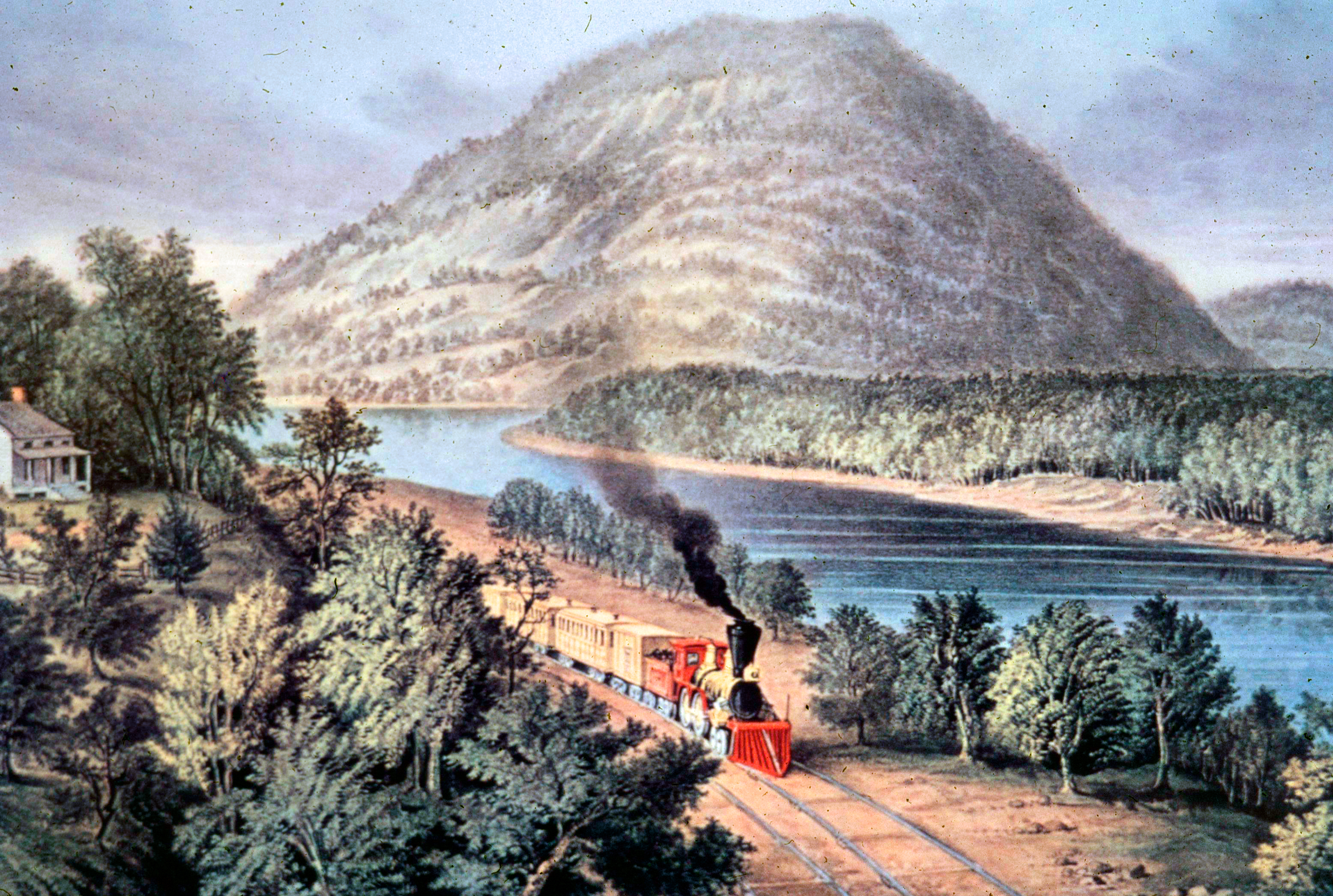
“Lookout Mountain, Tennessee, And The Chattanooga Rail Road,” Currier & Ives, 1866. Nashville & Chattanooga, later Nashville, Chattanooga & St. Louis, later Louisville & Nashville. American-Rails.com collection.
To learn more about Civil War railroads, this page is the war encyclopedia: two networks, USMRR, Haupt and McCallum, Manassas, Gettysburg, Chickamauga, Andrews’s raid, Sherman, City Point. The Pacific Railway Act is a sentence at the end of it, on purpose. Transcontinental is Promontory. The Chase is April 1862. The Erie War is 1868. This page is the 1860s frame: mileage, the war as the center of gravity, the Pacific project as the western half of the decade, Vanderbilt on the Hudson, Pullman’s Pioneer, the first American Bessemer rails, Westinghouse’s 1869 brake, and a wreck at Angola that showed what wood cars and stove heat still did.
On this page: At a glance · Mileage · The war (not this encyclopedia) · Pacific railroad · Vanderbilt · Pullman, steel, air brake · Angola · By 1870
At a glance
| Item | Detail |
|---|---|
| Miles in operation, 1860 | About 30,600 (Poor / hub). Roughly two-thirds in Union territory; about 9,000 in the Confederacy |
| Miles in operation, 1870 | 52,922 (Stover) |
| The war | April 1861–April 1865. Encyclopedia: Civil War railroads. Episode: Great Locomotive Chase |
| Transcontinental telegraph | Completed October 24, 1861. See pole lines |
| Pacific Railway Acts | July 1, 1862; amended July 2, 1864. Promontory Summit May 10, 1869. Encyclopedia: transcontinental |
| Northern Pacific charter | July 2, 1864. Finished 1883, not this decade |
| New York Central | Vanderbilt: Harlem 1863, Hudson River Railroad 1864, NYC 1867, New York Central & Hudson River 1869. See New York Central |
| Erie War | 1868. Vanderbilt vs. Drew, Gould, Fisk. See Erie War |
| Pullman Pioneer | Sleeping car, 1864–65. Hotel and dining cars follow in the late 1860s |
| Steel rail | First American Bessemer rail often dated May 25, 1865, Chicago Rolling Mill. Common practice is the 1870s |
| Janney coupler | Patent 1868. Not yet a national standard |
| Westinghouse air brake | Patent April 13, 1869. See air brake |
| Angola Horror | December 18, 1867, Lake Shore. See Angola |
Mileage is the Stover / Poor series used on the history hub. Wartime building was hundreds of miles a year, not thousands; the jump to 52,922 is mostly postwar. Information compiled September 6, 2026.
Thirty thousand miles, then fifty-three
The 1850s left a map of about 30,600 miles, four eastern trunks pointing at the interior, Chicago already a hub, and no rail to the Pacific. The 1860s add more than 20,000 miles. Little of that was laid under fire. National construction during the war itself was in the hundreds of miles a year. The USMRR relaid and rebuilt in Virginia and Tennessee; that is captured tonnage and construction corps work, counted on the war leaf. The big addition is 1866–70: the Union Pacific and Central Pacific, repaired Southern mains, and Midwest fill-in. Stover’s 52,922 in 1870 is the next census point. The 1870s will add even more, then hit 1873.
Gauge was still an argument. Standard 4 feet 8½ inches dominated the North. Five-foot track was still common in the Deep South. Erie was still six feet. The Southern conversion to standard is May 1886, a generation later. A decade page that pretends 1869 produced one American railroad is selling Promontory as a gauge story. It was not.
The war
From Fort Sumter to Appomattox the railroad was a weapon. The Union had the shops, the rail mills, and a connected network. The Confederacy had new mileage, 5-foot gauge on much of it, and roads that often failed to connect in the same city. How each side used that iron—Johnston to Manassas, Jackson on the B&O, Haupt’s beanpole bridge, Gettysburg from the rear, Longstreet to Chickamauga and the larger Union answer, Andrews at Big Shanty, Sherman on the Western & Atlantic, Grant at City Point—is Civil War railroads. The raid that stole the General is the Chase.
This page does not retell those campaigns. In 1860 the South’s railroad was a plantation-to-port machine. In 1865 much of it was broken: shops empty, rails in the roadbed of somebody else’s army, bridges in the rivers. Rebuilding through 1869 is why Southern mileage can grow in the 1870s without anyone pretending the Confederacy won the railroad war. The North’s wartime lesson was organization: McCallum’s reports, Haupt’s construction corps, a military railroad run as a system. That idea outlives Appomattox. The Pacific bill outlives it too, because secession took Southern votes out of Congress.
The Pacific railroad
Lincoln signed the first Pacific Railway Act on July 1, 1862: Union Pacific west from the Missouri at Omaha / Council Bluffs, Central Pacific east from Sacramento, land and bonds to pay for it. A second act, July 2, 1864, sweetened the terms and chartered the Northern Pacific (finished 1883). Central Pacific broke ground in Sacramento in January 1863. Union Pacific’s first rails at Omaha are 1865 in earnest after the war. The last spike at Promontory Summit, Utah Territory, is May 10, 1869.
Chinese labor on the Sierra, Irish and veterans on the plains, the ten-mile day, the Crédit Mobilier that will explode in the 1870s—that encyclopedia is the transcontinental. The 1860s frame only has to say: the war made the central route politically possible; the decade closed with a continuous iron line from the Missouri to the Pacific, still two companies, still not a single-system coast-to-coast railroad. The unfinished transcontinental on the history hub starts here.
The wire beat the rail. The transcontinental telegraph opened October 24, 1861. For eight years a message could cross the continent faster than a train. Pole lines along the new Pacific grade then made the two one landscape. That plant is pole lines.
Vanderbilt takes the Central
Cornelius Vanderbilt spent the 1850s as a steamboat man. In this decade he bought the railroad. He took the New York & Harlem in 1863, the Hudson River Railroad in 1864, the New York Central in 1867, and formed the New York Central & Hudson River in 1869. That is the Water Level Route assembled as one property from Manhattan toward Buffalo. Chicago is still a Lake Shore problem; he will solve it in the 1870s. The company history is New York Central. The baron history is tycoons.
The same decade he tried to buy Erie and ran into Daniel Drew, Jay Gould, and Jim Fisk. Convertible bonds, a ferry to Jersey City, a satchel in Albany, settlement July 2, 1868. That fight is the Erie War. It is not how the Civil War ended, and it is not Black Friday (1869).
Pullman, Bessemer, Westinghouse
George M. Pullman’s 1859 rebuilt sleeper was a coach with berths. The Pioneer, 1864–65, is the car that made the name: a purpose-built sleeping car, wider and higher than a day coach, the ancestor of the Palace fleet. Hotel cars and dining cars follow before 1870.
Iron T-rail had been ordinary since the 1840s. Steel was the next step. Experimental Bessemer plants at Wyandotte, Michigan, and Troy, New York, date from 1864–65. The first steel rail rolled in the United States is commonly dated May 25, 1865, at the Chicago Rolling Mill. Pennsylvania Steel near Harrisburg followed. Most main lines in 1869 were still iron. The 1870s are when steel becomes what a busy main is laid with. Do not write 1865 as the year the country converted.
Eli H. Janney patented his automatic knuckle coupler in 1868. George Westinghouse patented the straight air brake on April 13, 1869. Neither was yet a national standard. Link-and-pin and hand brakes still killed men. The Master Car Builders and the Safety Appliance Act are later. The patents are 1860s facts; the air-brake is the hardware story.
Angola, December 18, 1867
The Lake Shore’s New York Express derailed at a truss bridge east of Angola, New York, on December 18, 1867. Cars went down the bank and burned. About 49 people died. Stoves and wood coaches did what they always did when a train left the rail. The wreck is one reason later roads talked harder about couplers, brakes, and heat that was not a coal stove in a varnished box. The disaster is the Angola Horror. Ashtabula, on the same corridor family, is 1876.
By 1870
A continuous line existed from the Missouri to the Pacific. It was still two companies. Vanderbilt owned the Hudson and the Central. Pullman cars were on the better trains. Steel rail had been rolled in Chicago. Westinghouse had a patent. The South was putting track back. Oil from western Pennsylvania was already a carload commodity. The Erie War had shown what a printing press could do to a railroad. Mileage was 52,922.
What the 1860s did not finish: a single gauge, a safe coupler, a brake that one man could apply to a train, a Pacific railroad under one flag, or a South that looked like 1859. The 1870s open with that unfinished list, then add the Panic of 1873 and the strike of 1877.
Related Reading on American-Rails.com
- Railroad history hub — the national encyclopedia
- 1850s · 1870s
- Civil War railroads · Great Locomotive Chase
- Transcontinental railroad · Erie War (1868)
- New York Central · Tycoons
- Westinghouse air brake · Angola Horror
- Pole lines · Passenger cars · Troop trains
Sources
- Stover, John F. The Routledge Historical Atlas of the American Railroads. New York: Routledge, 1999. Mileage ~30,600 (1860) and 52,922 (1870).
- Poor / period operated-mileage tables for 1860 (often printed 30,626 or 30,635).
- Pacific Railway Act, July 1, 1862; amendment July 2, 1864 (Northern Pacific charter the same day). Promontory Summit, May 10, 1869.
- Transcontinental telegraph completed October 24, 1861.
- American-Rails.com Civil War railroads leaf (USMRR, campaigns, 1860 split). Transcontinental leaf (construction). Erie War leaf (1868). New York Central leaf (Vanderbilt 1863–69).
- Westinghouse air-brake patent, April 13, 1869; Janney coupler patent, 1868.
- First American Bessemer steel rail, Chicago Rolling Mill, May 25, 1865 (period claim in Ringwalt and later summaries).
- Angola Horror, December 18, 1867; American-Rails.com /angola.html.
- Pullman Pioneer sleeping car, 1864–65; hotel/dining cars late 1860s (Welsh, Howes, and Holland, The Cars of Pullman).
Recent Articles


-
Duluth, South Shore, and Atlantic Railway: Map, Roster, Timetables
Oct 21, 26 11:21 PM
 Duluth, South Shore & Atlantic Railway, the South Shore. Marquette to the Sault, St. Ignace, Houghton, and Duluth-Superior. Soo Line on January 1, 1961. Twenty-four diesels.
-
Detroit, Toledo and Ironton Diesel Roster (All-Time)
Oct 21, 26 02:55 PM
 All-time diesel roster of the Detroit, Toledo and Ironton. 119 frames, each counted once. Serials and builder order numbers included. Last steam was December 24, 1955.
-
Detroit, Toledo and Ironton Steam Roster (Post 1900)
Oct 21, 26 02:49 PM
 Detroit, Toledo and Ironton steam locomotives built after 1900. Drury's class grid. The quantity column prints 141. Counted once, the frames are 137. Last steam was Mikado 805 on December 24, 1955.
-
Detroit, Toledo and Ironton Railroad: Map, Roster, History
Oct 21, 26 02:40 PM
 Detroit, Toledo & Ironton, reporting mark DTI, from Detroit to Ironton, Ohio. Railway organized May 2, 1905. Railroad articles filed February 21, 1914. Henry Ford, 1920 to 1929. Steam and diesel r…
-
Iowa, Chicago and Eastern Railroad: Roster, Map, History
Oct 21, 26 01:04 PM
 Iowa, Chicago & Eastern Railroad Corporation, reporting mark ICE. About 1,125 miles and about 275 miles of trackage rights from the I&M Rail Link. Operations at 12:01 a.m. July 30, 2002. Canad…
-
Rapid City, Pierre & Eastern Railroad: Route, Roster, Overview
Oct 21, 26 10:16 AM
 Rapid City, Pierre & Eastern Railroad, reporting mark RCPE. Genesee & Wyoming Class II. Agreement of January 2, 2014, Finance Docket 35799. Freight service from June 1, 2014, on the Dakota, Mi…
-
Dakota, Minnesota & Eastern Railroad: Roster, Map, History
Oct 21, 26 12:26 AM
 Dakota, Minnesota & Eastern Railroad, reporting mark DME. The July 2, 1986 Chicago & North Western sale, 826 miles and 139 miles of trackage rights. Canadian Pacific control October 30, 2008…
-
Detroit and Mackinac Railway: Map, Roster, History
Oct 20, 26 11:58 PM
 Detroit & Mackinac Railway, the Turtle Line. Bay City to Cheboygan along Lake Huron. Incorporated December 29, 1894. Lake State Railway leased the operation in 1992 and bought the lines in 1997. E…
-
Davenport, Rock Island and Northwestern Railroad
Oct 20, 26 11:22 PM
 Davenport, Rock Island and North Western Railway, the DRI Line. Clinton to East Moline across the Crescent Bridge. Burlington and Milwaukee. Merged into the Soo Line on June 29, 1995. Eighteen diesels…
-
Chicago Great Western Steam Roster (Post 1900)
Oct 20, 26 11:17 PM
 Chicago Great Western steam locomotives built or rebuilt since 1900. Drury's class grid. 320 frames, each once. The quantity column prints 376 because a rebuild is listed again. Last steam in the reti…
-
Chicago Great Western Diesel Roster (All-Time)
Oct 20, 26 10:47 PM
 All-time diesel roster of the Chicago Great Western. 157 frames, each counted once. Serials and builder order numbers included. Steam was gone by 1950. The 1963 glance figure of 141 is one year's flee…
-
Chicago Great Western Railway: Map, Photos, History, Rosters
Oct 20, 26 10:43 PM
 The Chicago Great Western, the Corn Belt Route, linked Chicago, the Twin Cities, Omaha, and Kansas City from September 27, 1885, until the Chicago & North Western merger at 12:01 a.m. on July 1, 1968…
-
Chicago, South Shore & South Bend Railroad: "The South Shore Line"
Oct 20, 26 05:48 PM
 Chicago South Shore & South Bend, the South Shore Line, from the 1901 Air Line through Samuel Insull's 1925 rebuild, the orange cars, the 800s, and the railroad NICTD and Anacostia still run.
-
Northwestern Virginia Railroad: Map, History, Timetable
Oct 20, 26 04:18 PM
 Northwestern Virginia Railroad, chartered February 14, 1851, Grafton to Parkersburg, 104 miles. Opened May 1, 1857. Foreclosure sale February 15, 1865, as the Parkersburg Branch. Twenty-three tunnels…
-
"Exposition Flyer" (Train): Consist, Timetable, History
Oct 20, 26 03:29 PM
 Exposition Flyer, Chicago to Oakland, June 10, 1939 to March 20, 1949. Burlington, Rio Grande, and Western Pacific. Heavyweight cars, then diesels and a vista-dome. Replaced by the California Zephyr.
-
Chicago, St. Paul, Minneapolis & Omaha Railway, "The Omaha Road"
Oct 20, 26 02:13 PM
 The Omaha Road, reporting mark CMO. Formed May 26, 1880. North Western management on December 16, 1882. Leased January 1, 1957. Class K-1 No. 183 and the sublettered diesels.
-
Chicago and Western Indiana Railroad: Map, Rosters, History
Oct 20, 26 01:17 PM
 Chicago and Western Indiana, chartered June 5, 1879. Five equal owners, Dearborn Station, and two main lines. Dolton suburban mile 16.6. Fifteen diesels. Railroad service ended in 1994. The Illinois c…
-
Railroad Tell-Tales: Protecting The Brakeman
Oct 20, 26 12:58 PM
 Railroad tell-tales: hanging ropes that warned a man on a freight-car roof of a low bridge or tunnel. The 1897 bridge-warning report, the 1905 Wisconsin statute, retainers, and why the roof walk outla…
-
Chicago & North Western Steam Roster (Post 1900)
Oct 20, 26 12:54 PM
 Chicago & North Western steam locomotives built since 1900, and the Omaha Road list beside it. Drury's parent quantity column sums to 1,445, with four rows left blank. The Omaha Road column sums to 24…
-
Chicago & North Western Diesel Roster (All-Time)
Oct 20, 26 12:49 PM
 All-time diesel roster of the Chicago & North Western. 2,494 frames, each counted once, including Chicago Great Western, Minneapolis & St. Louis, and Omaha Road units that received North Western numbe…
-
Chicago and North Western Railroad: Map, History, Logo
Oct 20, 26 12:37 PM
 The Chicago & North Western, chartered as the Galena & Chicago Union in 1836 and formed in June 1859. Granger railroad of the 400s, the Cowboy Line, and Powder River coal. Union Pacific common control…
-
Chicago & Illinois Midland Steam Roster (Post 1900)
Oct 20, 26 12:30 AM
 Chicago & Illinois Midland steam locomotives built since 1900. Drury's class grid, 57 engines. Twenty-six 2-10-2s, including nine from the Wabash and nine from the Atlantic Coast Line. Last road steam…
-
Chicago & Illinois Midland Diesel Roster (All-Time)
Oct 20, 26 12:20 AM
 All-time diesel roster of the Chicago & Illinois Midland. 28 frames, each counted once. Six SW1200s, five SD9s, the only two RS1325s, two SD18s, six SD38-2s, and four SD20s. Serials included.
-
Chicago and Illinois Midland Railroad: Map, Rosters, History
Oct 20, 26 12:17 AM
 The Chicago & Illinois Midland moved Illinois coal for Commonwealth Edison, Taylorville and Springfield to Pekin, with Peoria over the Peoria & Pekin Union. The 1906 railway began operating February 1…
-
Chicago & Eastern Illinois Diesel Roster (All-Time)
Oct 19, 26 04:23 PM
 All-time diesel roster of the Chicago & Eastern Illinois. 143 frames, each counted once. Switchers, F3s, FP7s, E7s, the BL1, and the GP7s through GP35s. Serials included.
-
Chicago & Eastern Illinois Steam Roster (Post 1900)
Oct 19, 26 04:19 PM
Chicago & Eastern Illinois steam locomotives built or rebuilt since 1900. 146 Consolidations, 60 Mikados, and 24 Pacifics. Drury's class grid. Last steam was Mikado 1944 at Vincennes on May 5, 1950. -
Chicago and Eastern Illinois Railroad: Map, Rosters, History
Oct 19, 26 03:57 PM
 The Chicago & Eastern Illinois ran from Chicago to Evansville, St. Louis, and Thebes. First company of the name, August 28, 1877. The remainder merged into the Missouri Pacific on October 15, 1976. St…
-
Rock Island Diesel Roser: All-Time
Oct 19, 26 11:05 AM
 Chicago, Rock Island and Pacific diesel locomotives, 1,029 frames counted once. Switchers, cab units, road-switchers, two acquired slugs, five RDCs, and bi-power 10000. Serial and order are separate c…
-
Rock Island Steam Roster: Post 1900
Oct 19, 26 11:01 AM
Chicago, Rock Island and Pacific steam locomotives built or rebuilt since 1900. Drury's class grid, 1,482 frames counted once, including 85 4-8-4s. Last revenue steam was July 1953. -
Rock Island Railroad: Map, Pictures, Logo, History
Oct 19, 26 10:51 AM
 The Chicago, Rock Island and Pacific ran from Chicago to the Twin Cities, Denver, Tucumcari, and the Gulf. First train October 10, 1852. Directed service ended March 23, 1980. Steam and diesel rosters…
-
EMD "F7" Locomotives: Cab, Top Speed, Specs, Rosters
Oct 19, 26 12:27 AM
 EMD F7 cab units and boosters, 1,500 horsepower, built February 1949 through December 1953. Gear ratios, specifications, and the production roster by owner, serial, and order.
-
Harlem Transfer Company: An NYC Terminal System
Oct 19, 26 12:01 AM
 Harlem Transfer Company, the Lackawanna's offline freight terminal on the Bronx side of the Harlem River at East 135th Street. Carfloats to Hoboken, boxcab No. 2, and GE 44-tonner 53.
-
Belpre Industrial Parkersburg Railroad: Roster, History, Photos
Oct 18, 26 11:44 PM
 Belpre Industrial Parkersburg Railroad, a Class III short line leasing about 46.9 miles of CSX track at Parkersburg since 2020. The Ohio River bridge, the Marietta Subdivision, and five GP38-3s.
-
Chicago, Peoria & St. Louis Railroad: Map, Timetables, History
Oct 18, 26 10:57 PM
 Chicago, Peoria & St. Louis Railroad, an Illinois line from Pekin and Peoria through Springfield to Madison. Chartered in 1853. Sold in parcels on November 20, 1924. The Pekin line is today the Illino…
-
Chicago, Burlington & Quincy Diesel Roster (All-Time)
Oct 18, 26 10:54 PM
 All-time diesel roster of the Chicago, Burlington & Quincy. 951 parent frames, 72 Colorado & Southern, and 36 Fort Worth & Denver, each counted once. Serials included.
-
Burlington Railroad (CB&Q): Map, History, Rosters, Photos
Oct 18, 26 10:49 PM
 The Chicago, Burlington & Quincy, the Burlington Route, ran from Chicago to Denver, the Twin Cities, and the Gulf. Steam built since 1900 and the diesel fleets are companion rosters. Burlington Northe…
-
Chicago, Burlington & Quincy Steam Roster (Post 1900)
Oct 18, 26 10:33 PM
 Chicago, Burlington & Quincy steam locomotives built or rebuilt since 1900. 429 Prairies, 383 Mikados, the Hudsons, and the O-5 4-8-4s. Drury's class grid.
-
Virginian Railway's 2-6-6-6 Locomotives (Class AG)
Oct 18, 26 01:38 PM
 Virginian Railway class AG. Eight Lima 2-6-6-6s, Nos. 900-907, built in 1945 for the east end. Billed at 753,000 pounds. Scrapped in 1960.
-
Pennsylvania (PRR) Steam Roster: Post 1906
Oct 18, 26 01:05 PM
ennsylvania steam after 1906—H8, H9, and H10 Consolidations, 574 L1s Mikados, 598 I1s Decapods, 425 K4s Pacifics, 301 M1 Mountains. Drury’s grid. Last steam November 30, 1957. -
Chicago, Aurora and Elgin Railroad: The "Roarin' Elgin"
Oct 18, 26 10:54 AM
The Chicago, Aurora & Elgin, the Roarin' Elgin, ran 600-volt third-rail trains from Chicago to Aurora, Batavia, and Elgin. Passenger service ended at noon on July 3, 1957. Freight ended June 11, 1959. -
Algoma Central Railway: Map, Logo, Rosters
Oct 17, 26 10:49 PM
 Algoma Central Railway, Sault Ste. Marie to Hearst. Wisconsin Central on February 1, 1995. Fifty-nine steam locomotives and forty-two diesels.
-
Akron, Canton and Youngstown Railroad: Map, History, Rosters
Oct 17, 26 05:49 PM
 Akron, Canton and Youngstown Railroad, Mogadore to Delphos. The rails never reached Canton or Youngstown. Norfolk & Western control on October 16, 1964. Twenty-six diesels and the historical society's…
-
Georgia Railroad: Map, History, Logo, Rosters
Oct 17, 26 12:59 PM
 Georgia Railroad, the Georgia Railroad and Banking Company, Augusta to Atlanta, with the Athens branch and the Macon Road. Mark GA. The railroad properties were sold on November 4, 1982.
-
West Point Route (Railroad): Map, History, Logo
Oct 16, 26 11:26 PM
 The West Point Route was a trademarked name comprising the Atlanta & West Point and Western Railway of Alabama, which were controlled by the Georgia Railroad.
-
Virginian Railway Diesel Roster (All-Time)
Oct 16, 26 11:11 PM
 All-time diesel roster of the Virginian Railway. 40 Fairbanks-Morse H16-44s, 25 H24-66 Train Masters, and one GE 44-tonner. Serials included.
-
Virginian Railway Steam Roster (Post 1900)
Oct 16, 26 10:55 PM
 Virginian Railway steam locomotives built since 1900. Mikados, 2-8-8-2s, the Triplex, class AE 2-10-10-2s, and the 1945 2-6-6-6s.
-
Virginian Railway: Map, Rosters, History, Electrification
Oct 16, 26 10:51 PM
 Virginian Railway, Deepwater to Norfolk. Combined in 1907 and completed in 1909. Electrified from Roanoke to Elmore. Absorbed by the Norfolk & Western on December 1, 1959.
-
Baldwin "Centipede" Locomotives: Specs, Roster, Photos
Oct 16, 26 03:58 PM
 Baldwin DR-12-8-1500/2 Centipede—2-D+D-2, two 608SC engines, 3,000 hp. SAL 4500 from the 1943 test bed. 54 on the serial list, 52 sold. PRR BP60 then BH50. None preserved.
-
Louisville & Nashville Class M-1 2-8-4s: The Big Emmas
Oct 16, 26 03:52 PM
Louisville & Nashville class M-1, 42 Big Emma 2-8-4s. Baldwin in 1942 and 1944, Lima in 1949. Coal trains from Neon to DeCoursey. No locomotive survives. -
Tennessee, Alabama and Georgia Railway: Map, History, Rosters
Oct 16, 26 03:21 PM
 Tennessee, Alabama and Georgia Railway, Chattanooga to Gadsden. The May 1929 card is 91.7 miles. Southern stock control closed on a January 1, 1971 schedule. Five diesels and Prince's steam list.