Baltimore & Ohio Railroad: Linking 13 Great States With The Nation
Last revised: September 15, 2026
By: Adam Burns
The Baltimore & Ohio, Linking 13 Great States With The Nation. The slogan was not advertising copy so much as a promise the railroad tried to keep for a century and a half. Maryland chartered it on February 28, 1827 as a common carrier for public use—the first railroad in the United States organized that way. Construction began on Independence Day 1828. Regular trains ran to Ellicott’s Mills on May 24, 1830. The first train from Baltimore rolled into Wheeling on January 1, 1853. Chicago opened November 23, 1874. The Chesapeake & Ohio took control on February 4, 1963. Chessie System, Inc. became the parent on June 15, 1973. The corporate name vanished into the C&O on April 30, 1987, a week after the company’s 160th birthday. Reporting mark BO.
It was never the richest of the three eastern trunks. Pennsylvania and New York Central had easier water-level routes and deeper pockets. The B&O had mountains, a stubborn shop culture at Mount Clare, and a reputation for treating passengers as if the dining car still mattered. Brian Solomon, in Amtrak, recalled his grandfather’s verdict from the early twentieth century: the B&O set the table better than anyone. When the charter finally died it had outlived both northern rivals by more than a decade.

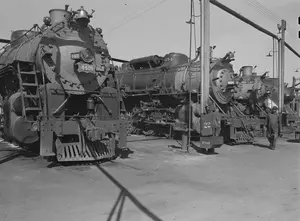
A busy scene in this Baltimore & Ohio publicity photo at Sir Johns Run, West Virginia, during the early 1950s: an A-B-B-A lash-up of FTs heads a westbound manifest at left while 2-6-6-4 #7705 (Class KB-1a), a former Seaboard Air Line engine, leads another at right. An eastbound coal drag sits in the background. American-Rails.com collection.
On this page: At a glance · Baltimore answers the Erie Canal · Horses, Tom Thumb, and Ellicott’s Mills · Cumberland and Wheeling · Civil War · Ohio, St. Louis, and Chicago · Philadelphia, New York, and the Royal Blue Line · Baltimore Belt · Willard and the passenger years · How the map was built · Postwar years · C&O, Chessie, and CSX · What remains
At a glance
The Baltimore & Ohio Railroad logo. Author’s work.
| Item | Detail |
|---|---|
| Headquarters | Baltimore, Maryland |
| Charter | Maryland, February 28, 1827. Virginia confirmed March 8, 1827 |
| Organized | April 23–24, 1827. First president Philip E. Thomas |
| Cornerstone | July 4, 1828, Charles Carroll of Carrollton |
| First regular service | Baltimore–Ellicott’s Mills, May 24, 1830 |
| Ohio River | Last spike December 24, 1852. First Baltimore–Wheeling train January 1, 1853 |
| Chicago | Baltimore, Pittsburgh & Chicago open November 23, 1874 |
| Route-miles (1930) | 5,468.50. Peak plant, including subsidiaries, on the order of 6,000 route-miles / 10,000 miles of track |
| States | Delaware, New York, New Jersey, Maryland, Virginia, Pennsylvania, West Virginia, Ohio, Michigan, Indiana, Kentucky (Louisville), Illinois, Missouri (Alton years) |
| Gauge | 4 feet 8½ inches (English practice adopted in the early 1830s) |
| Slogan / mark | Linking 13 Great States With The Nation / BO |
| Notable presidents | Philip E. Thomas; John W. Garrett (1858–84); Daniel Willard (1910–41) |
| C&O control | ICC December 31, 1962. Closed February 4, 1963 |
| Chessie System, Inc. | Incorporated February 26, 1973; parent of C&O, B&O, and Western Maryland June 15, 1973 |
| End of the name | Merged into C&O April 30, 1987. C&O into CSX Transportation August 31, 1987 |
| Rosters | Steam (post-1900) · All-time diesel |
Kirk Reynolds and David Oroszi, Baltimore & Ohio Railroad, is the company narrative used throughout. Early chronology follows Milton Reizenstein’s 1921 economic history and the Baltimore & Ohio Railroad Historical Society. Information compiled September 15, 2026.
Baltimore answers the Erie Canal
New York opened the Erie Canal in 1825 and stole the western trade. Philadelphia answered with a state system of canals and inclined planes toward Pittsburgh. Baltimore lived off the National Road and could see both cities pulling ahead. On February 12, 1827 about twenty-five merchants and bankers met to consider a railroad—an untried thing in America as a public highway. Philip E. Thomas, Alexander Brown, and William Patterson were in that room. Lawyer John V. L. McMahon took a charter to Annapolis. Maryland passed it February 28. Virginia followed March 8. Stock sold in a rush. The company organized in late April, Thomas as first president.
Canal men broke ground on the Fourth of July. The B&O did the same. On July 4, 1828 Charles Carroll of Carrollton, last living signer of the Declaration of Independence, turned the first spadeful at Baltimore. The object was the Ohio River at Wheeling, then in Virginia, with Cumberland on the way. Pennsylvania would not give an easy crossing. The railroad would have to climb Maryland and what became West Virginia, over the Alleghenies, guessing at grades and curves no American engineer had yet proven a train could take. Men sailed to England to watch railways already at work. They came home with 4 feet 8½ inches as the gauge that left room for inside-connected machinery, and with the knowledge that a proper guideway was still an experiment.
Horses, Tom Thumb, and Ellicott’s Mills
The first track used granite stringers and strap iron. Wooden beams on crossties came next. Strap rail worked until it wore loose and sprang up through car floors—snake-heads—and by the 1840s Robert L. Stevens’s solid iron T-rail, developed on the Camden & Amboy, was the way forward. Public riding began in January 1830 over the first mile and a half from Pratt Street. Regular service opened to Ellicott’s Mills, thirteen miles, on May 24, 1830. Horses pulled rebuilt carriages. The railroad put up a two-story stone depot and a turntable. Granite from Ellicott’s Quarries, farm produce, and less-than-carload freight paid the bills before passengers did.
That August Peter Cooper ran his little vertical-boiler engine, the Tom Thumb, on the line. The famous contest with a horse is dated August 28, 1830. Cooper did not mean to write a timetable. He meant to prove steam could take the B&O’s tight curves. In 1831 Phineas Davis of York, Pennsylvania, delivered the 0-4-0 York. The stable emptied. Steam took the railroad west.

The transition from steam to diesel: Baltimore & Ohio E7A #66, about a year old, and 4-6-2 #5086 (Class P-1a) await their next assignments in Cumberland, Maryland, during October 1946.
Frederick opened on a branch December 1, 1831. Point of Rocks, April 1, 1832. Harpers Ferry, still in Virginia, on December 1, 1834. A Potomac bridge followed. The Washington Branch, using Benjamin Henry Latrobe Jr.’s Thomas Viaduct at Relay, reached the capital on August 25, 1835. That is still, in the railroad sense, among the oldest passenger assignments in the country; MARC’s Camden Line uses the same iron.
Cumberland and Wheeling
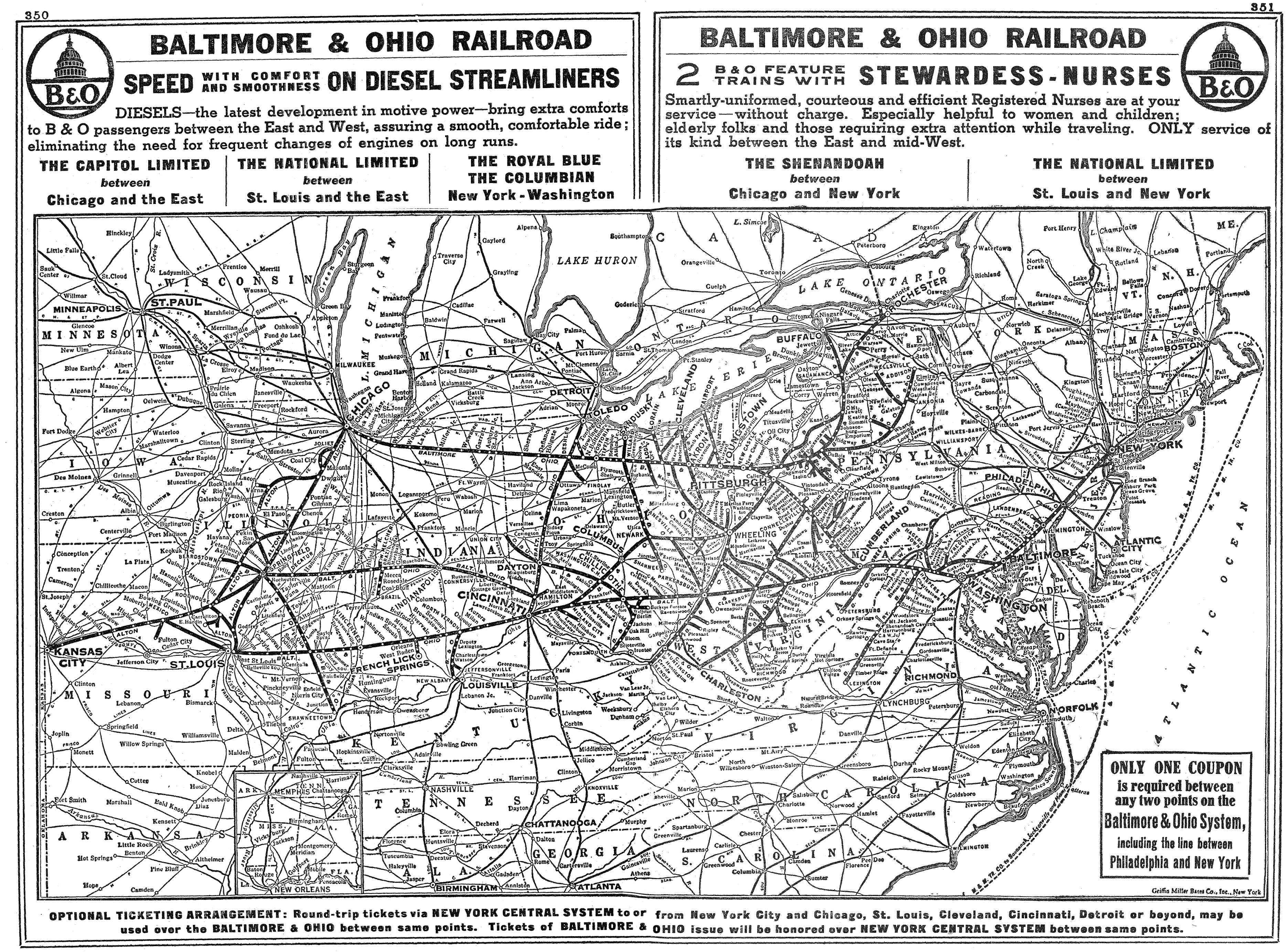
An official 1940 system map of the Baltimore & Ohio. Author’s collection.
West of Harpers Ferry the work slowed. Martinsburg, May 1842; Hancock, June 1; Cumberland on November 5, 1842, 178 miles from Baltimore and a division point for the rest of the company’s life. The Pennsylvania Railroad took a charter in 1846 and locked the easier Pittsburgh route. Thomas Swann became president October 11, 1848, and pushed construction again: southwest to Bridge Valley (later Grafton) and Fairmont, then northwest toward the Ohio. The last spike went down at Rosby’s Rock on Grave Creek at 6:05 p.m. on December 24, 1852, 379 miles from Baltimore. The first through train reached Wheeling on New Year’s Day 1853. Formal opening followed January 10. West Virginia was still nine years away.
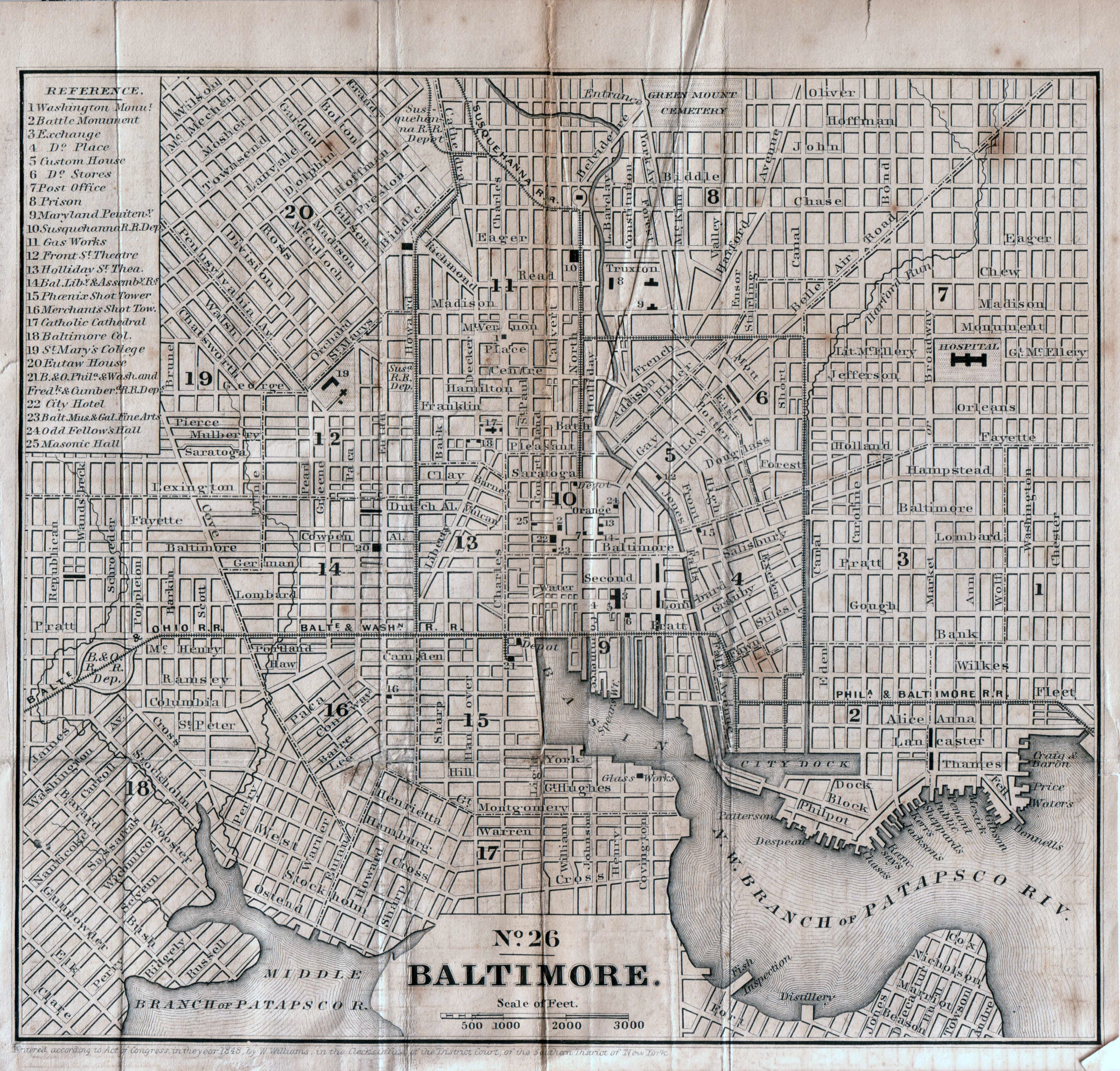
Downtown Baltimore, Maryland, as it appeared in 1848. From Appleton’s Railroad and Steamboat Companion. Author’s collection.
Grafton, named for engineer John Grafton and laid out in 1856, became the hinge. From there the Northwestern Virginia Railroad—chartered February 14, 1851, leased by the B&O in December 1856, opened May 1, 1857—ran the Parkersburg Branch to a better Ohio River port aimed at Cincinnati and St. Louis. Sharp curves, tunnels, and grades. It carried that name until CSX took it up in the 1980s.
Civil War
No American railroad sat closer to the fighting. The main line crossed the Potomac at Harpers Ferry, ran the border counties, and fed Washington. Confederate raiders cut it again and again. Stonewall Jackson wrecked shops at Martinsburg and rolled locomotives into the river. Bridges burned. John W. Garrett, president from 1858, kept the road running for the Union and made himself indispensable to Lincoln’s War Department. Troops, beef, and powder moved west from Baltimore and east from the Ohio. Camden Station saw Lincoln in and out of the city. When the war ended the B&O had a wrecked plant and a national reputation. Rebuilding was the 1860s. Expansion was the 1870s.
Ohio, St. Louis, and Chicago
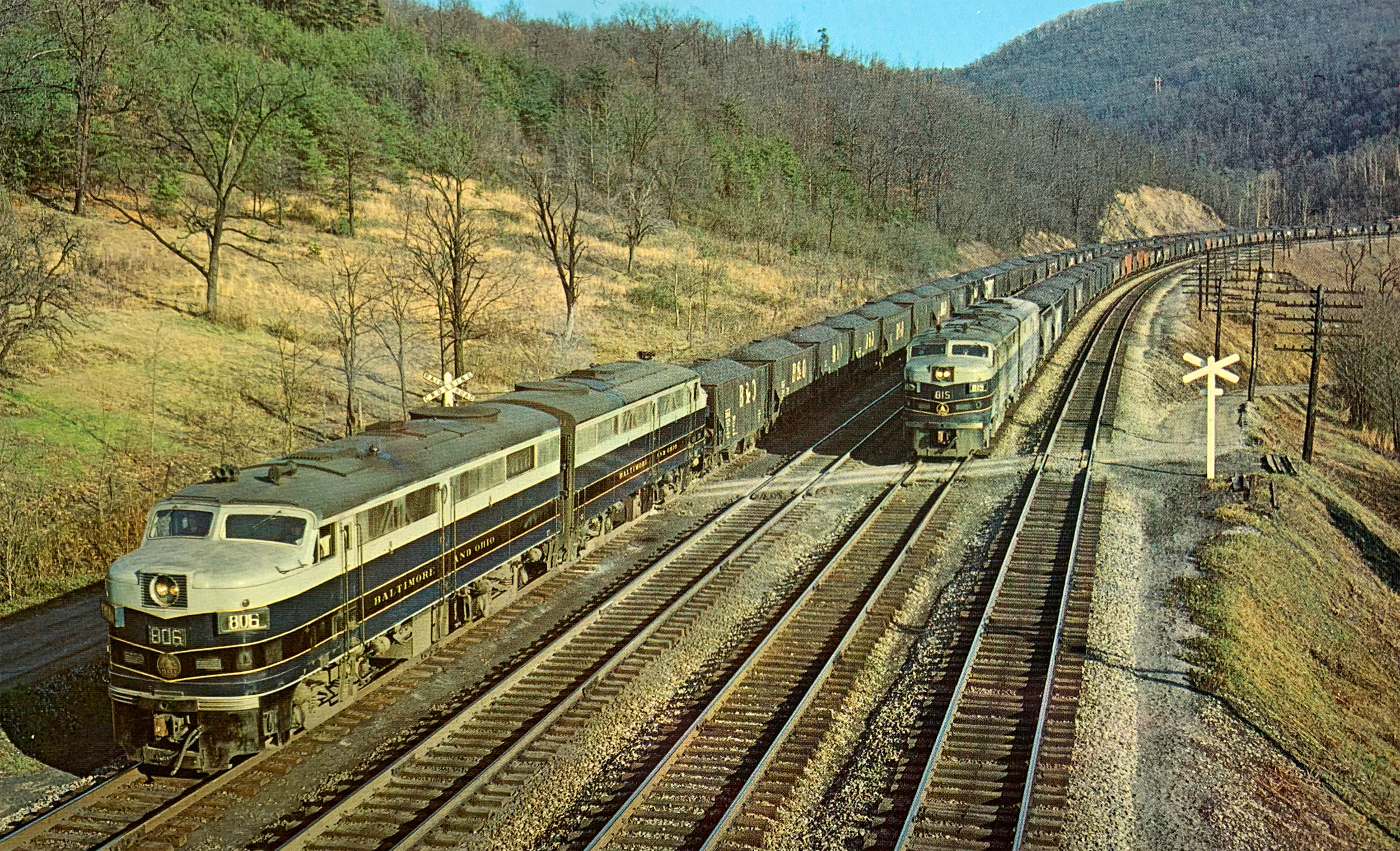
In this Baltimore & Ohio publicity photo, FA-2s have westbound coal drags at Orleans, West Virginia, during the early 1950s.
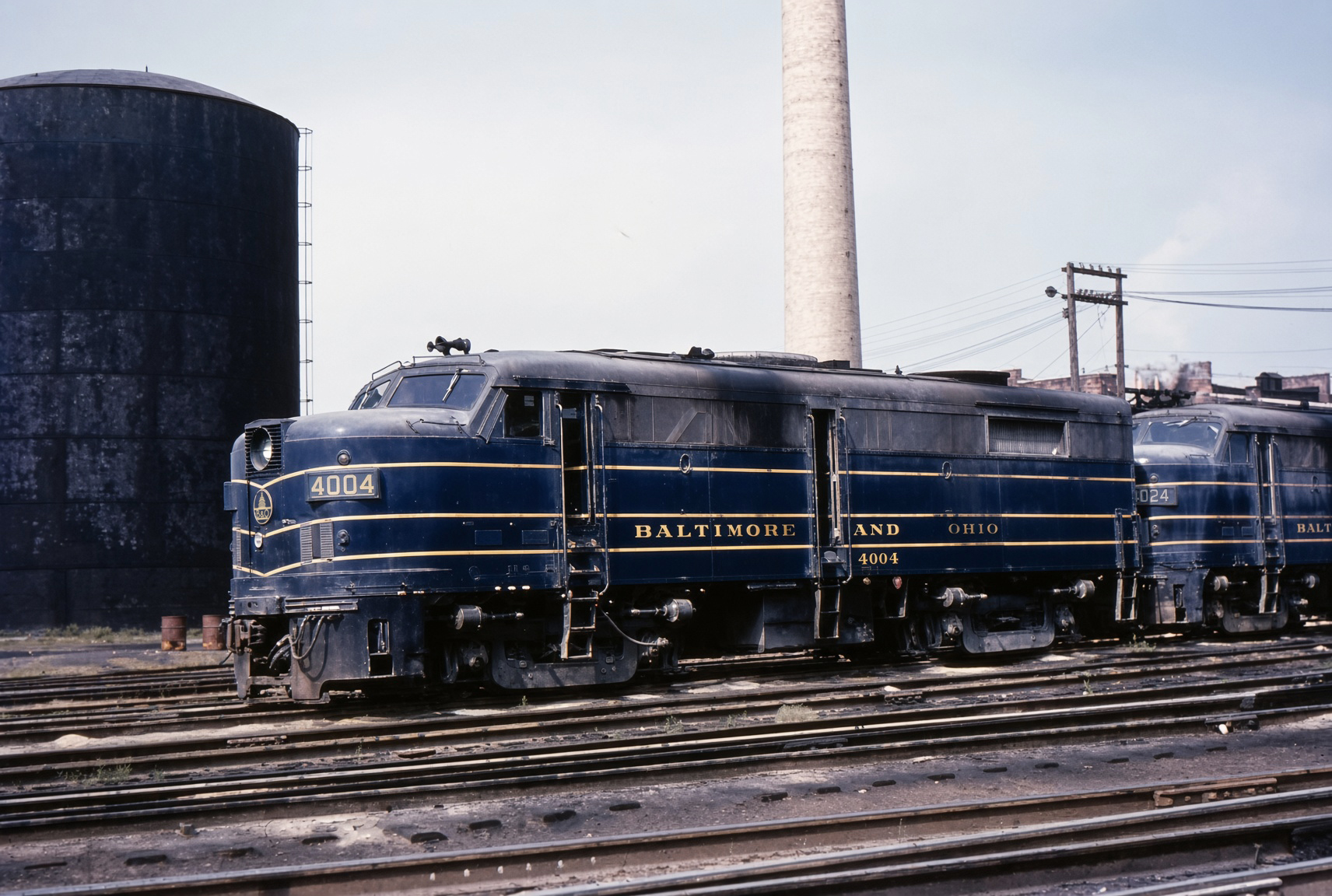
A pair of handsome, albeit grimy, Baltimore & Ohio FA-2s - #4004 and #4024 - are seen here between assignments at the Willard, Ohio terminal (named for legendary president Daniel Willard, which led the company from 1910 to 1941), circa 1960. The B&O was not a big Alco customer and primarily stuck with Electro-Motive products. However, it did test out a few models, such as the FA.
Parkersburg connected by carferry with the Marietta & Cincinnati. A 7,100-foot Ohio River bridge, Parkersburg to Belpre, opened January 7, 1871 and killed the ferry. The B&O took the M&C in 1882 and recast it as the Baltimore & Ohio Southwestern in 1889. Beyond Cincinnati the Ohio & Mississippi, built to six-foot gauge and opened 1857, reached St. Louis. It converted to standard gauge in July 1871. The B&O bought it in 1893 and folded it into the Southwestern in 1900. Eastern markets had a Mississippi River gateway twenty years after Wheeling.
Pittsburgh was the missing city. The Pittsburgh & Connellsville, organized 1837, started construction in 1847 with B&O money. The Pennsylvania fought it in court; the B&O won in 1868. Sand Patch Grade, Cumberland to Pittsburgh, opened in May 1871 and became the Chicago main in all but name. Additional Pittsburgh access came from Wheeling (Wheeling, Pittsburgh & Baltimore) and from Fairmont and Morgantown (the Fairmont, Morgantown & Pittsburgh, the Sheepskin Line).
Chicago itself arrived by a roundabout. The Central Ohio, leased 1866, ran from the river near Wheeling to Newark and Columbus. The Sandusky, Mansfield & Newark, leased 1869, ran Newark to Lake Erie. From a spot on that line called Chicago Junction—later Willard, for Daniel Willard—the Baltimore, Pittsburgh & Chicago built 260 miles west. Operations began November 23, 1874, at first using Illinois Central rights into town. Adams Street, then Monroe Street, then Grand Central Station in 1891. A true through route Baltimore–Pittsburgh–Chicago waited until the Akron & Chicago Junction opened August 1, 1891. Regular passenger and freight by that path followed in 1893.
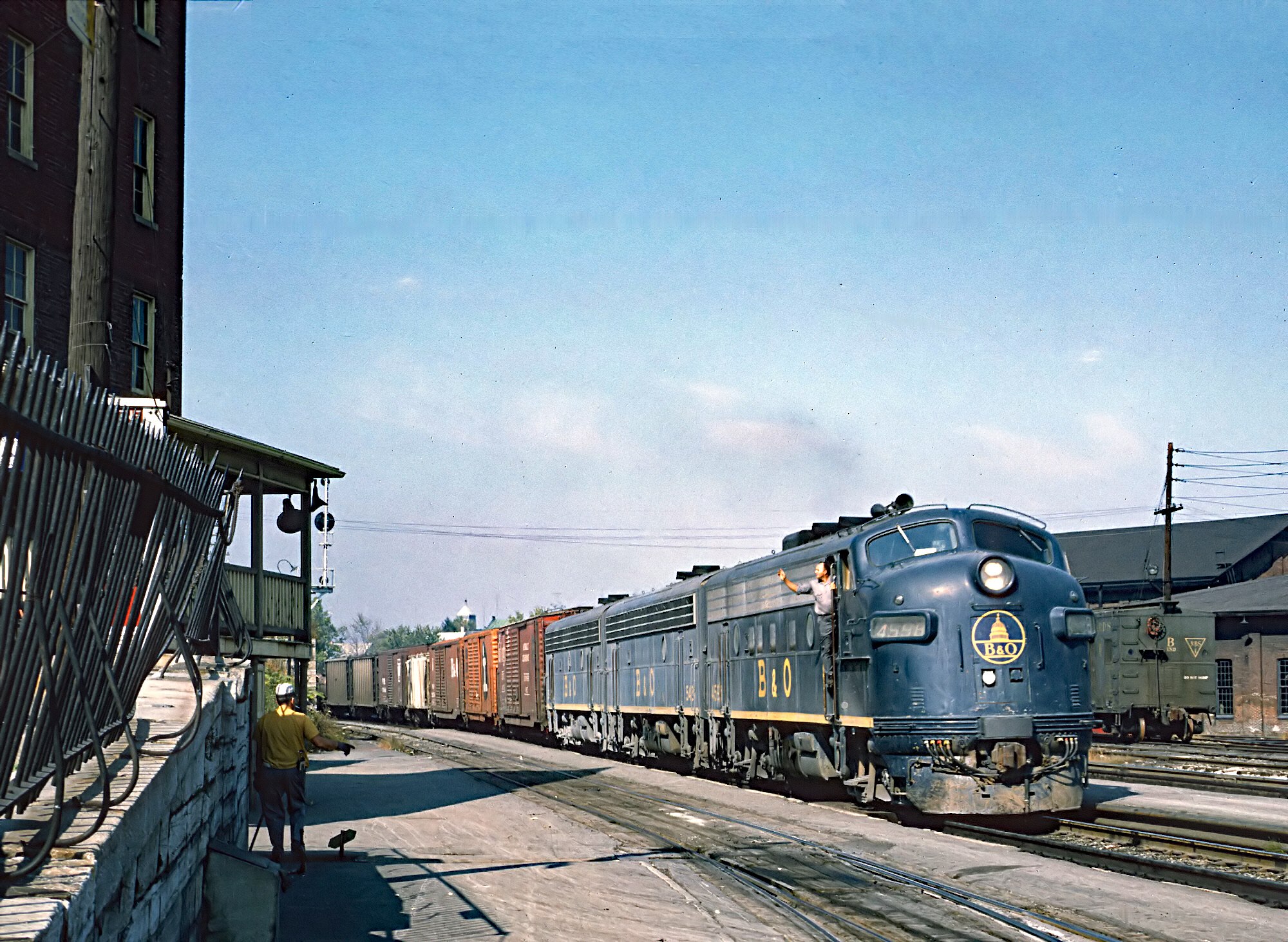
Baltimore & Ohio F7s lead their freight eastbound through the once-important division point of Martinsburg, West Virginia, on October 11, 1969. Roger Puta photo.
The Great Railroad Strike of 1877 started on this railroad. A pay cut at Martinsburg on July 16 spread to Baltimore on July 20. Militia fired. The country caught fire after that. The strike is a national story; the B&O was where it began.

Baltimore & Ohio FPA-2 #810 and FB-2s receive a bath at the wash rack in Willard, Ohio, on August 14, 1956. J. W. Swanberg photo. American-Rails.com collection.
Philadelphia, New York, and the Royal Blue Line
After Chicago the B&O wanted the eastern seaboard the Pennsylvania already owned. Subsidiary Delaware Western opened Baltimore–Philadelphia, 111 miles, in September 1886. New York was a friendly-connection job: Philadelphia & Reading to Bound Brook, Central Railroad of New Jersey to Jersey City, then a ferry to Manhattan. That patchwork was the Royal Blue Line. Passengers never rode a B&O locomotive into New York. The railroad still put its name on the Royal Blue and fought the Pennsylvania on service until it gave up the market in April 1958.

An A-B-A set of B&O F7s, led by #4553, heads a general manifest westbound through Garrett, Indiana, in March 1958. Richard Wallin photo.
Baltimore Belt
For decades the New York–Washington line and the Washington–Cumberland main did not meet in Baltimore except by car ferry across the harbor. The Baltimore Belt Railroad and the Howard Street Tunnel closed that gap. Official List No. 29 (January 1, 1948) put the territory at 7.2 miles, Bay View to Hamburg Street, four miles of it under wire. General Electric supplied 600-volt direct-current motors. Coke-fired steam ran first on May 1, 1895. An electric test came June 27. The public saw it on July 1, 1895—the first main-line railroad electrification in the United States. Overhead contact gave way by 1900 to a conventional third rail; coal smoke ate the original shoes. Mount Royal Station rose at the north portal. It still stands.
The project was expensive. Debt from the Belt and from western expansion helped put the company into receivership in 1896. The Pennsylvania took a controlling stock interest in the community-of-interest years after 1901 and sold down after 1906. The B&O came out independent, poorer, and still itself. Electric motors on the Belt were renewed in 1903–06, 1910–12, and 1923. Diesels made the wire unnecessary in the early 1950s. CSX still runs the Belt.
Electric locomotive classes
| Class | Years | Builder | Qty | Notes |
|---|---|---|---|---|
| LE-1 | 1895–96 | GE | 3 | Steeple-cab. First motors |
| LE-2 | 1903–06 | GE | 4 | Boxcab |
| OE-1 | 1910 | GE | 2 | Steeple-cab |
| OE-2 | 1912 | GE | 2 | Steeple-cab |
| OE-3 | 1923 | GE | 2 | Steeple-cab |
| OE-4 | 1923 | GE | 2 | Steeple-cab. Last class |
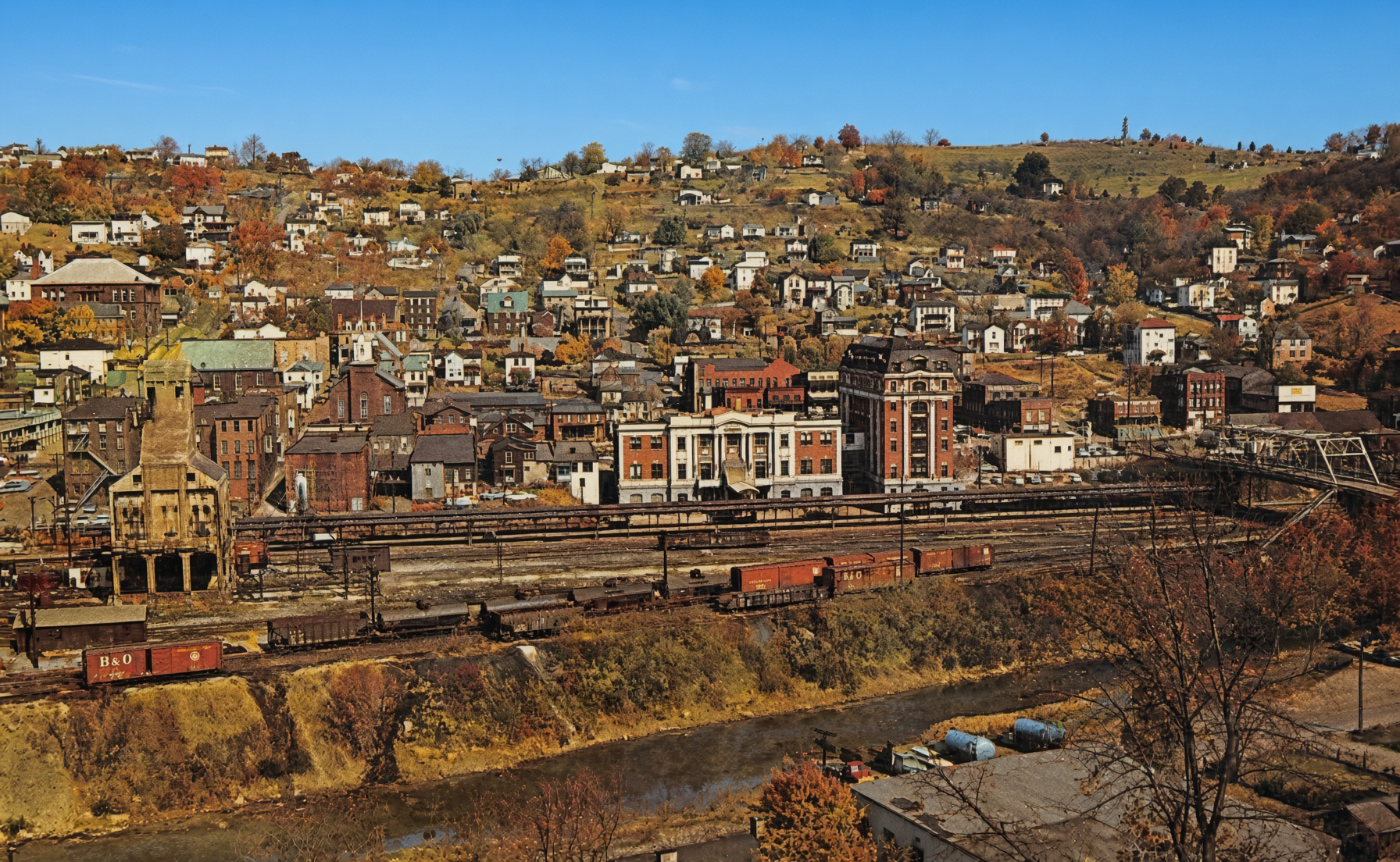
A bird’s-eye view of Baltimore & Ohio’s yard in Grafton, West Virginia, during a late fall afternoon, circa 1962. The long covered station platform came down a few years later. C. H. Ruth photo.
Willard and the passenger years
Daniel Willard took the presidency in 1910 and held it until June 1941. He steered the company through federal control in the First World War, the Depression, and the first years of the Second. Mount Clare Shops in Baltimore remained a place that rebuilt rather than bought when money was short. The Fair of the Iron Horse at Halethorpe, September 24–October 8, 1927, marked the centennial with a pageant of American locomotives. Willard’s railroad put passenger service at the center of its public face even when freight paid the bills.
The Capitol Limited began May 12, 1923, Washington/Baltimore to Chicago. The National Limited followed April 26, 1925, to St. Louis. After government control ended March 1, 1920, Willard even negotiated a short-lived deal to use Pennsylvania Station in New York. The Columbian, launched May 24, 1931 as an all-coach companion to the Royal Blue, was the first fully air-conditioned train in the United States. Electro-Motive’s EA/EB set of 1935 put a streamlined diesel on the Royal Blue; Mount Clare and Otto Kuhler then wrapped heavyweight cars to match. The Cincinnatian debuted January 19, 1947. Strata-Dome cars on the 1949 Columbian were the first domes in the East, where clearances had long forbidden them. The Shenandoah was the secondary Chicago train. A full passenger survey is B&O passenger trains.

An Electro-Motive builder’s photo of new Baltimore & Ohio F3s, #84 closest to the photographer, in July 1947. These units were steam-generator equipped for passenger service.
Diesels arrived earlier than the streamliner story admits. An Ingersoll-Rand boxcab, B&O 1, went to work in 1925 among the first commercially successful diesel switchers in the country. The 1930s brought the passenger cab units that made the publicity photographs. Freight followed with FTs, F3s, F7s, and Alco FAs. The steam roster after 1900 is B&O steam. The diesels are B&O diesels.
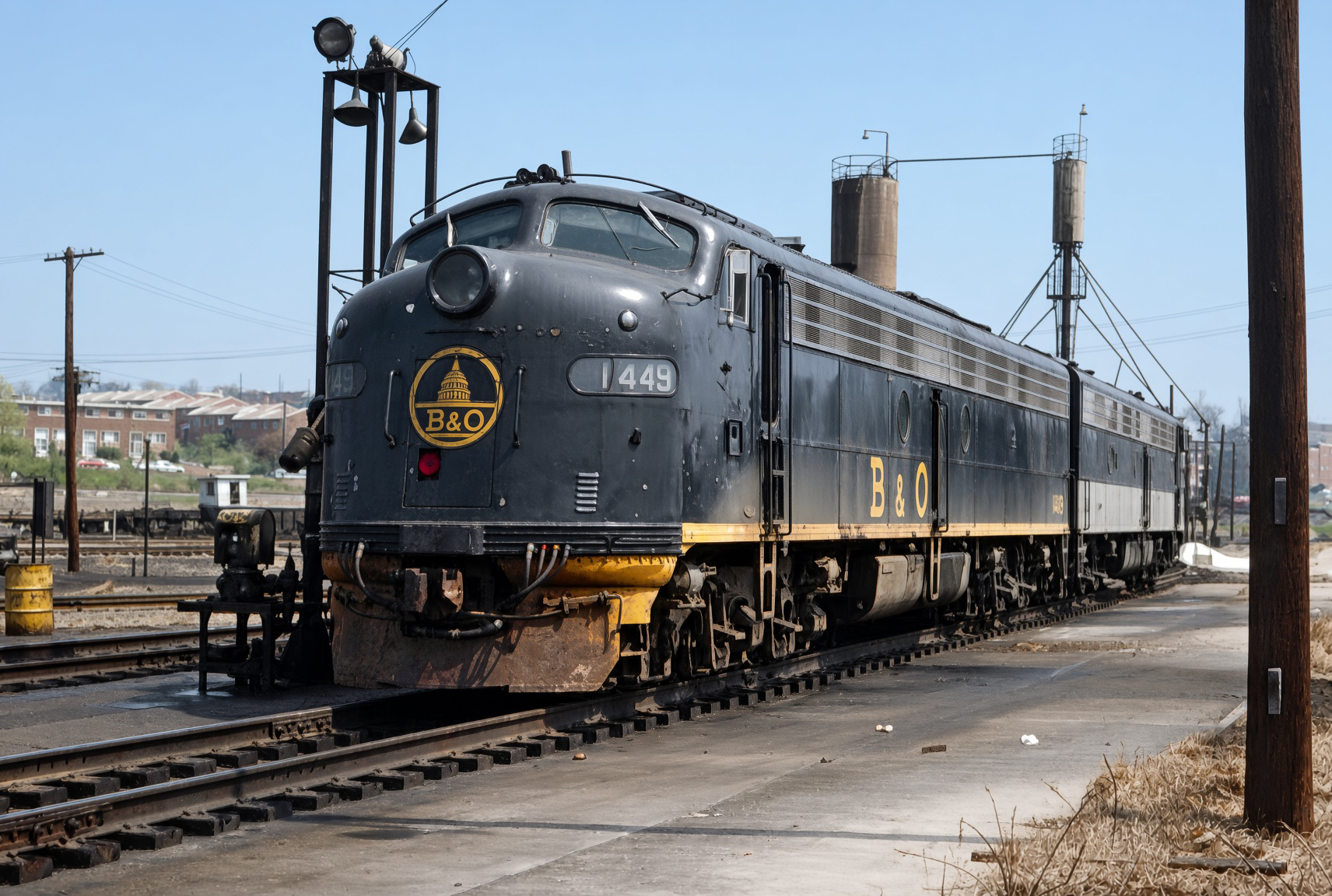
Baltimore & Ohio E8A #1449 and another E unit layover at the Ivy City engine terminal in Washington, D.C., on April 19, 1970. Marty Bernard photo.

Baltimore & Ohio E7As in the short-lived Sunburst livery at the Ivy City engine terminal, Washington, D.C., circa 1963. #1426 appears to be missing its nose herald. Photographer unknown.
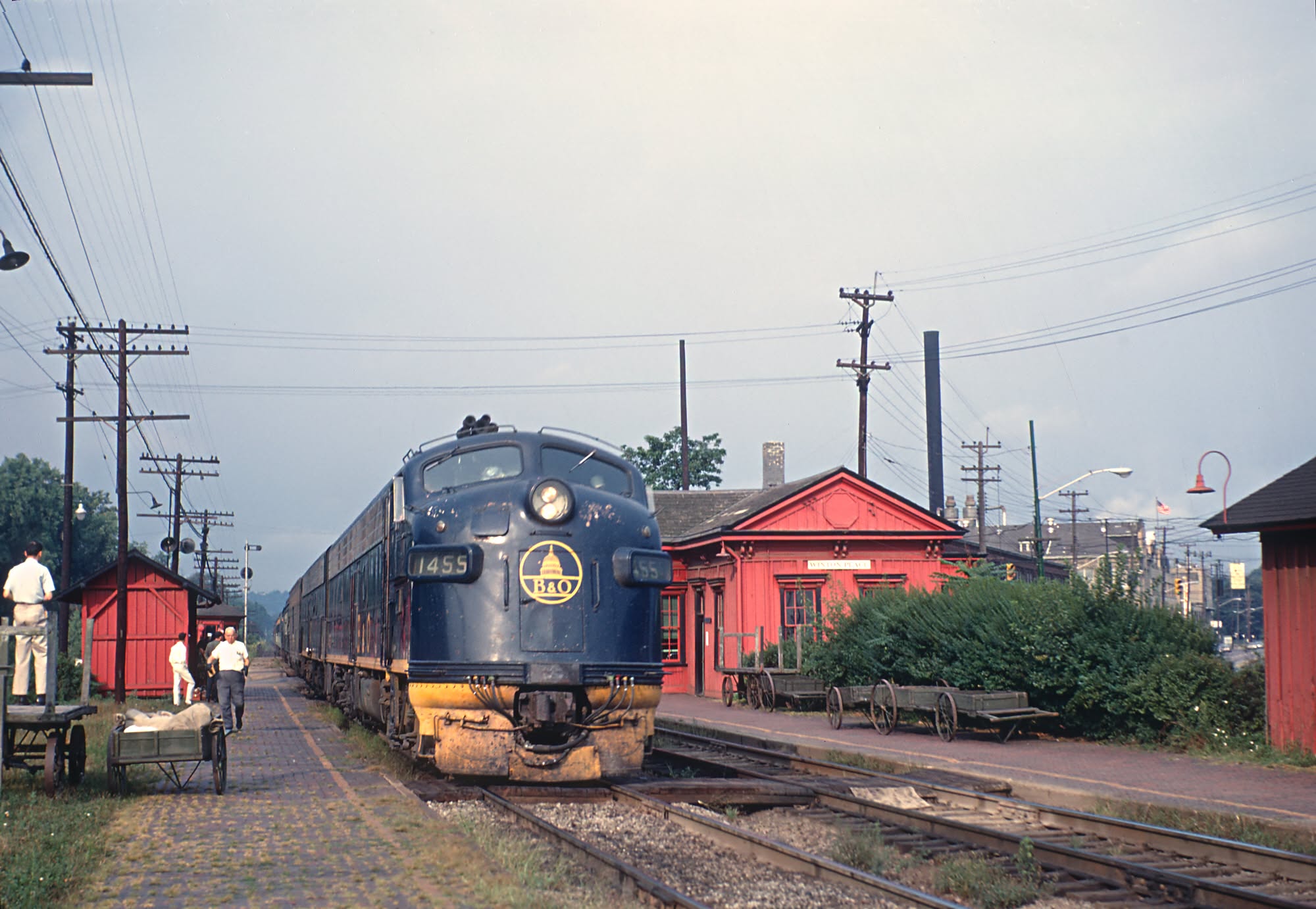
Baltimore & Ohio E9A #1455 has train 54, the Cincinnatian, at Winton Place in Cincinnati, Ohio in August, 1967. Rick Burn photo.
How the map was built
The B&O was never one charter stretched west. It was a stack of companies, some built, some bought, some leased, that together made thirteen states and a slogan.
Baltimore & Ohio Chicago Terminal
The most important terminal subsidiary. In 1910 the B&O bought the bankrupt Chicago Terminal Transfer Railroad, itself descended from the La Salle & Chicago of 1867. At its peak the B&OCT ran Chicago Heights to Franklin Park via Blue Island and La Grange, with connections at Bellwood, Forest Hill, South Chicago, East Chicago, Calumet Park, Whiting, and Pine Junction. It put the parent into Grand Central Station on the North Side. The company still exists on paper as a CSX subsidiary. The terminal story is B&OCT.

Baltimore & Ohio F7A #4532 leads an eastbound freight through Martinsburg, West Virginia, on October 11, 1969. Roger Puta photo.
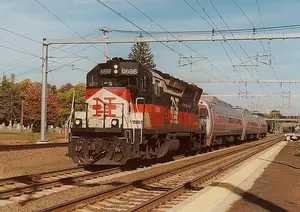
Baltimore & Ohio GP9 #6586 is working freight service at University Station in Washington, DC during November, 1968. Rick Burn photo.
Baltimore, Pittsburgh & Chicago
Wholly owned, incorporated March 1872 in Ohio and Indiana (Illinois company 1873) to build from Chicago Junction to Chicago. Newark, Ohio, in 1873; open November 23, 1874. Consolidated 1876 as the Baltimore & Ohio and Chicago Railroad.
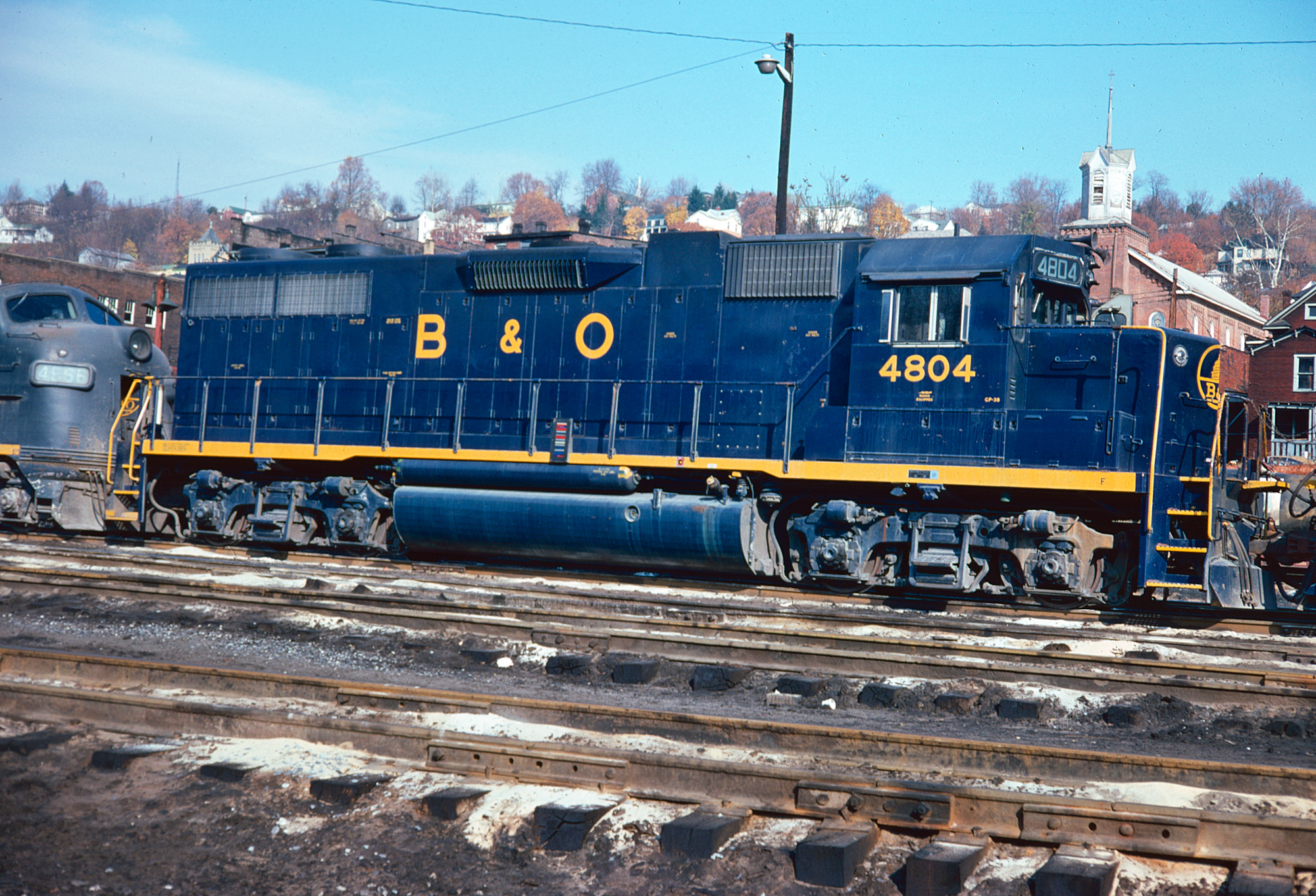
Baltimore & Ohio GP38 #4804 and F7A #4566 layover in Grafton, West Virginia, in November 1970. American-Rails.com collection.
Buffalo, Rochester & Pittsburgh
A central Pennsylvania–Buffalo/Rochester coal road, assembled March 10, 1887, from the Pittsburgh & State Line and an earlier BR&P after the Rochester & Pittsburgh failed. Willard bought it in 1929 and took over January 1, 1932, to reach western New York. The connection to Buffalo was never the best. He also bought the Buffalo & Susquehanna in 1932, a 1893 consolidation of logging lines from Sagamore, Pennsylvania, toward Addison and Wellsville, New York. Flooding in November 1942 cut the B&S south of Galeton. The north end became the Wellsville, Addison & Galeton in 1956 and lasted until 1979.
Marietta & Cincinnati / Northwestern Virginia / Ohio & Mississippi
The M&C formed in 1851 from the Belpre & Cincinnati and Franklin & Ohio, opened Marietta–Cincinnati in early 1857, and gave the B&O its Ohio stepping-stone. The Northwestern Virginia, the Parkersburg Branch, opened May 1, 1857. The Ohio & Mississippi, six-foot gauge to St. Louis with branches to Jeffersonville/Louisville and Shawneetown–Beardstown via Flora, was the Mississippi River piece. Together they are the St. Louis main.
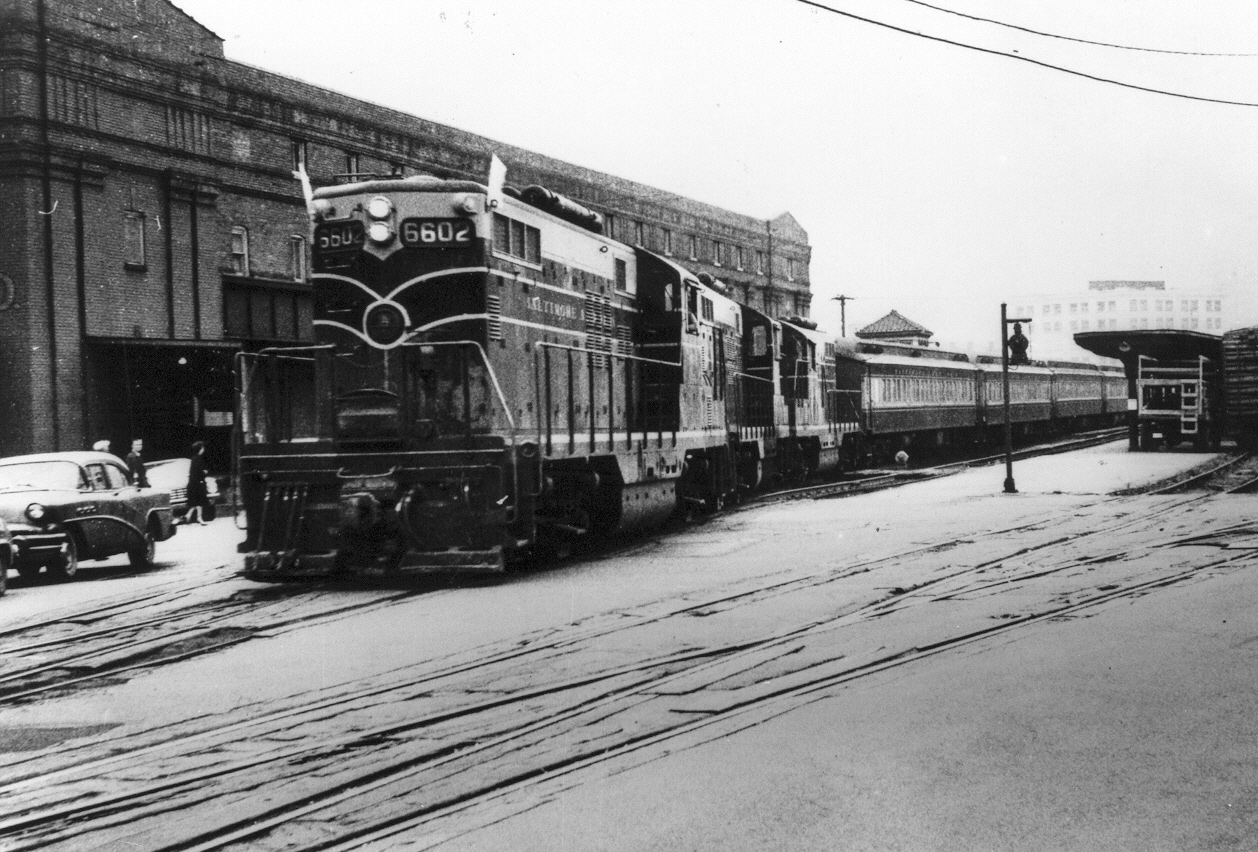
Baltimore & Ohio passenger GP9s, led by #6602, have arrived from Washington, D.C., with a passenger special at the large station in Wheeling, West Virginia, on May 12, 1963. The station remains; the tracks are gone. Photographer unknown. American-Rails.com collection.
Pittsburgh & Connellsville
Sand Patch. Cumberland to Pittsburgh, May 1871. The Chicago freight artery of the twentieth century still uses this mountain.
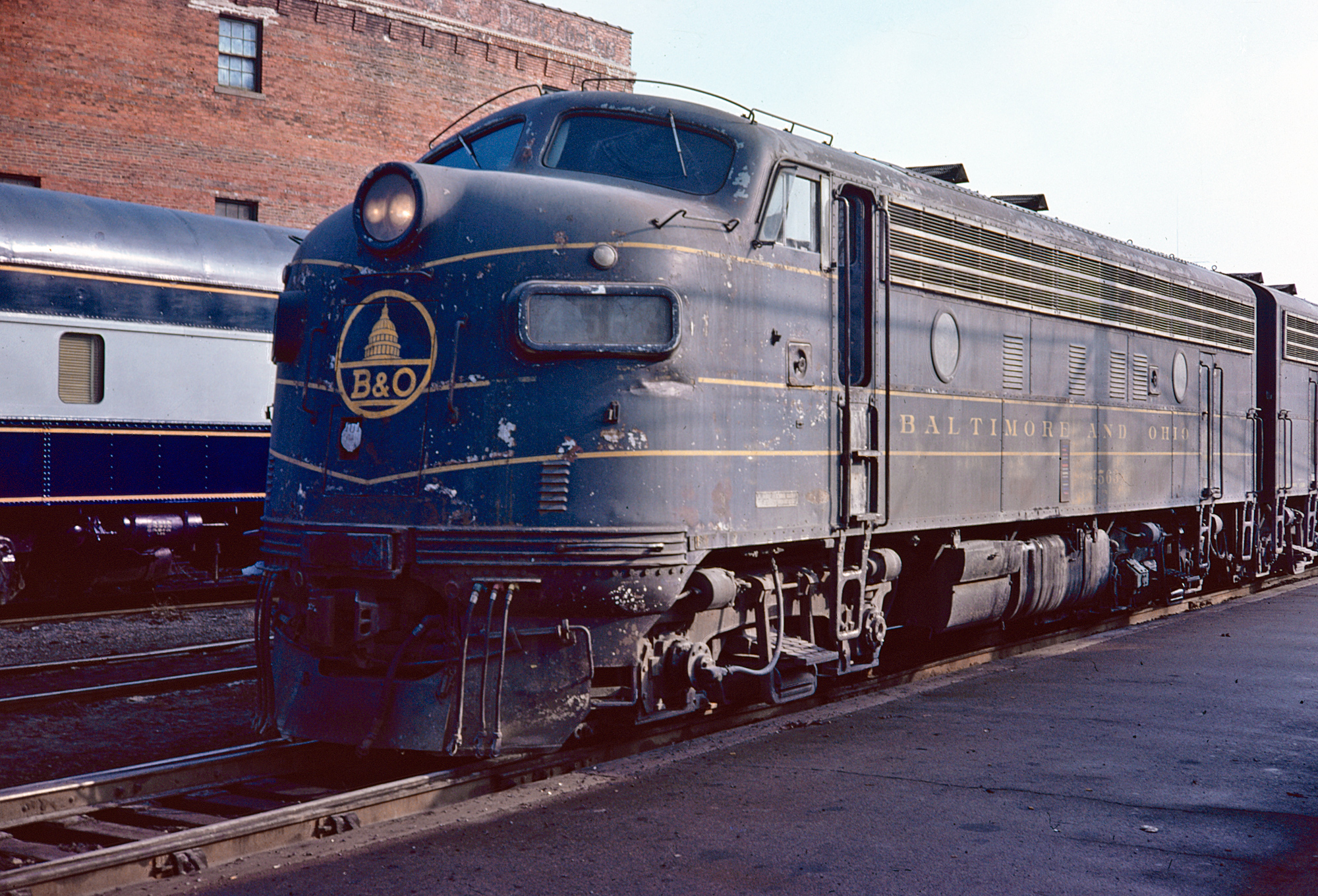
Baltimore & Ohio F7A #4563 sits at the west end of High Yard in Parkersburg, West Virginia, near OB Tower, awaiting departure west, February 1974. Parkersburg was a major division point on the St. Louis main. American-Rails.com collection.
Ohio River Rail Road
Backed by Rockefeller/Standard Oil money, construction south of Wheeling began in 1882 and reached Huntington in 1888, hugging the river. Oil and petrochemical plants followed. The B&O leased it in September 1901 and bought it in 1912. It tied Wheeling to Parkersburg and, at Huntington/Kenova, to the Chesapeake & Ohio.

A Baltimore & Ohio FA-2/FB-2 set has train #34 heading east through historic Harpers Ferry, West Virginia, as it crosses the Potomac River in the spring of 1956. Clarence Cade photo.
Virginia Extension
After the Civil War the B&O tried the Shenandoah. It leased the Winchester & Potomac, Harpers Ferry to Winchester, July 1, 1867; took the Winchester & Strasburg, 19 miles; and in 1873 used the Virginia Midland as far as Harrisonburg. The Valley Railroad, aimed at Salem near Roanoke, reached only Lexington in 1883 and stopped. The 1896 receivership sold the northern pieces. The VRR hung on into the early 1940s.
Alton Railroad
Willard bought the bankrupt Chicago & Alton in 1929 and renamed it the Alton Railroad in 1931, looking at Kansas City. The Abraham Lincoln streamliner was the passenger face of that hope. The Depression and the B&O’s own books killed the experiment. The Alton was separated in 1942, slipped into receivership, and went to the Gulf, Mobile & Ohio in May 1947.

A Baltimore & Ohio F7A rolls southbound along 2nd Street in St. Marys, West Virginia, on a summer day in the 1960s. The tankers are likely from the Quaker State refinery a quarter-mile behind the photographer. Trains have used this street trackage since the 1880s, at about 10 mph. John King photo.
Postwar years
Roy B. White succeeded Willard in 1941 and saw the company through the war. Howard E. Simpson inherited the 1950s. Highways and airlines took the passengers. Coal and merchandise still moved, but after 1956 the books turned. Payrolls shrank. Trailer-on-flat-car service was tried. By 1960 the losses were serious. Jervis Langdon Jr. came in 1961 to keep the railroad out of court. The Norfolk & Western–Virginian combination of 1959 had already opened the modern merger era. The New York Central wanted the B&O. So did the Chesapeake & Ohio.

Baltimore & Ohio F7s just east of Cumberland, Maryland, with a general manifest on a spring day in the 1950s. Photographer unknown. American-Rails.com collection.

B&O F7s, led by #935, head west at Shenandoah Junction, West Virginia, in September 1955. Photographer unknown.
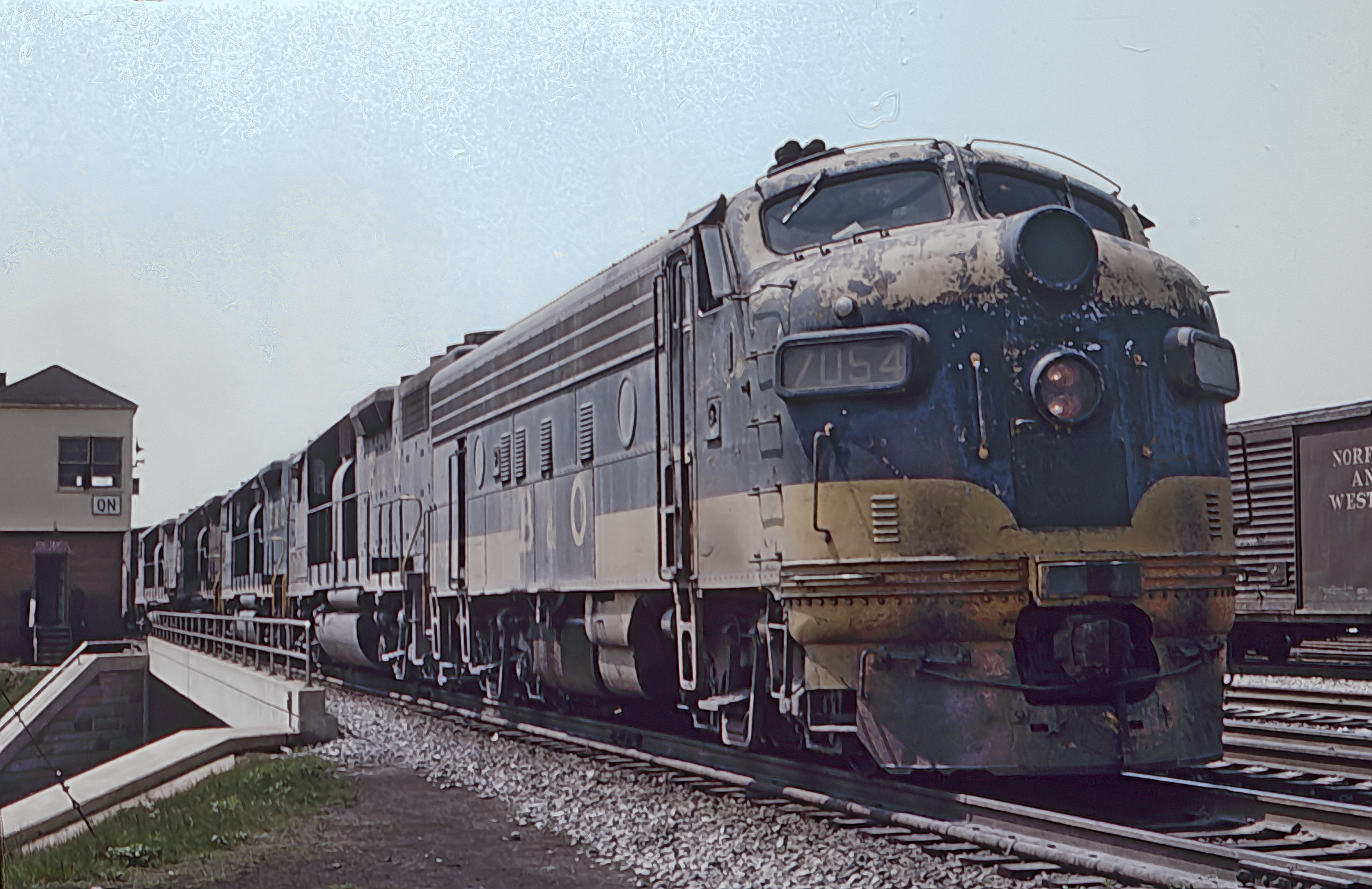
Baltmore & Ohio F7A #7054 (ex-C&O #7054) leads a freight past QN Tower on the Metropolitan Branch in Washington, DC on April 29, 1970. Marty Bernard photo.
C&O, Chessie, and CSX
The Interstate Commerce Commission approved C&O control on December 31, 1962. Direct control closed February 4, 1963. It was not a merger of the two corporations. The C&O left the B&O standing, in part to keep a Maryland tax exemption and in part because B&O people would not have taken an erasure quietly. Western Maryland stock accumulated until C&O/B&O had the Wild Mary in 1967. Yellow, blue, and vermilion GP40-2s with the Chess-“C” kitten silhouette began arriving in 1972. Chessie System, Inc. was incorporated in Virginia on February 26, 1973, and became parent of the C&O, B&O, and Western Maryland on June 15. The holding-company story is Chessie System. The C&O itself is Chesapeake & Ohio.
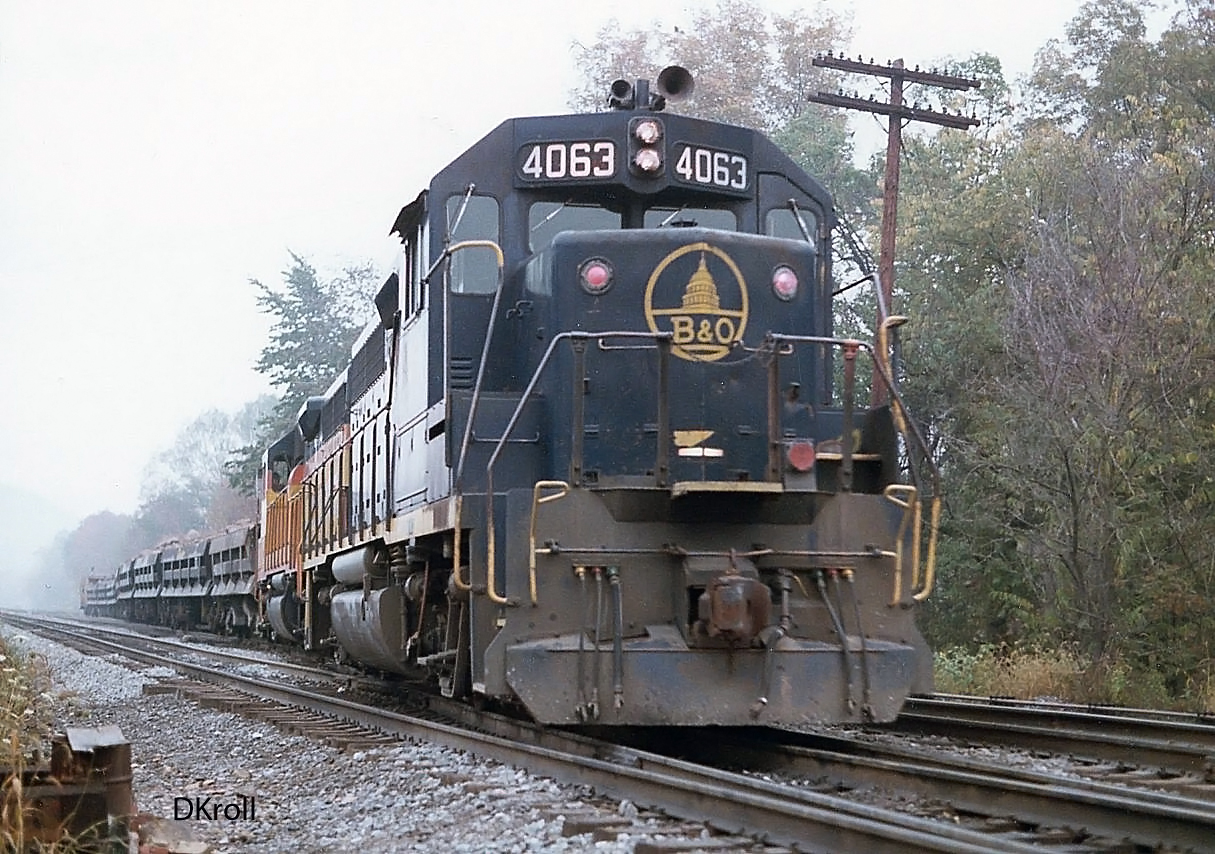
Baltimore & Ohio GP40 #4063 leads a ballast train repairing flood damage on the Sand Patch main near Hyndman, Pennsylvania, on October 15, 1984. Doug Kroll photo.
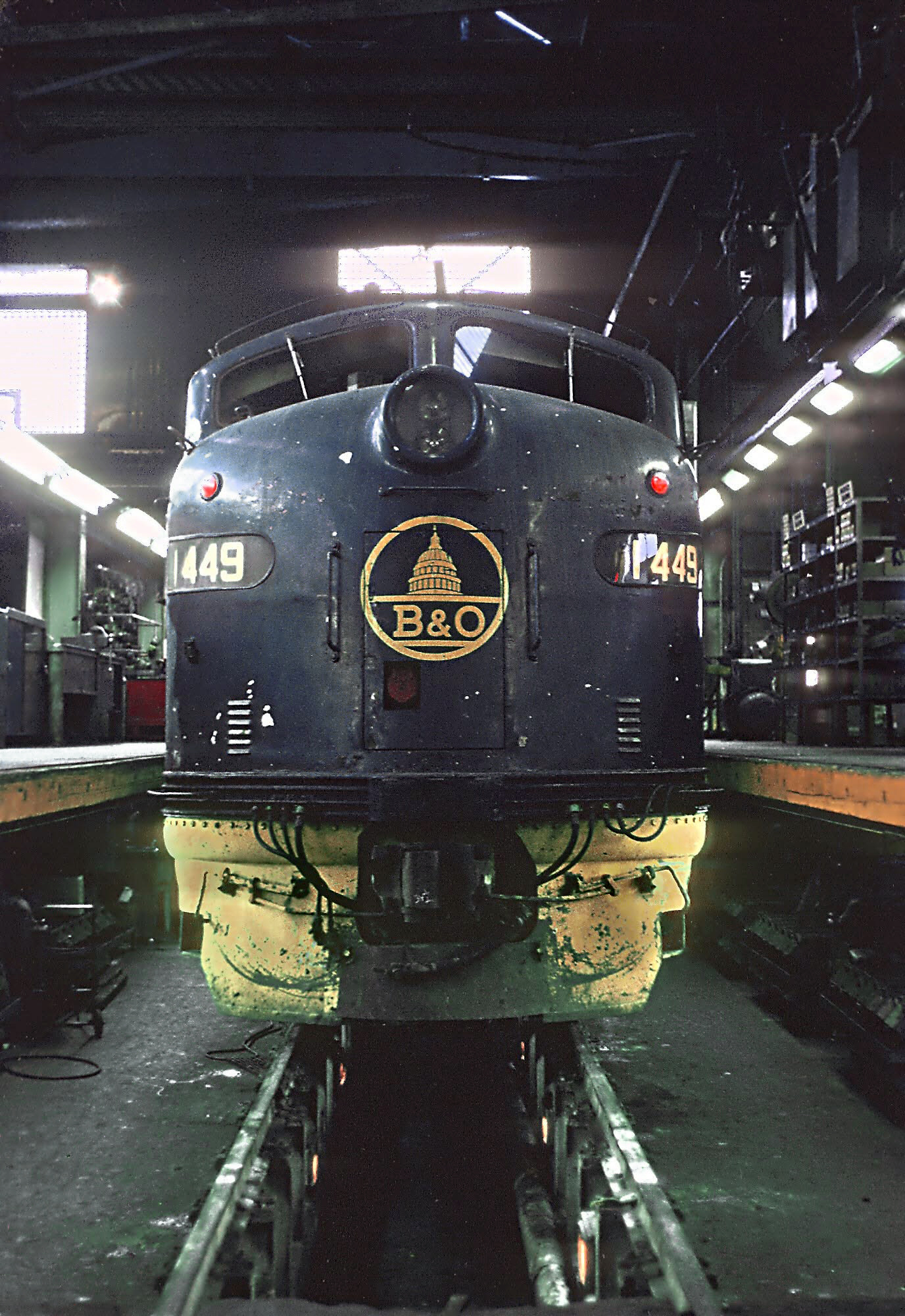
Baltimore & Ohio E8A #1449 receives attention at the shops in Cumberland, Maryland on December 5, 1970. Roger Puta photo.
Chessie System and Seaboard Coast Line Industries formed CSX Corporation on November 1, 1980. The B&O was already a paper company with a tax reason to exist. Western Maryland merged into the B&O on May 1, 1983. The B&O merged into the C&O on April 30, 1987. The C&O dissolved into CSX Transportation on August 31, 1987.
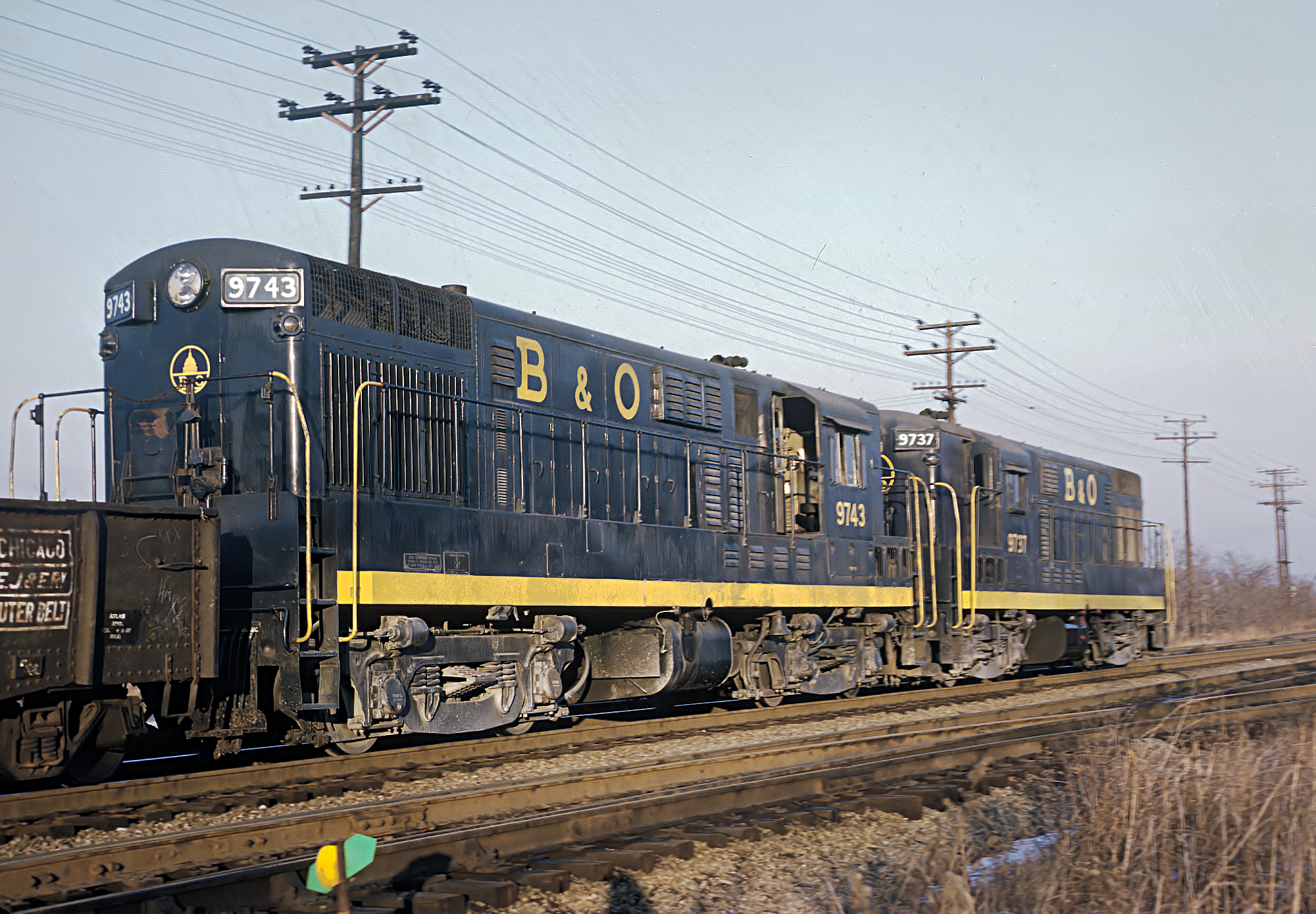
Baltimore & Ohio H16-44s #9743 (built as #6709) and #9737 (built as #925) on the Curtis Bay Branch in Baltimore, Maryland, on December 14, 1969. Roger Puta photo.
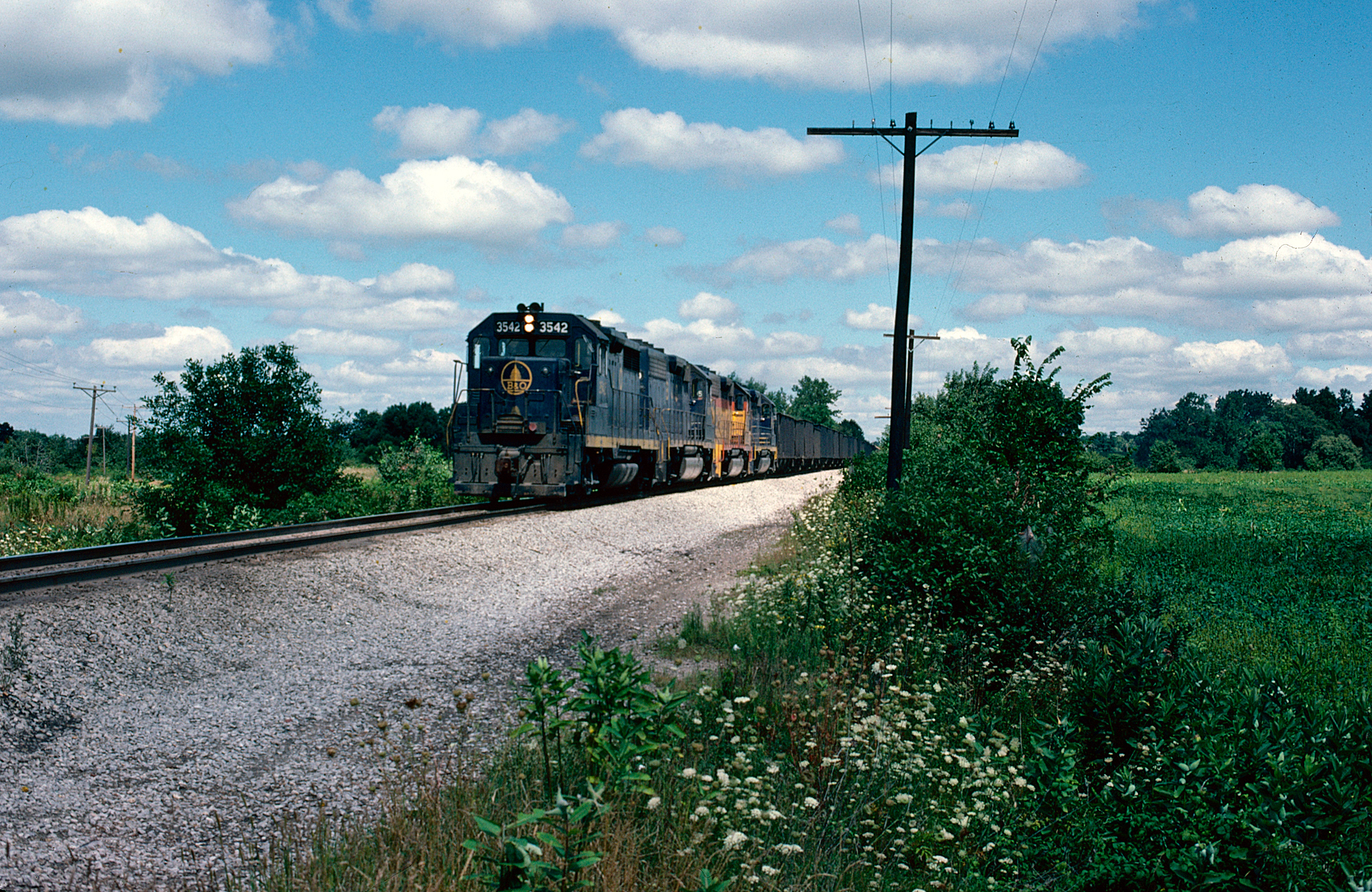
Baltimore & Ohio Geeps, led by GP35 #3542, southbound near Chippewa Lake, Ohio, on the CL&W Subdivision (Cleveland, Lorain & Wheeling), August 20, 1978. American-Rails.com collection.
The 1980s were hard on the old map. In 1985, just as double-stack containers were becoming the intermodal standard, CSX moved to cut the St. Louis main between Clarksburg and Parkersburg—the Parkersburg Branch—and much of the Ohio Division. When the container business took off, CSX lacked a short St. Louis–East Coast route of its own until Conrail pieces arrived in 1999. The abandoned right-of-way is still argued about. Upgraded for stacks it would have been the shortest haul between the St. Louis gateway and the Atlantic.

A pair of Chessie System/B&O GP40-2s lead an eastbound hotshot Philadelphia Trailerjet along the St. Louis main near Porterfield, Ohio, in June 1981. The right-of-way is empty today. Author’s collection.
What remains
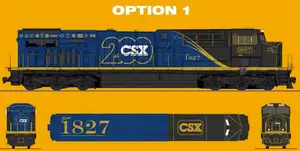
CSX still runs the original Baltimore–Cumberland mountain main, Sand Patch, the Chicago line through Willard, and pieces of the Ohio River and northern West Virginia coal web. The Belt is an urban artery. Ellicott City station is a museum. Mount Clare is the B&O Railroad Museum. MARC uses the old Washington Branch and the Metropolitan Branch. Amtrak’s Floridian covers the former Capitol Limited path east of Chicago. In May 2023 CSX painted ES44AH 1827 in a B&O-inspired blue and gray, the charter year on the cab.
Mike Schafer, in Classic American Railroads, wrote the sentence that still fits: the B&O was never a healthy and extremely profitable railroad, and it is remembered for its pioneer spirit, determination in the face of adversity, innovative technology, superior service, courteous employees, and aesthetic equipment.
Related reading on American-Rails.com
- B&O steam roster (post-1900) · B&O diesel roster · B&O passenger trains
- Tom Thumb · Capitol Limited · National Limited · Royal Blue
- Columbian · Cincinnatian · Shenandoah
- Steam classes: E 2-8-0 · EL 2-8-8-0 · EM-1 2-8-8-4 · KB-1 2-6-6-4 · KK 2-6-6-2 · KL-1 2-6-8-0 · LL-1 0-8-8-0 · N-1 4-4-4-4 · P 4-6-2 · Q 2-8-2 · T 4-8-2 · V 4-6-4 · S 2-10-2
- B&O Chicago Terminal · Alton Railroad · Western Maryland
- Chesapeake & Ohio · Chessie System · CSX
- Pennsylvania Railroad · The Great Strike of 1877 · Railroads in the 1820s and 1830s
Sources
- Reynolds, Kirk, and David Oroszi. Baltimore & Ohio Railroad. Osceola, Wis.: MBI, 2000. Company narrative, subsidiaries, C&O years
- Reizenstein, Milton. The Economic History of the Baltimore and Ohio Railroad, 1827–1853. Baltimore, 1921. Chronology: charter February 28, 1827; cornerstone July 4, 1828; Ellicott’s Mills; Harpers Ferry December 1, 1834; Cumberland November 5, 1842; last spike December 24, 1852; first Wheeling train January 1, 1853
- Baltimore & Ohio Railroad Historical Society. Company history summary. First common carrier; Chicago Junction/Willard; 1874 Chicago line; Metropolitan Branch 1873
- Harwood, Herbert H., Jr. Royal Blue Line. The Baltimore–Philadelphia–Jersey City passenger route
- Schafer, Mike. Classic American Railroads. Osceola, Wis.: MBI, 1996. Character of the company
- Welsh, Joe. Baltimore & Ohio’s Capitol Limited and National Limited. St. Paul: MBI, 2007
- Solomon, Brian. Amtrak. Dining-car reputation. Electro-Motive E Units and F Units. Minneapolis: Voyageur Press, 2011
- Trains Magazine CSX merger family tree. Chessie System, Inc., February 26 / June 15, 1973; WM into B&O May 1, 1983; B&O into C&O April 30, 1987; C&O into CSXT August 31, 1987
- Baltimore Belt: B&O Official List No. 29, January 1, 1948 (7.2 miles Bay View–Hamburg Street; four miles electrified). July 1, 1895 public electric service
- Baltimore, Pittsburgh & Chicago / B&O&C: operations November 23, 1874 (borail.net timeline; B&O Historical Society)
- Live American-Rails Tom Thumb, passenger-train, steam-class, diesel-roster, Chessie, C&O, CSX, Alton, and 1877 pages as linked above
Recent Articles


-
Cranberry Grade (B&O): Map, Operation, History
Nov 24, 26 11:49 PM
 Cranberry Grade is the Baltimore & Ohio climb from Rowlesburg and M&K Junction to Terra Alta. Piedmont opened July 21, 1851. Fairmont opened June 22, 1852.
-
Saluda Railroad Grade (NC): Map, History, Trail
Nov 24, 26 11:45 PM
 Saluda Grade, the Asheville and Spartanburg climb at Saluda, North Carolina. First train July 4, 1878. The 1987 marker gives 4.7 feet in every 100. Trail purchase completed June 17, 2025.
-
Hell Gate Bridge: Facts, Height, Construction, Images
Nov 24, 26 10:31 PM
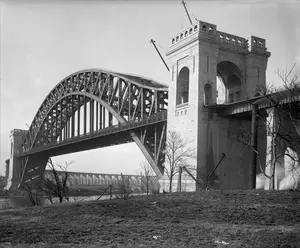
 Hell Gate Bridge, Gustav Lindenthal’s four-track arch from Astoria to Wards Island. The arch was completed in September 1916. Samuel Rea dedicated it on March 9, 1917.
-
Sherman Hill, Tackling Wyoming's Black Hills
Nov 24, 26 09:48 PM
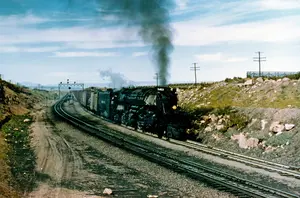
 Sherman Hill, the Union Pacific climb from Cheyenne to Laramie. The 1868 summit, the 1901 tunnel line, and the westbound line opened in 1953.
-
Cascade Tunnel (Washington): Map, Avalanche, Ventilation
Nov 24, 26 03:01 PM
 Cascade Tunnel at Stevens Pass, Scenic to Berne. The 1900 bore and the tunnel opened January 12, 1929. Wellington, the wires that came down in 1956, and the railroad that still uses it.
-
Moffat Tunnel (Colorado): Ventilation, Length, Facts, Map
Nov 24, 26 01:31 PM
 Moffat Tunnel under James Peak, about 50 miles west of Denver. The Commission bore, holed through July 7, 1927, and opened February 26, 1928. More than six miles, at about 9,200 feet, and still a Unio…
-
B&O's Thomas Viaduct (Bridge): History and Photos
Nov 24, 26 01:26 PM
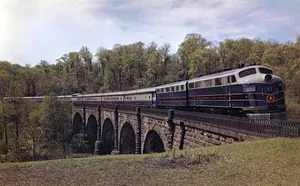
 Thomas Viaduct at Relay, Maryland. Eight stone arches of the Baltimore & Ohio Washington Branch over the Patapsco, finished July 4, 1835. Latrobe, McCartney, and the railroad that still crosses.
-
Cookeville Depot Caboose Gets a State Grant
Nov 24, 26 01:01 PM
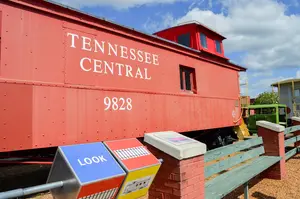
 The Friends of the Cookeville Depot Museum received a $12,000 Tennessee grant to restore the Tennessee Central caboose. The car has been closed to visitors since the COVID pandemic.
-
CSX Opens a Vote on Four CSX 200 Paint Schemes
Nov 24, 26 12:41 PM
 CSX recently posted four paint schemes for a CSX 200 locomotive and will take votes fronm the public through November 25.
-
Reading & Northern Schedules 2102 for Wilkes-Barre
Nov 24, 26 12:33 PM
 Times Leader reported on November 23, 2026, that Reading and Northern signed the Luzerne County rail purchase and scheduled steam locomotive 2102 for a Wilkes-Barre display on November 24.
-
Great Northern 1355 Cab Comes Off in Sioux City
Nov 24, 26 11:38 AM
On November 19, 2026, crews lifted the cab off Great Northern 1355 at the Sioux City Railroad Museum. The project manager estimates test runs sometime in 2029. -
Norwood & St. Lawrence 210 Arrives in Madrid
Nov 24, 26 11:35 AM
WWNY reported on November 20, 2026, that Norwood and St. Lawrence locomotive 210 arrived at the St. Lawrence Power and Equipment Museum in Madrid, New York -
Huntsville Depot Vote on Railroad Equipment Is Delayed
Nov 24, 26 11:31 AM
On November 19, 2026, the Huntsville City Council postponed a vote on moving 12 pieces of railroad equipment off the Huntsville Depot. The next date is December 3. -
CNJ Train Shed Work Is Underway at Liberty State Park
Nov 24, 26 11:29 AM
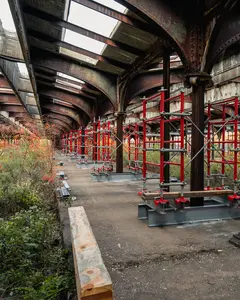
 Railfan and Railroad reported on November 17, 2026, that New Jersey is installing temporary supports on the 1914 Central Railroad of New Jersey train shed in Jersey City.
-
Starrucca Viaduct: Completed By The NY&E (1848)
Nov 24, 26 11:06 AM
 Starrucca Viaduct at Lanesboro, Pennsylvania. Stone arches of the New York & Erie, 1,040 feet, first locomotive December 9, 1848. Adams, Kirkwood, and the railroad that still crosses.
-
Hoosac Tunnel (Massachusetts): Map, Length, Location, History
Nov 23, 26 11:59 PM
 Hoosac Tunnel, Florida to North Adams, Massachusetts. 25,081 feet. First train February 9, 1875. Haupt, the Shanlys, 1911 electrification, and Berkshire & Eastern freight today.
-
Tehachapi Loop Grade: Map, Passenger Trains, History
Nov 23, 26 11:47 PM
 Tehachapi Loop, at Walong in Kern County. William Hood, opened 1876. The 77-foot spiral, Santa Fe trackage rights, and Union Pacific and BNSF service today.
-
Horseshoe Curve (Pennsylvania): Map, Photos, History, Operation
Nov 23, 26 11:37 PM
 Horseshoe Curve, west of Altoona. Thomson and Haupt, opened February 15, 1854. Grades, Gallitzin tunnels, helpers, and Norfolk Southern service today.
-
John I. Blair: Net Worth, Railroads, Biography
Nov 23, 26 10:41 PM
 John Insley Blair was born August 22, 1802, in Warren County, New Jersey. He helped build the road that became the Delaware, Lackawanna and Western, and he took an interest in the Cedar Rapids and Mis…
-
Russell Sage: Net Worth, Railroads, Biography
Nov 23, 26 10:33 PM
 Russell Sage was born August 4, 1816. The Congressional biography says Shenandoah, Oneida County, New York. Britannica says Verona. He died July 22, 1906. Britannica estimates the fortune at $70 milli…
-
Henry E. Huntington: Net Worth, Railroads, Biography
Nov 23, 26 09:04 PM
 Henry Edwards Huntington was born February 27, 1850, in Oneonta, New York. He developed the Pacific Electric in Los Angeles and founded the Huntington Library. He died May 23, 1927. The estate tax ret…
-
William A. Clark: Net Worth, Railroads, Biography
Nov 23, 26 04:31 PM
 William Andrews Clark was born January 8, 1839, near Connellsville, Pennsylvania. He was a senator from Montana and a builder of the San Pedro, Los Angeles and Salt Lake Railroad. He died March 2, 192…
-
"Train Of Tomorrow" (General Motors): A 1947 Concept
Nov 23, 26 04:08 PM
 General Motors Train of Tomorrow, 1947. E7A 765 and four Pullman-Standard Astra Dome cars, the 1947-1949 tour, the 1950 Union Pacific purchase, Portland-Seattle trains 457 and 458, and Moon Glow.
-
William B. Ogden: Net Worth, Railroads, Biography
Nov 23, 26 03:09 PM
 William Butler Ogden was born June 15, 1805, in Walton, New York. He was the first mayor of Chicago and a president of the Chicago and North Western and the Union Pacific. He died August 3, 1877.
-
CPKC Holiday Train Stops at Kansas City Union Station
Nov 23, 26 02:54 PM
 The CPKC Holiday Train is scheduled at Kansas City Union Station on November 27, 2026, from 6 to 6:45 p.m. Blue Springs is a first-time stop.
-
Hartford Line Adds Trains for Thanksgiving Week
Nov 23, 26 02:02 PM
 CTDOT is adding Hartford Line trains on November 24, 25, and 29, 2026. Thanksgiving Day is a Saturday schedule in the department release.
-
Asa Packer: Net Worth, Lehigh Valley Railroad, Biography
Nov 23, 26 01:51 PM
 Asa Packer was born December 29, 1805, in Mystic, Connecticut. He built the Lehigh Valley Railroad, served in Congress, and founded Lehigh University. He died May 17, 1879, in Philadelphia.
-
Steamtown Lists Moscow Holiday Express Trips
Nov 23, 26 01:41 PM
 Steamtown lists Holiday Express trips to Moscow on November 27, 28, and 29, 2026. The plan page says 11 a.m. to 2 p.m. Recreation.gov says 11 a.m. to 2:30 p.m.
-
Indiana Rail Experience Lists the Reindeer Run
Nov 23, 26 01:27 PM
 The Reindeer Run is a new one-hour Christmas train on November 27, 28, and 29, 2026, from Edon, Hudson, and South Milford. Coach starts at $17 and $30.
-
Sunset Limited Derails in Louisiana After Hitting a Truck
Nov 23, 26 08:59 AM
The eastbound Sunset Limited struck a truck hauling a bulldozer at a Broussard crossing on Sunday evening, November 22, 2026. Amtrak said 95 customers were aboard and that the passenger cars stayed up… -
David H. Moffat: Net Worth, Railroads, Biography
Nov 23, 26 12:24 AM
 David H. Moffat was born July 23, 1839, in Washingtonville, New York. He led the First National Bank of Denver and built the Moffat Road toward Salt Lake City. He died March 18, 1911.
-
William Jackson Palmer: Net Worth, Railroads, Biography
Nov 23, 26 12:15 AM
 William Jackson Palmer was born September 17, 1836, in Leipsic, Delaware. He built the Denver & Rio Grande and founded Colorado Springs. He died March 13, 1909.
-
Thomas C. Durant: Net Worth, Railroads, Biography
Nov 23, 26 12:00 AM
Thomas Clark Durant was born February 6, 1820, in Lee, Massachusetts. Vice president of the Union Pacific, he organized the Credit Mobilier. He died in 1885. -
Henry H. Rogers: Net Worth, Railroads, Biography
Nov 22, 26 11:54 PM
 Henry Huttleston Rogers, born January 29, 1840, was a Standard Oil vice-president who built the Virginian Railway. He died in New York on May 19, 1909.
-
Van Sweringen Brothers: Net Worth, Railroads, Biography
Nov 22, 26 11:38 PM
 Oris Paxton Van Sweringen, born April 24, 1879, near Wooster, Ohio, and Mantis James Van Sweringen, born July 8, 1881, developed Shaker Heights and a railroad system around the Nickel Plate. Oris died…
-
Alfred E. Perlman: President, Railroads, Biography
Nov 22, 26 12:33 AM
 Alfred Edward Perlman, born November 22, 1902, in St. Paul, was executive vice president of the Denver and Rio Grande Western, president of the New York Central, and president of the Western Pacific.
-
Patrick B. McGinnis: Net Worth, Railroads, Biography
Nov 22, 26 12:04 AM
 Patrick Benedict McGinnis, born May 23, 1904, in Palmyra, New York, chaired the Norfolk Southern and the Central of Georgia and presided over the New Haven and the Boston and Maine.
-
George Westinghouse: Net Worth, Air Brake, Biography
Nov 21, 26 11:35 PM
George Westinghouse was born at Central Bridge on October 6, 1846. He died in New York on March 12, 1914. He built the air brake the railroads came to use. -
NYC's "Xplorer" (Train): Concept, Consist, Photos
Nov 21, 26 11:31 PM
New York Central Xplorer, the Ohio Xplorer, Cleveland to Cincinnati in 1956. Pullman-Standard Train X cars, Baldwin-Lima-Hamilton locomotive 20, trains 423 and 424, timetable, consist, and photographs… -
Frisco Diesel Roster (All-Time)
Nov 21, 26 10:27 PM
 St. Louis-San Francisco diesel locomotives, each frame once. From VO-1000 No. 200 in 1941 through the GP40-2s and SD38-2s of 1979.
-
Frisco Steam Roster (Built Since 1900)
Nov 21, 26 10:18 PM
 St. Louis-San Francisco steam locomotives built since 1900. Mikados, Mountains, and twenty-five 4-8-4s.
-
Robert R. Young: Net Worth, Railroads, Biography
Nov 21, 26 09:47 PM
 Robert Ralph Young, born February 14, 1897, in Canadian, Texas, chaired the Chesapeake and Ohio and, in 1954, the New York Central. He died on January 25, 1958, in Palm Beach.
-
St. Louis-San Francisco Railway (Frisco): Map, Rosters, History
Nov 21, 26 06:37 PM
 History of the St. Louis-San Francisco Railway, the Frisco. The Pacific Railroad, the coonskin, Yoakum, Pensacola, and the Burlington Northern merger of November 21, 1980. Steam and diesel rosters are…
-
Kuhn, Loeb and Company: Net Worth, Railroads, History
Nov 21, 26 01:34 PM
 Kuhn, Loeb and Company was the New York banking house in E. H. Harriman's circle. Abraham Kuhn and Solomon Loeb opened the banking partnership in 1867. Jacob H. Schiff joined on January 1, 1875.
-
Otto Kahn: Net Worth, Railroads, Biography
Nov 21, 26 01:22 PM
Otto Hermann Kahn was born in Mannheim on February 21, 1867. He died in New York on March 29, 1934. He was the Kuhn, Loeb partner in E. H. Harriman's railroad work. -
George Pullman: Net Worth, Palace Cars, Biography
Nov 21, 26 11:01 AM
 George M. Pullman was born at Brocton on March 3, 1831. He died in Chicago on October 19, 1897. He built the palace-car company that owned the sleeping cars.
-
Arthur E. Stilwell: Net Worth, Railroads, Biography
Nov 21, 26 12:33 AM
Arthur E. Stilwell was born in Rochester on October 21, 1859. He died in New York on September 26, 1928. He built the road to Port Arthur and the Kansas City, Mexico and Orient. -
Frederick Weyerhaeuser: Net Worth, Railroads, Biography
Nov 21, 26 12:22 AM
 Frederick Weyerhaeuser was born at Niedersaulheim on November 21, 1834. He died at Pasadena on April 4, 1914. He was a lumberman and a railroad director.
-
John Murray Forbes: Net Worth, CB&Q, Biography
Nov 21, 26 12:13 AM
 John Murray Forbes was born at Bordeaux on February 23, 1813. He died at Milton on October 12, 1898. He was chairman of the Chicago, Burlington and Quincy.
-
Henry B. Plant: Net Worth, Plant System, Biography
Nov 20, 26 10:27 PM
 Henry Bradley Plant was born at Branford, Connecticut, on October 27, 1819. He died at his home on Fifth Avenue on June 23, 1899. He was president of the Plant system and of the Southern Express Compa…