Grif Teller: Biography, PRR Calendar Art & Legacy
Last revised: September 5, 2026
By: Adam Burns
Griffith Harold “Grif” Teller (December 9, 1899 – April 8, 1993) never drew a Pennsylvania Railroad paycheck. He worked for the Osborne Company, a Newark calendar house, and later as a freelancer. From the 1928 wall calendar through 1942, and again from 1947 through 1958, he painted the oil that went on the Pennsy’s big calendars—27 of the 33 scenes in the 1925–1958 series. Hundreds of thousands of copies went out each year to shippers, passengers, and anyone the railroad wanted to remember it. For a generation that is how the public saw the Pennsylvania Railroad: K4s at dawn, GG1s at the Army–Navy game, Horseshoe Curve in oil.
He got the job overnight. In 1927 another Osborne artist had not produced a sketch for a morning meeting with the railroad. Teller painted through the night. The result, When the Broad Way Meets the Dawn, became the 1928 calendar and kept the account. He signed early work Griffith H. Teller. His boss, Tom Graham, told him Grif would stick. It did.
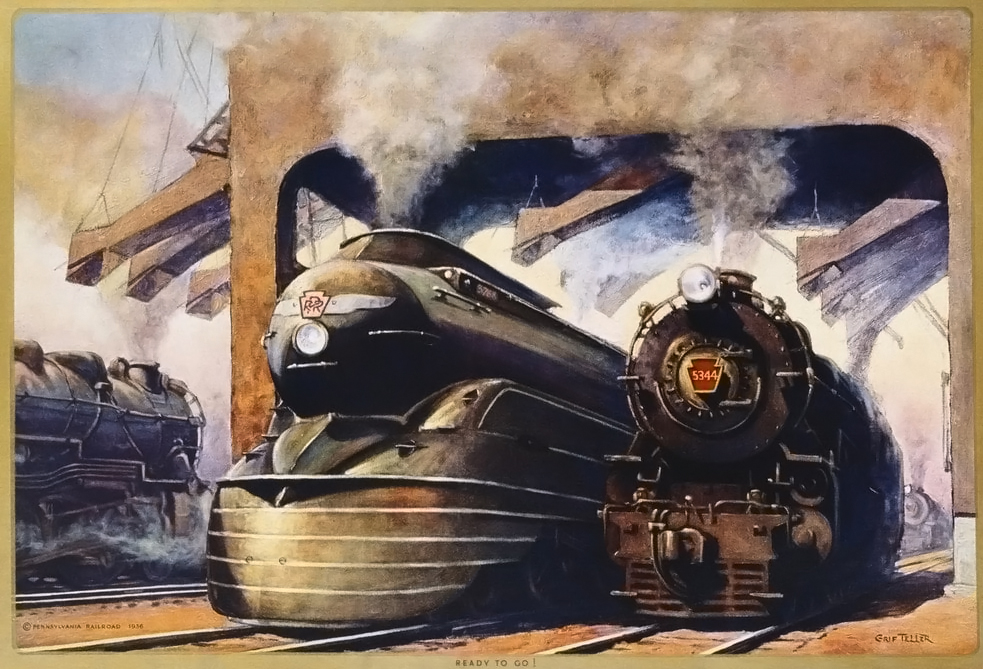
Ready to Go. Grif Teller. Pennsylvania K4s #3768, in Raymond Loewy streamlining applied in 1936 for the Broadway Limited, with K4s #5344. American-Rails.com collection.
On this page: At a glance · Newark and Osborne · 1928: the overnight painting · The wall calendars · War years and the return · Four paintings on this page · How he worked · After the calendars · Why he matters · Related reading · Sources
At a glance
| Item | Detail |
|---|---|
| Name | Griffith Harold Teller. Signed Grif Teller on the PRR work |
| Born / died | December 9, 1899, Newark, N.J. — April 8, 1993, Westfield, N.J. (age 93). Buried Immaculate Conception Cemetery |
| Family | Parents Albert D. and Mary H. Teller. Wife Mabel (Osborne coworker). Children Robert, John, and Ruth. Long resident of Little Falls, N.J. |
| Training | Aunt Evelyn Ryerson French (early lessons). Fawcett School of Industrial Arts / Newark School of Fine and Industrial Arts. Art Students League, New York. Landscape study with John F. Carlson in the 1930s |
| Employer | Osborne Company (calendar and advertising art), Newark then Clifton, N.J., from 1918 (shipping room, then design). Laid off after Osborne was sold in 1953. Freelance thereafter. Never a PRR employee |
| PRR wall calendars | Series 1925–1958, 33 oils. Teller painted 27: 1928–1942 and 1947–1958. Last full-size wall calendar 1958 (Conway Yard) |
| First PRR oil | When the Broad Way Meets the Dawn, 1928 calendar. Overnight substitute sketch, 1927, then the finished painting |
| War gap | 1943–44 Dean Cornwell; 1945 Alexander Leydenfrost; 1946 Frank Reilly. Patriotic scenes. Teller returned for 1947 (Working Partners) |
| Standard book | Dan Cupper, Crossroads of Commerce: The Pennsylvania Railroad Calendar Art of Grif Teller, photographs by Ken Murry (Great Eastern, 1992; Stackpole reprint 2003) |
The railroad, the curve, the GG1, and the Broadway are their own leaves. This page is the painter.
Newark, a lemonade stand, and Osborne
Teller was born in Newark on December 9, 1899, near the Erie Railroad’s Greenwood Lake branch. He and a brother ran a lemonade stand by the tracks. That is the origin story he told: he learned what a locomotive looked like before he learned what a client wanted. An aunt, Evelyn Ryerson French, gave him lessons at twelve or thirteen. Some of the first pictures went on the backs of shingles. He left Barringer High School as a junior for the Fawcett School of Industrial Arts, later the Newark School of Fine and Industrial Arts, and finished in 1918. He also studied at the Art Students League in New York.
That same year he took a temporary job in the shipping department of the Osborne Company, a color-calendar and advertising house. He showed paintings to the head of the designing department and stayed. Osborne printed the Pennsylvania’s first wall calendar in 1925. Teller was on the staff. He was not yet the railroad’s painter. Early non-PRR work he signed Griffith H. Teller. Tom Graham, who ran Osborne’s art department, told him to sign Grif.
1928: When the Broad Way Meets the Dawn
In mid-1927 the artist Osborne had assigned to the 1928 Pennsy calendar had not produced a preliminary the railroad would see the next morning. The account was at risk. Teller took the job on the condition that if the railroad liked the sketch he would paint the finish. He worked through the night. When the Broad Way Meets the Dawn shows the eastbound Broadway Limited coming out of the dark into morning on the overnight Chicago–New York run—Juniata Valley country in the usual telling. The railroad bought it. The 1928 calendar is the start of the Teller series. The original later went to the Railroad Museum of Pennsylvania in Strasburg. PennDOT used the image on a “Preserve Our Heritage” license plate beginning in 1998.
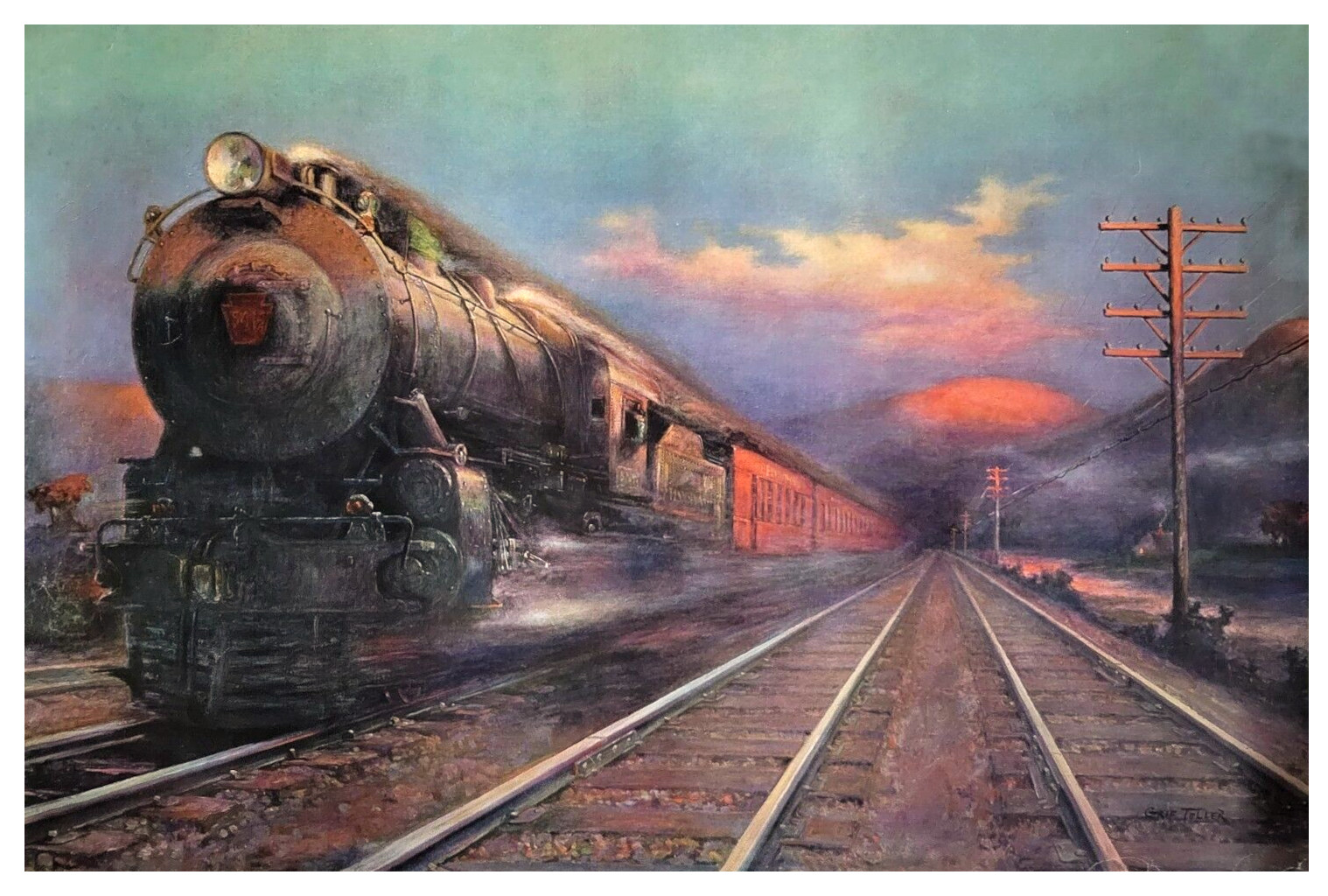
When the Broad Way Meets the Dawn. Grif Teller. 1928 Pennsylvania Railroad wall calendar: the pre-streamlined Broadway Limited. His first PRR calendar oil. American-Rails.com collection.
The Pennsylvania came back the next year. From 1929 through 1942 every wall-calendar oil is Teller. Titles from those years include Giant Conquerors of Space and Time (1931), The World’s Greatest Highway (1935, Horseshoe Curve), The Main Line of American Commerce (1938), Leaders of the Fleet of Modernism (1939), and The Steel King (1941). He painted the railroad at the peak of its power, on the main line, in places a shipper would recognize: Rockville Bridge, the Curve, the Philadelphia and Pittsburgh industrial edges. He was not inventing a fantasy Pennsy. He was selling the one that existed.
What the calendars were
The wall calendar was advertising, not a gallery print. Osborne printed it; the railroad handed it out by the hundreds of thousands. Cupper’s figure for the series is 33 oils from 1925 through 1958. Teller did 27. The picture also migrated onto timetables, matchbooks, playing cards, and magazine pages. A desk or a kitchen in the Northeast in 1938 could have a Teller hanging for twelve months whether the household owned a share of PRR stock or not.
He was a commercial landscape painter who had learned to put a locomotive in the landscape so it still read as a locomotive. That is a harder trick than a builder’s broadside. The calendars are why collectors still hunt the paper and why the oils, when they surface, bring railroad-art money. They are also why a biography of Teller is railroad history, not only art history. The Pennsy of the calendar is the Pennsy a large public remembered after the merger and the collapse.
1943–46, then 1947–58
In the war the railroad wanted patriotic pictures. Other Osborne (and contract) artists filled those years: Dean Cornwell 1943 and 1944, Alexander Leydenfrost 1945, Frank Reilly 1946. Teller’s last prewar calendar was 1942, Partners in National Defense. He returned for 1947, Working Partners—an EMD passenger diesel and a Q2 duplex in the same frame, which is the postwar Pennsy in one glance.
Osborne was sold to a competitor in 1953. Teller was laid off. The railroad kept him as a freelancer for the remaining wall calendars through 1958 (Conway Yard, the big classification plant west of Pittsburgh). Full-size wall calendars stopped after that. Pocket calendars used two more Teller scenes: 1960 Partners in Progress and a 1961 Zoo Tower view. Those are not the 28-inch wall sheets.
The four paintings on this page
The article here features four Teller oils. They are not a complete catalog. They are the ones on the site, and they span the job from the first calendar to the diesel-and-trailer 1950s.
Ready to Go. K4s 3768 in the 1936 Raymond Loewy casing for the Broadway Limited, with K4s 5344. 3768 is the streamlined Pacific everyone knows from publicity stills; 5344 is the unstreamlined running mate in the same picture. The live caption dated the canvas to 1936, the year of the Loewy casing. The 1936 wall calendar title in the standard lists is Speed-Safety-Comfort (electrified passenger at Claymont, Delaware). Treat Ready to Go as a Teller painting of those two K4s, not as a second name for the 1936 calendar sheet unless a catalogue raisonne says otherwise.
When the Broad Way Meets the Dawn (1928 calendar). First Teller PRR oil. Pre-streamlined Broadway Limited. The overnight save of the Osborne account.
Main Lines—Freight and Passenger (1949 calendar) is not on this page, but the older areas of this site once did and described it as a GG1 passing under a steam freight. The 1949 calendar scene is an electric-powered passenger train at Whitford, Pennsylvania, milepost 28. The GG1-and-steam sandwich belongs to a different picture. Crossroads of Commerce (1950) is three trains at the west end of Rockville Bridge, including J1 2-10-4 6444. The 1953 calendar reused the Crossroads of Commerce title for a main-line scene near Steubenville, Ohio.
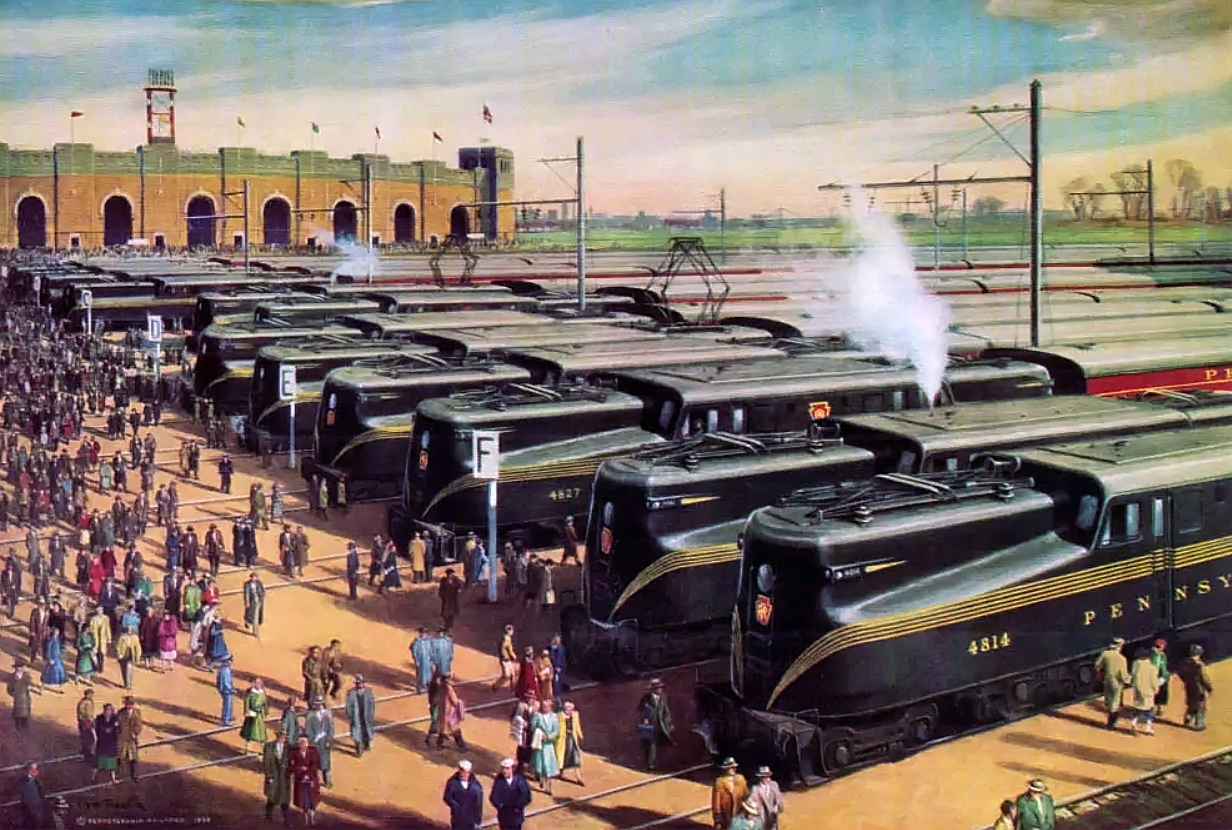
Mass Transportation. Grif Teller. 1955 Pennsylvania Railroad wall calendar. GG1s at Philadelphia’s Municipal Stadium for the Army–Navy game, a consist the railroad actually ran. American-Rails.com collection.
Mass Transportation (1955). A lineup of GG1s at Municipal Stadium (later JFK Stadium) in Philadelphia for the Army–Navy game. That was a real Pennsy assignment: extra sections, electric motors, a stadium the railroad could reach. Teller painted a traffic move, not a fantasy terminal.
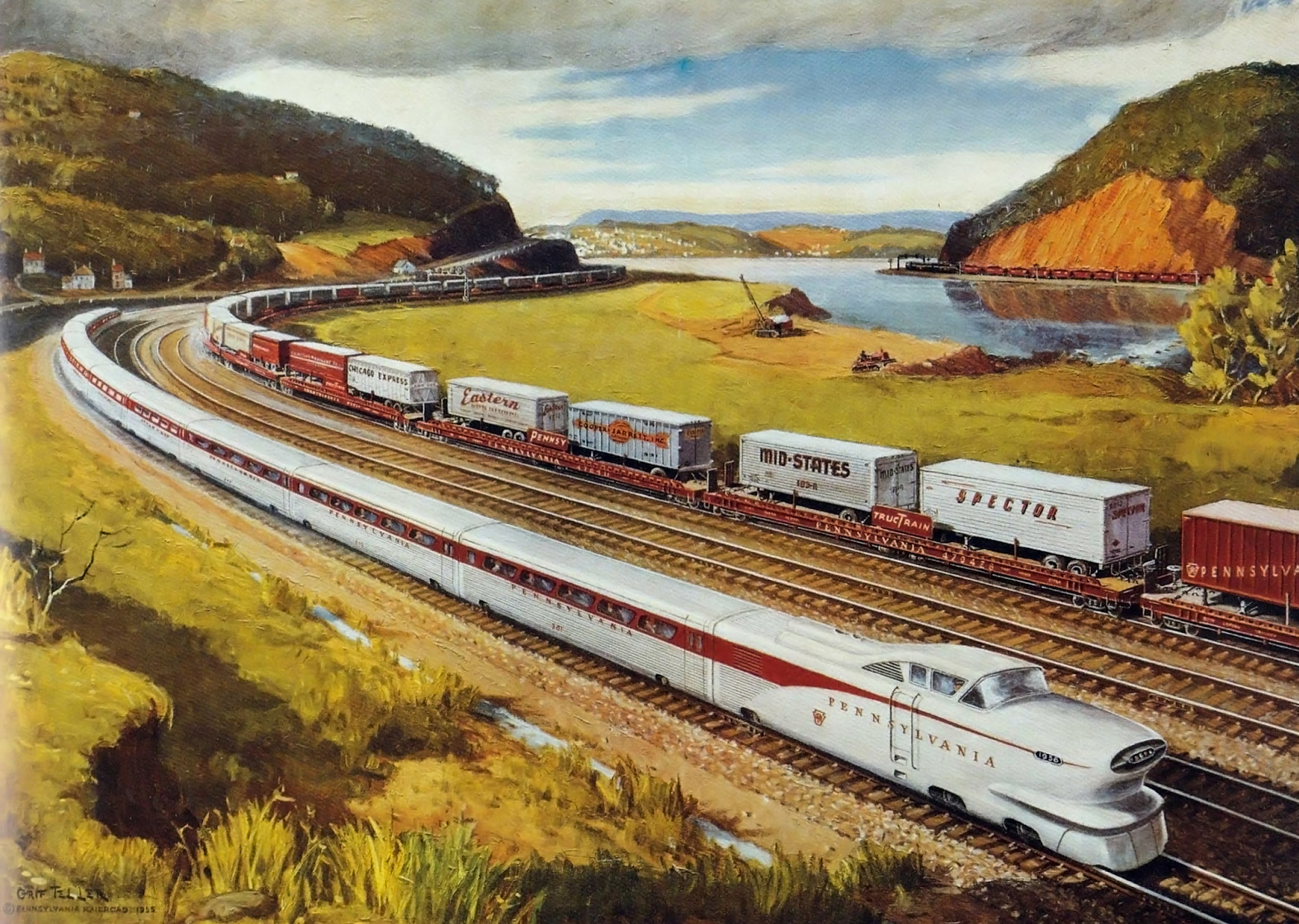
Dynamic Progress. Grif Teller. 1956 Pennsylvania Railroad wall calendar. GM’s Aerotrain, which the PRR tested and did not buy, and a TrucTrain of highway trailers on flats. American-Rails.com collection.
Dynamic Progress (1956). The calendar is selling a future the railroad was testing: GM’s Aerotrain and piggyback, which the Pennsy branded TrucTrain. The Aerotrain was a flop as a fleet. The trailers were not. Teller put both in one oil the year before the last two wall calendars. That is the late Pennsy talking to shippers, not a steam romantic looking backward.
Other Teller wall years worth knowing, even without a scan on this page: The Horseshoe Curve (1952, three trains on the curve—distinct from the 1935 World’s Greatest Highway, also at the curve); Working Partners (1947); Conway Yard (1958, last wall sheet).
How he worked
Teller went to the property. He stood at the Curve, at Rockville, at the stadium, at Conway. Dan Cupper’s line is that he was painter and historian: the pictures had to be accurate enough that a Pennsy official would hang them in an office. He studied with landscape painter John F. Carlson in the 1930s, which is a better influence to name than a vague Hudson River School. The locomotives are specific numbers when the oil is read closely. The geography is a real milepost. He was almost run down on the main once, studying a scene, when a GG1 came on and the engineer leaned on the whistle.
He married Mabel, who also worked at Osborne. They had three children. Little Falls, New Jersey, was home for much of his adult life. After the 1953 layoff he took other commercial work and freelance commissions and retired from that grind in 1968. Railroad fans had already found him.
Murry, Cupper, and Strasburg
Ken Murry, a Mountville, Pennsylvania, photographer, bought the 1953 Crossroads of Commerce original at a Philadelphia auction in 1976 and had Teller restore it. They became friends. Murry commissioned new oils, including Pride of the Pennsy, used on a 1980 tribute wall calendar for Teller’s eightieth birthday—same format as the 1940s–50s sheets, sold in a tube. Teller kept taking railroad commissions into the 1980s. More than fifty railroad paintings after the official calendars is the figure in Cupper’s circle.
Cupper’s Crossroads of Commerce, with Murry’s photographs of the art, is the book. Great Eastern Publishing, 1992; Stackpole reprint, 2003. The live page had the second author as “Ken Mury” and dated the book only 2003. Murry is the spelling on the title page. The Railroad Museum of Pennsylvania holds Teller originals, including the 1928 dawn painting. That museum is the place to see the work in person. Confirm what is on view before you go.
Why he matters to rail history
O. Winston Link documented the last Class I steam railroad at night, on film, for himself. Teller documented the largest American railroad at high tide, in oil, for a client that printed the picture a third of a million times. Different jobs. Same result: a visual memory that outlived the company.
- He was the Pennsy’s public painter for thirty years of wall calendars, with a four-year war gap. No other American railroad had a single artist that visible, that long, on that scale.
- He was not a railfan with a brush. He was a calendar-house commercial artist who learned the railroad well enough that the railroad kept him after his employer was sold.
- The pictures track the company. 1928 Broadway at dawn. 1936 streamlining. 1947 diesel and duplex. 1955 Army–Navy GG1s. 1956 Aerotrain and trailers. 1958 Conway Yard. That is a corporate history in oils.
- The paper survived the railroad. Penn Central did not. The calendars did. Collectors, the Strasburg museum, and Cupper’s book are why a 1950s kitchen print still defines “Pennsylvania Railroad” for people who never rode it.
Teller died April 8, 1993, at his son’s house in Westfield, New Jersey. He was 93.
Related Reading on American-Rails.com
- Pennsylvania Railroad
- PRR passenger trains (Broadway Limited and the fleet)
- PRR GG1
- Horseshoe Curve
- Railroad Museum of Pennsylvania
- Penn Central
- O. Winston Link (another artist who fixed how the public sees a railroad)
- Railroad history
- Railroad museums
Sources
- Dan Cupper, Crossroads of Commerce: The Pennsylvania Railroad Calendar Art of Grif Teller, photographs by Ken Murry (Great Eastern Publishing, 1992; Stackpole Books, 2003): 33 calendars 1925–1958, Teller 27 of them; life and career
- Dan Cupper, “Grif Teller Paints the Pennsy,” Pennsylvania Heritage: 1928–42 and 1947–58; Cornwell, Leydenfrost, Reilly in the war years; Carlson; Ken Murry from 1976; Pride of the Pennsy / 1980 tribute calendar
- Wikipedia, “Grif Teller”: December 9, 1899–April 8, 1993; Osborne; 1928 first calendar; war gap; 1953 layoff; freelance through the end of the wall series
- Philadelphia Inquirer, Rose Simmons, April 10, 1993, obituary: death at son’s home, Westfield; 1927 overnight sketch; Army–Navy, Rockville, Horseshoe, Edge Moor
- Baltimore Sun, April 18, 1993, review of Cupper: Greenwood Lake lemonade stand; 1928 When the Broad Way Meets the Dawn; Murry as photographer of the book (Sun’s 1925 start date is the series, not Teller’s first oil)
- Railroad Picture Archives / Thomas C. Ayers calendar-art album: year-by-year titles and locations (1949 Whitford; 1950 Rockville / J1 6444; 1952 Horseshoe Curve; 1953 Steubenville; 1955 Mass Transportation; 1956 Dynamic Progress; 1958 Conway Yard)
- Pennsylvania Historical and Museum Commission / Railroad Museum of Pennsylvania: 1928 painting; Teller holdings; PennDOT heritage plate
- Higbytoys PRR calendar-art list: 1935 Horseshoe as World’s Greatest Highway; 1936 Speed-Safety-Comfort at Claymont; 1949 Whitford
Teller oils at the Railroad Museum of Pennsylvania are original art. Confirm what is on exhibit before you plan a visit.
Recent Articles


-
Bessemer & Lake Erie Railroad: "The Bessemer Road"
Sep 15, 26 05:20 PM
 Bessemer & Lake Erie—Bear Creek 1865, Carnegie 1897, U.S. Steel 1901. Ore south from Conneaut, coal north. 2-10-4s, Missabe sister road. CN May 10, 2004. Complete corporate history.
 -
Bangor and Aroostook Railroad: "Serving Northern Maine"
Sep 15, 26 05:05 PM
 Bangor & Aroostook—chartered February 13, 1891, first trains January 1, 1894. Potatoes, paper, Searsport, State of Maine reefers. MM&A 2003, Lac-Mégantic 2013, CP 2020, CPKC today. Complete co…
 -
Baltimore & Ohio Chicago Terminal Railroad: Map and History
Sep 15, 26 03:11 PM
 B&OCT—formed January 6, 1910 to buy Chicago Terminal Transfer. Grand Central, Barr Yard, 78 route-miles. Assigned B&O steam. Complete diesel roster. CSX paper subsidiary, mark BOCT.
 -
The "Alphabet Route" (Railroad): Photos and History
Sep 15, 26 02:53 PM
 Alphabet Route—eight railroads, not one company. P&WV to Connellsville February 11, 1931. Alpha Jets Chicago/St. Louis–New York/Boston. NKP, W&LE, P&WV, WM, Reading, CNJ, L&HR, New Hav…
 -
Milwaukee Road Livestock Operations: Cattle, Dakotas & Montana
Sep 15, 26 02:36 PM
 Milwaukee Road livestock traffic—Dakota and Montana cattle, Iowa hogs, Chicago markets, 28-hour law, head-end stock cars. By 1974 mostly Montana. Rick Burn’s Helena speech. Operations history, not the…
 -
Spirit of Jasper Ride & Dine (2026): Season Pause
Sep 15, 26 02:29 PM
 Spirit of Jasper Ride & Dine in Jasper, Indiana—seated meal on board. Operator: not running public trains for 2026. Depot remains open as a rental. Confirm on spiritofjaspertrain.com.
 -
South Carolina Canal & Rail Road Company: Map and History
Sep 15, 26 01:59 PM
 South Carolina Canal & Rail Road—chartered December 19, 1827. Best Friend of Charleston, 136 miles Charleston–Hamburg October 1833, Aiken inclined plane. South Carolina Railroad 1844, Southern 189…
 -
The Practice of Double-Heading: The Steam Era
Sep 15, 26 01:43 PM
 Doubleheading—two locomotives on the point, each with its own steam crew. Not a rear helper, not diesel MU. How it worked, PRR 1877, mountain grades, and what MU ended.
 -
Mohawk and Hudson Railroad: Map, Pictures, Locomotives
Sep 15, 26 01:20 PM
 Mohawk & Hudson Railroad—New York’s first railroad, chartered April 17, 1826. DeWitt Clinton, inclined planes, Albany & Schenectady 1847, first New York Central May 17, 1853. Complete corporat…
 -
Essex Clipper Dinner Train (2026): Dates, Tickets & What to Expect
Sep 15, 26 01:09 PM
 2026 Essex Clipper Dinner Train in Essex, CT—2.5 hours, four-course meal $129.99, 18+. Fall dates through Oct. 25. Confirm on essexsteamtrain.com.
 -
Camden & Amboy Railroad: Map, History, Photos
Sep 15, 26 12:53 PM
 Camden & Amboy Railroad—chartered February 4, 1830. Joint Companies monopoly with the Delaware & Raritan Canal, John Bull, T-rail. United New Jersey 1872, PRR 999-year lease 1871. Complete corpora…
 -
Cafe Lafayette Dinner Train (2026): Dates, Tickets & What to Expect
Sep 15, 26 12:47 PM
2026 Cafe Lafayette Dinner Train in North Woodstock, NH—2 hours, 20 miles, five-course meal from $125. May–October. Confirm on nhdinnertrain.com. -
Christmas Train Ride Locations (2026): A Complete Guide
Sep 15, 26 10:47 AM
 2026 Christmas train rides by state—Santa, North Pole Express, and holiday trains. Not Polar Express. State guides and product pages. Confirm dates on each railroad.
 -
Baltimore & Ohio Railroad: Linking 13 Great States With The Nation
Sep 15, 26 10:22 AM
 Baltimore & Ohio Railroad—first U.S. common carrier, chartered February 28, 1827. Wheeling 1853, Chicago 1874, C&O control 1963, Chessie 1973, into CSX April 30, 1987. Complete corporate history.
 -
Delaware & Hudson Railway: The Bridge Line
Sep 15, 26 09:59 AM
 Delaware & Hudson Railway—Wurts brothers canal 1823, gravity railroad 1829, Stourbridge Lion, Bridge Line to Montreal. Guilford 1984, CP 1991, NS south line 2015, CPKC north.
 -
Delaware & Hudson Diesel Roster (All-Time)
Sep 15, 26 12:17 AM
 All-time Delaware & Hudson diesel roster—Alco S-2s through C-628s and PA-4s, GE U-boats, Baldwin RF-16s, EMD SD45s and GP38-2/GP39-2s. Serials, dates, dispositions.
 -
Granite Railway, Our Country's First Railroad
Sep 14, 26 11:28 PM
 Granite Railway of Quincy, Massachusetts—chartered March 4, 1826, opened October 7, 1826. Gridley Bryant, 5-foot gauge, horses, Bunker Hill Monument stone. First commercial U.S. railroad.
 -
Milwaukee Road Skytop Lounges: History, Specs & Floor Plans
Sep 14, 26 11:09 PM
 Milwaukee Road Skytop observation cars—Brooks Stevens, 1948. Four Rapids parlor-lounges from Milwaukee Shops, six Creek sleeper-lounges from Pullman-Standard. Floor plans, roster, preservation.
 -
West Virginia Christmas Train Rides (2026): A Complete Guide
Sep 14, 26 11:02 PM
2026 West Virginia Christmas trains—Potomac Eagle North Pole Express in Romney and Christmas at Cass. Not Polar Express. Elkins Polar is not listed for 2026. -
Railroads Of Today: Class I Map, PSR & the 2026 Industry
Sep 14, 26 10:30 PM
 U.S. freight rail in 2026—six Class I railroads on a nearly 140,000-mile network. PSR as everyday practice, how the STB works, traffic mix, short lines and regionals.
 -
Railroad History (USA): Timeline, Facts & How the Network Was Built
Sep 14, 26 10:03 PM
 Full U.S. railroad history hub—origins and inventors, Golden Age peak mileage, Civil War and transcontinental, streamliners, ICC regulation, Penn Central and Conrail, Staggers Act, PSR, and today’s Cl…
 -
Railroads In The 2020s: CPKC, East Palestine & the UP–NS Case
Sep 14, 26 09:51 PM
 U.S. railroads 2020–2026—Class I mileage 91,773 in 2020. COVID traffic drop, CPKC April 14 2023, East Palestine Feb. 3 2023, UP–NS $85 billion case still before the STB.
 -
Railroads In The 2010s: PSR, Coal’s Decline & Positive Train Control
Sep 14, 26 03:51 PM
 U.S. railroads 2010–2020—Class I mileage 95,573 to 91,773. Buffett closed BNSF Feb. 12 2010, Harrison at CP June 29 2012 and CSX 2017, PTC deadline Dec. 31 2018.
 -
Virginia Christmas Train Rides (2026): A Complete Guide
Sep 14, 26 03:46 PM
 2026 Virginia Christmas trains—Virginia Scenic Railway Santa Express from Staunton, about 60 minutes. Confirm dates. Not Polar Express.
 -
MARC Train: Maryland Commuter Rail History, Lines & Roster
Sep 14, 26 01:16 PM
 MARC Train history—Maryland Rail Commuter 1984, B&O and PRR corridors, Penn/Camden/Brunswick lines, Silver Spring 1996, all-time locomotive roster.
 -
Railroads In The 2000s: Merger Freeze, Wisconsin Central & Buffett
Sep 13, 26 07:57 AM
 U.S. railroads 2000–2010—Class I mileage 99,250 to 95,573. STB merger freeze March 17 2000, CN–WC Oct. 9 2001, BNSF Railway Jan. 24 2005, Buffett Nov. 3 2009.
 -
Railroads In The 1990s: Mega-Mergers, Conrail’s Split & the STB
Sep 13, 26 12:13 AM
 U.S. railroads 1990–2000—Class I mileage 119,758 to 99,250. BNSF Sept. 22 1995, UP–SP Sept. 11 1996, Conrail split June 1 1999, ICC Termination Dec. 29 1995.
 -
Railroads In The 1980s: Staggers, Mega-Mergers & Conrail’s IPO
Sep 12, 26 11:12 PM
 U.S. railroads 1980–1990—Class I mileage 164,822 to 119,758. Staggers Oct. 14 1980, CSX and Norfolk Southern, UP–Missouri Pacific–Western Pacific, Conrail IPO March 26 1987.
 -
Wabash Class O-1 4-8-4s: History, Roster & Specifications
Sep 12, 26 11:01 PM
 Wabash Class O-1 4-8-4s—Baldwin 1930–31, twenty-five engines 2900–2924. Fast freight, complete roster, specifications. None preserved.
 -
Staggers Rail Act of 1980: Statute, Contract Rates & the ICC
Sep 10, 26 11:23 PM
 Staggers Rail Act, Pub. L. 96-448, signed October 14, 1980. Harley Staggers, S.1946, contract rates, 180% variable-cost test, abandonments, short lines.
 -
Rock Island E8A 652: Bicentennial Independence Paint & History
Sep 10, 26 10:42 PM
 Rock Island E8A 652—EMD March 1952, serial 15199. 20th Century Railroad Club Independence bicentennial scheme, Peoria and Quad Cities Rockets, Midland Railway, Manly Junction Museum.
 -
Vermont Christmas Train Rides (2026): A Complete Guide
Sep 10, 26 10:37 PM
2026 Vermont Christmas trains—Okemo Valley Holiday Express from Chester Depot Dec. 19–20. Polar is Burlington Dec. 5–6 only. -
Railroads In The 1970s: Penn Central, Amtrak & Conrail
Sep 10, 26 10:18 AM
 U.S. railroads 1970–1980—196,479 miles at the decade’s start. Penn Central bankruptcy June 21 1970, Amtrak May 1 1971, 3R/4R Acts, Conrail April 1 1976, Rock Island 1975, Milwaukee 1977.
 -
Railroads In The 1960s: Mergers, Passenger Collapse & Penn Central
Sep 10, 26 10:03 AM
 U.S. railroads 1960–1970—207,334 to 196,479 miles. Erie Lackawanna 1960, C&O–B&O 1963, N&W–Nickel Plate 1964, SCL 1967, Penn Central Feb. 1 1968.
 -
South Carolina Christmas Train Rides (2026): A Complete Guide
Sep 10, 26 08:36 AM
 2026 South Carolina Christmas trains—South Carolina Railroad Museum Santa Train in Winnsboro. Confirm December dates. Not Polar Express. Drop light-festival padding.
 -
Steam Locomotive Feedwater Heaters: Elesco, Coffin & Worthington
Sep 10, 26 08:29 AM
 Steam locomotive feedwater heaters—open Worthington vs closed Elesco and Coffin. How they work, how to identify them on a smokebox, and why not every engine had one.
 -
Oregon Christmas Train Rides (2026): A Complete Guide
Sep 10, 26 08:22 AM
2026 Oregon Christmas trains—Portland Holiday Express, Garibaldi Candy Cane Express, Sumpter Valley Christmas Trains Dec. 11–13. Polar is Mount Hood. -
Lake Shore & Michigan Southern: Map, History, Timetables
Sep 10, 26 08:12 AM
 Lake Shore & Michigan Southern Railway—Erie & Kalamazoo 1833, Michigan Southern to Chicago 1852, LS&MS April 6 1869, Vanderbilt, Ashtabula 1876, NYC merger Dec. 22 1914. 1910 map and Official Guide.
 -
Big Four Route (CCC&StL): Map, History
Sep 10, 26 12:19 AM
Cleveland, Cincinnati, Chicago & St. Louis Railway—Bee Line 1868, Ingalls’s first Big Four 1880, CCC&StL June 30, 1889, NYC lease Feb. 1, 1930. 1910 and 1930 maps, what still runs. -
Railroads In The 1950s: Diesel, the Interstate & Passenger Collapse
Sep 10, 26 12:15 AM
 U.S. railroads 1950–1960—223,779 to 211,459 miles. Interstate June 29, 1956, dieselization, passenger collapse, TOFC, 1957–58 recession, NYO&W 1957, N&W–Virginian 1959.
 -
New Jersey Christmas Train Rides (2026): A Complete Guide
Sep 10, 26 12:06 AM
 2026 New Jersey Christmas trains—Black River & Western Santa Express from Flemington and Pine Creek Christmas trains in Wall Township. Polar is Whippany and Phillipsburg.
 -
New Mexico Christmas Train Rides (2026): A Complete Guide
Sep 09, 26 11:57 PM
 2026 New Mexico Christmas trains—Cumbres & Toltec Santa’s Holiday Express from Chama Dec. 5–6 (and Antonito, Colo., Dec. 12–13). Coach $25/$15. Not Polar Express.
 -
Grand Trunk Railway: Map, History, Timetables
Sep 09, 26 11:47 PM
 Grand Trunk Railway of Canada—charter Nov. 10, 1852, Montreal–Toronto 1856, Portland, Sarnia, Victoria Bridge, St. Clair Tunnel 1891, Great Western 1882, GTPR, CN Jan. 20, 1923. 1893 map and Official…
 -
Troop Trains In World War II: Sleepers, Kitchen Cars & Movements
Sep 09, 26 11:42 PM
 WWII U.S. troop trains—almost 44 million armed-services passengers, Pullman troop sleepers, ACF kitchen cars, hospital trains, monthly movement tables 1942–45. Not the Military Railway Service. ODT an…
 -
Railroads In The 1940s: War Traffic, Last Steam & the Diesel Flood
Sep 09, 26 11:37 PM
 U.S. railroads 1940–1950—233,670 to 223,779 miles. World War II as the decade’s center, last new steam, diesel flood after V-J Day, 1945 car orders, California Zephyr 1949.
 -
Railroads In World War II: ODT, Record Traffic & Private Operation
Sep 09, 26 03:00 PM
 U.S. railroads in World War II—Lend-Lease freight, Pearl Harbor, Office of Defense Transportation, 1944 peak ~740 billion ton-miles, Dec. 1943–Jan. 1944 seizure. Private operation, not a USRA sequel.
 -
Montana Christmas Train Rides (2026): A Complete Guide
Sep 09, 26 02:54 PM
2026 Montana Christmas trains—Charlie Russell Chew Choo North Pole Adventure from Hanover/Lewistown, Nov. 27–Dec. 19, $71, about 1.5 hours. Not Polar Express. -
Railroads In The 1930s: Depression, Streamliners & the FT
Sep 09, 26 09:32 AM
 U.S. railroads 1930–1940—249,052 to 233,670 miles. Section 77, Eastman, Motor Carrier Act, M-10000 and Pioneer Zephyr 1934, EMC FT 1939. Decade frame, not the streamliner encyclopedia.
 -
Sugar Cane Train (Lahaina): LK&P History, Roster & 2026 End
Sep 09, 26 08:19 AM
 Lahaina, Kaanapali & Pacific Sugar Cane Train—3-foot tourist line 1970–2014. Anaka, Myrtle, 2023 and 2025 fires, September 2026 scrapping. Roster, Hahakea trestle, Pioneer Mill corridor.
 -
Massachusetts Christmas Train Rides (2026): A Complete Guide
Sep 09, 26 08:16 AM
 2026 Massachusetts Christmas trains—Shelburne Falls Moonlight Magic Friday Nov. 27; Edaville Festival of Lights in Carver. Polar is Cape Cod Central in Buzzards Bay.