Passenger Trains of the Pennsylvania Railroad: From the Paoli Local to the Broadway Limited
Published: April 22, 2026
By: Adam Burns
The Pennsylvania Railroad—affectionately known as the Pennsy or PRR—was America’s preeminent passenger carrier for much of the 19th and 20th centuries. In the densely populated Northeast and industrial Midwest, it moved more people than almost any other railroad. At its peak before the Great Depression, the PRR carried roughly 20 percent of all U.S. rail passengers. Its network was an “incomprehensible” web of intercity, long-distance, overnight, commuter, and suburban trains that connected New York, Philadelphia, Washington, Pittsburgh, Chicago, St. Louis, Detroit, Cleveland, Cincinnati, and scores of smaller cities. From humble 1848 coaches to the all-Pullman Broadway Limited, the Pennsy’s passenger service epitomized speed, luxury, frequency, and sheer volume. Even after the railroad itself vanished into Penn Central in 1968 and Amtrak in 1971, echoes of its commuter and intercity operations survive on the Northeast Corridor and Keystone routes today.
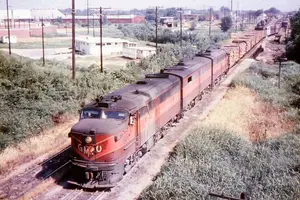
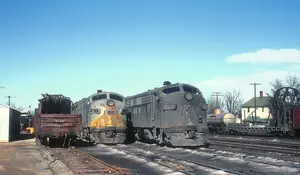
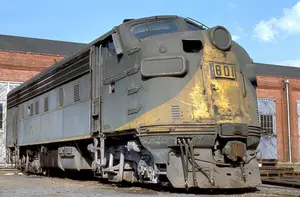
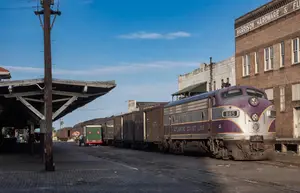
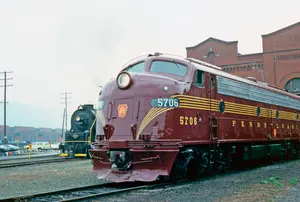
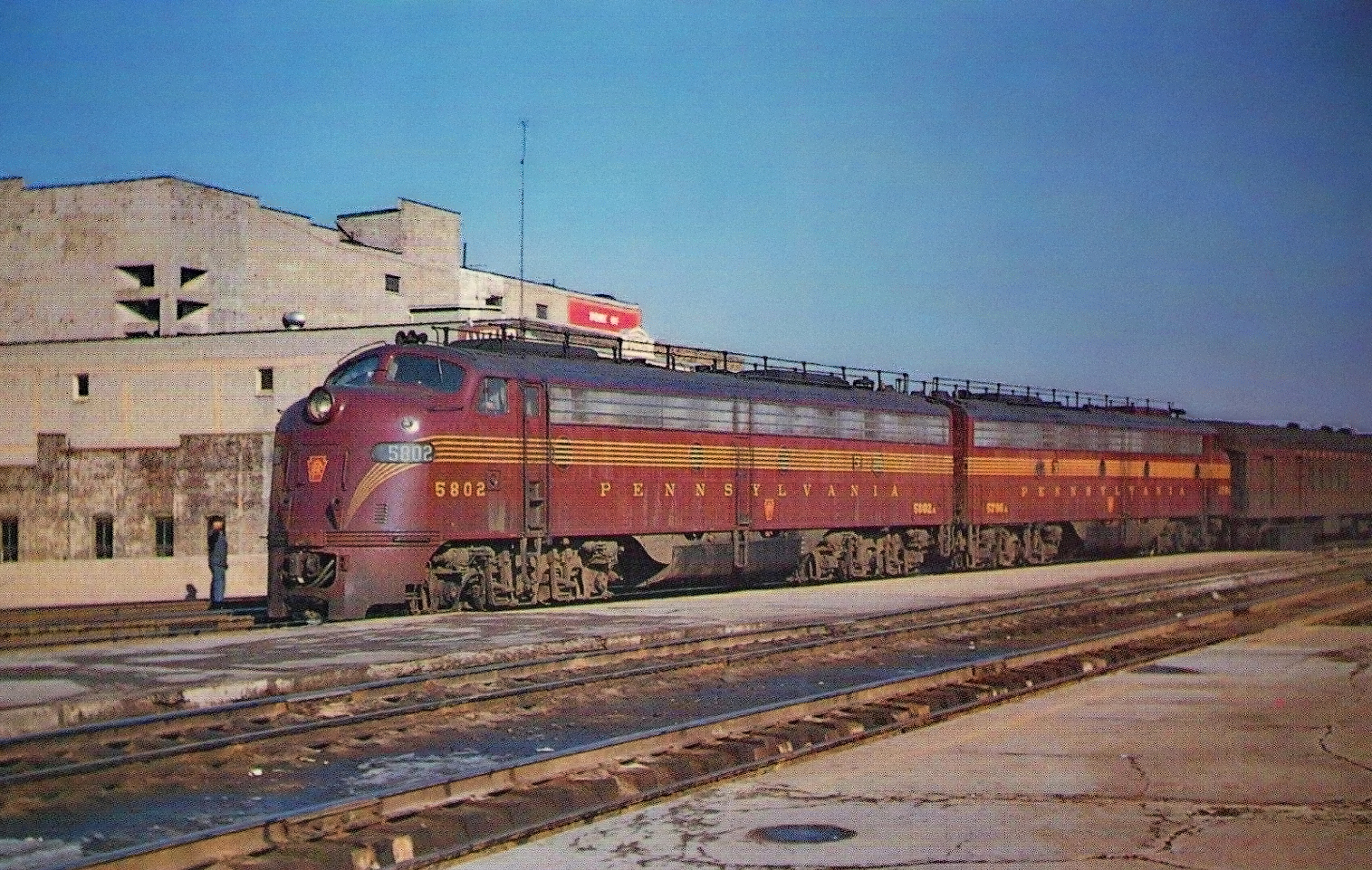 ennsylvania E8As #5802-A and #5706-A with their train at Dayton Union Station (Ohio) on February 5, 1956. Joe Stark photo.
The Primordial Years: 1848–1880s
The PRR’s passenger story began modestly. In 1848 it acquired its first passenger equipment—a baggage car and two coaches—for the start of all-rail service between Philadelphia and points west of Harrisburg. Additional cars were purchased secondhand from other lines. A future component road, the Camden & Amboy, is credited with operating the first passenger cars mounted on “trucks” (four- or six-wheel rotating assemblies) rather than rigid underframes, and with introducing a center-aisle coach design that became standard.
Sleeping cars arrived early. In 1836 the Cumberland Valley Railroad (a PRR affiliate) placed the world’s first sleeping car, the Chambersburg, into service on its Harrisburg route. By 1858 the PRR itself introduced the first “wide” passenger cars—nine feet across, nearly the width of modern equipment—for Philadelphia–Pittsburgh runs. “Smokers” and early sleeping cars followed, though dining en route was still rare. The first diners appeared on a PRR affiliate, the Philadelphia, Wilmington & Baltimore, in the early 1860s.
The 1870s marked the dawn of modern passenger service. In 1870 the PRR signed a long-term contract with the new Pullman Company to supply and operate sleeping cars on its overnight trains—an arrangement that lasted more than a century. In 1876 the railroad introduced the first true “limited” passenger train: a Jersey City–Chicago run with fewer stops and a limited number of cars to avoid crowding. By 1881 the flagship Pennsylvania Limited was covering the same route in 26 hours 40 minutes, the fastest schedule of its day.
Newest and finest equipment was assigned to it. In 1887 it became the first train on the system to feature vestibule cars (enclosed diaphragms between cars for safe passage). By the end of the century the Pennsylvania Limited was hailed as a “work of high art.” Its seven-car consist typically included a combination baggage-buffet-smoking-room-barber shop, a 40-seat dining car, four sleeping cars, and an observation-sleeper-lounge. On-board amenities included a stenographer, barber, and maid. The train wore a distinctive custom livery of green, cream, and red.
In 1885 the PRR effectively cornered the lucrative 225-mile New York–Philadelphia–Washington market (shared with rivals B&O, Jersey Central, and Reading). Its Congressional Limited Express became the train of choice for New York businessmen and Washington politicians.
The Plush Era and the Turn of the Century
As the 19th century closed, passenger trains everywhere entered their “plush” era. Competition for the New York–Chicago trade intensified among the New York Central, B&O, Erie, and PRR. Chicago had become the nation’s “Second City,” and travel volume was immense. On June 15, 1902, the PRR launched the Pennsylvania Special—a four-car train that covered more than 900 miles in 20 hours. By 1905 it was on an 18-hour schedule, faster than rival Chicago–Pittsburgh–New York trains would run 90 years later.
The PRR developed an astonishingly complex network. Its New York–Philadelphia–Washington corridor hosted through trains to New England (via New Haven & Hartford), the South, the Midwest, and suburban locals. Two early flagship trains on the NY–Washington route were the Federal and Colonial, operating via the New Haven & Hartford Railroad between Boston, the Bronx, and the PRR at Jersey City (ferry connection until Pennsylvania Station opened in 1910 and Hell Gate Bridge in 1917 completed all-rail Boston–Washington service). The PRR cooperated with the New Haven on the Senator, Patriot, William Penn, Colonial, and overnight Federal. It also relayed Southeastern carriers—Florida trains of the Seaboard Air Line and Atlantic Coast Line—northward to New York, as well as trains to Atlanta, New Orleans, and Cincinnati over Southern Railway and Chesapeake & Ohio lines.
The second great corridor was Philadelphia–Harrisburg–Pittsburgh, the heart of the Pennsylvania Railroad main line. The overnight all-sleeping-car Pittsburgher (introduced 1939) was the only New York–Pittsburgh train ever streamlinerized. Other stalwarts included the Duquesne, Juniata, Pittsburgh Night Express, New Yorker, and Iron City Express.
The third major east-west artery was the New York–Chicago route. The PRR sliced the lucrative pie with the New York Central. Its signature overnight all-Pullman train was the Broadway Limited. Originally named the Pennsylvania Special, it was renamed in 1912 in reference to the PRR’s “Broad Way of Commerce” between New York and Chicago. At its peak the 908-mile run was made in just under 16 hours—an average speed of nearly a mile a minute including stops. A 1934 public timetable listed its amenities: “Barber, Bath, Valet, Ladies’ Maid, Manicure, Train Secretary, Writing Desk and Stationery, Stock Quotations, Newspapers and Periodicals, Terminal Telephones, Baseball and Football Scores.” Though it epitomized luxury rail travel for an elite clientele, PRR accountants knew most other trains on the route generated better revenue.
The Golden Age Fleet Post-1900
By the first half of the 20th century the PRR fielded one of the most extensive passenger networks in North America. The New York–Chicago corridor alone supported dozens of trains. The Broadway Limited and its rival, the New York Central’s 20th Century Limited, were streamliners in 1938. Patronage was light enough that PRR officials briefly considered discontinuing the Broadway before World War II gave it a short-term boost.
Other notable Gotham–Chicago trains included the Manhattan Limited, Fort Dearborn, Progress Limited, New Yorker, Admiral, Gotham Limited, and the long-lived Pennsylvania Limited (which lasted until 1971). In 1939 the all-coach streamliner Trail Blazer joined the Broadway and the coach-and-sleeper General in the same time slot. Demand for overnight New York–Chicago service was so strong that trains left terminal cities at dinner hour and arrived at breakfast.
Chicago–Pittsburgh trains such as the Golden Triangle and Fort Pitt (and later the New Triangle) bolstered the service. West of Pittsburgh the PRR operated trains on the Panhandle route via Columbus and Logansport—the Seaboard Express, Metropolitan, and Ohioan. Direct Chicago–Washington service existed but was overshadowed by the B&O’s Columbian and Capitol Limited; PRR’s best-known entry here was the Liberty Limited.
The third major east-west corridor ran via Pittsburgh, Columbus, and Indianapolis to St. Louis. The 1,052-mile New York–St. Louis route was anchored by the Spirit of St. Louis (named for Charles Lindbergh’s plane). More basic St. Louis services included the St. Louisan, American, Gotham Limited, and Pennsylvania Limited (with St. Louis legs originating in Pittsburgh). In 1941 the all-coach Jeffersonian streamliner was introduced; in 1948 the Penn Texas extended service to Texas via Missouri Pacific connections.
Additional Midwest corridors included Chicago–Indianapolis–Louisville, Chicago–Cincinnati, and Chicago–Columbus. The Cincinnati Limited was the PRR’s premiere train on the 755-mile Cincinnati–Pittsburgh–New York route. Cleveland was served via connections at Pittsburgh; the 1939 timetable showed eight daily trains each way, anchored by the Clevelander (New York/Washington–Cleveland) and supplemented by the Akronite. Later the Steeler name was applied to some runs. Detroit was reached by the Red Arrow (East Coast–Detroit) and joint Wabash/PRR Detroit Arrow. Chicago–Louisville hosted the joint South Wind (with Louisville & Nashville, Atlantic Coast Line, and Florida East Coast) and later the Kentuckian and Louisville Daylight Express.
The PRR also ventured into Florida via the Southland (Chicago–Cincinnati–Florida) and maintained extensive service to Buffalo, Canada (the pre-WWII International Express), and even obscure branches. The Erie branch was served by Harrisburg and Pittsburgh trains including the overnight Northern Express and Southern Express.
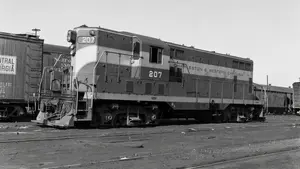
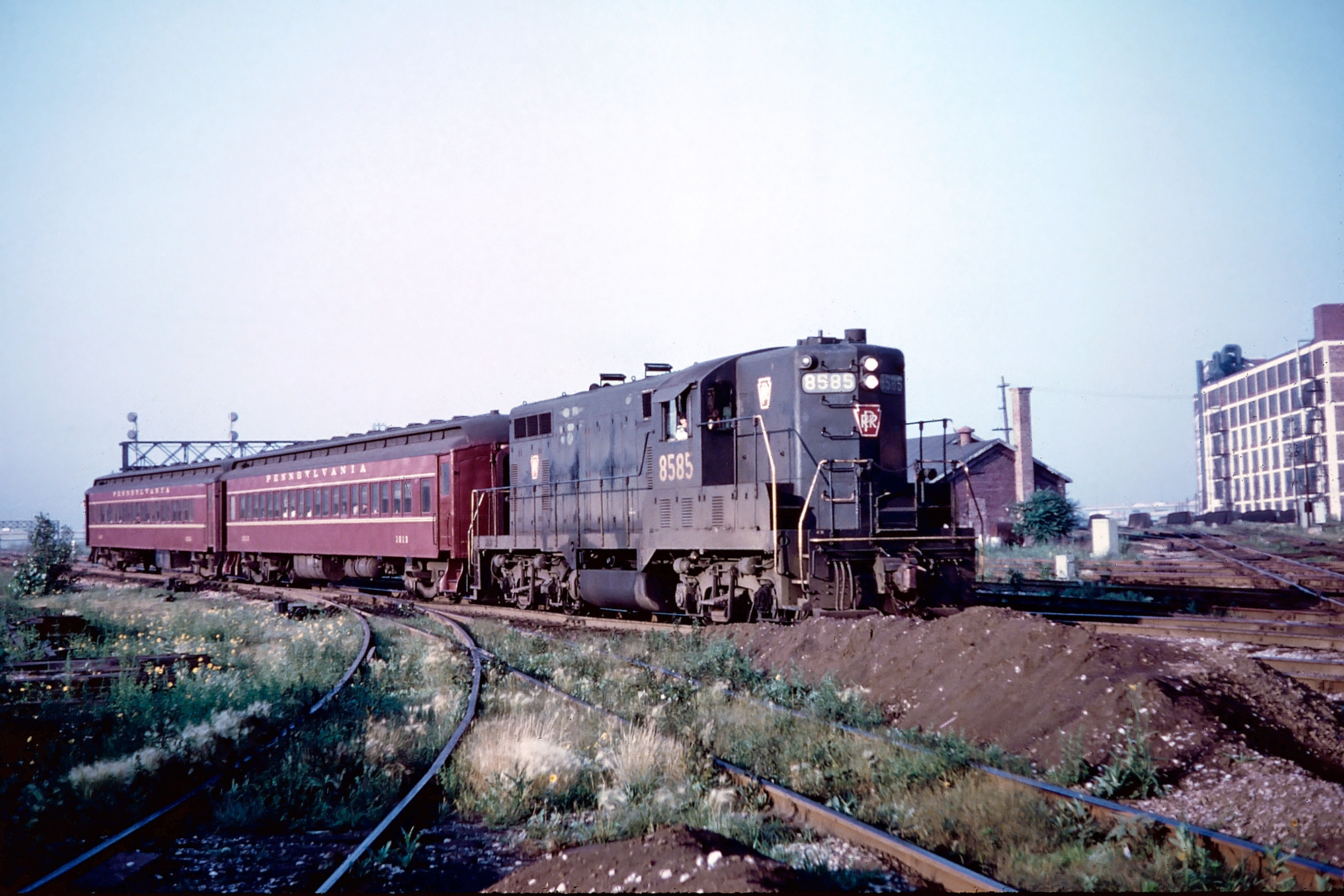 Pennsylvania GP7 #8585 is seen here with the Valparaiso Local in Chicago on August 15, 1964. Fred Byerly photo. Amercian-Rails.com collection.
The Suburban Side of the Pennsy
No other railroad matched the PRR’s commuter empire. It operated extensive suburban services in metropolitan New York and Philadelphia, and more modest operations in Pittsburgh, Chicago, and Baltimore/Washington. In Philadelphia the PRR built stub branches almost exclusively for suburban service: Chestnut Hill, Whitemarsh, Norristown, and Westchester. The crown jewel was the historic Main Line route west to Paoli. The “Paoli Locals” became an integral part of life in affluent suburbs—Villanova, Bryn Mawr, Radnor. Additional suburban trains ran along the New York–Washington main line as far east as Trenton and west to Wilmington, plus service out of Camden on the Pennsylvania-Reading Seashore Lines.
Local-type trains between Philadelphia and Harrisburg, and between Philadelphia and New York, earned the nickname “Clockers” because of their on-the-hour departures. In New York the PRR (and its Long Island Rail Road subsidiary until 1966) served countless bedroom communities in New Jersey and Long Island. Workers commuted to Washington and Baltimore on modest but reliable suburban trains between Baltimore’s Pennsylvania Station and Union Station in D.C. Pittsburgh had concentrated suburban service on the 17-mile downtown–Trafford segment of the Division Main Line, plus runs west to Beaver Falls on the P&WV&C main. Isolated weekday suburban runs existed to Brownsville, Sharon, Steubenville, and Buffalo, but most Pittsburgh suburban service ended by 1964. Chicago-area suburban trains were “meek at best” even before World War II; the local “Valpo Dummies” outlasted the Pennsy itself by more than two decades.
Other notable suburban or regional services included the Nellie Bly and New York–Atlantic City trains (ended early 1960s), Williamsport–Canandaigua (via Pullman connections with the New York Central), Wilkes-Barre–Sunbury, Cincinnati–Fort Wayne–Grand Rapids (the distinguished Northern Arrow), and the Eastern Shore Del-Mar-Va Express (day) and Cavalier (night) between Wilmington, Delaware, and Cape Charles, Virginia, with sleeping cars through to New York.
Streamliners, War, and Decline
The 1930s brought streamliners. In 1939 the PRR introduced the all-coach Trail Blazer on the New York–Chicago run and the Pittsburgher as its only New York–Pittsburgh streamliner. World War II dramatically increased ridership, but the postwar era brought competition from automobiles and airlines. The PRR modernized where it could—re-equipping the Congressional Limited in 1952 with stainless-steel Budd cars and tripling the service with the Morning Congressional, Mid-Day Congressional, and Afternoon Congressional. Yet patronage on flagship trains like the Broadway remained light.
By the 1950s and 1960s many secondary trains disappeared. The last principal intercity Washington–Buffalo run (via York) and various Chicago–Cincinnati–Columbus services were truncated or combined. Pittsburgh suburban service largely ended in 1964. The railroad itself merged into Penn Central in 1968; most long-distance passenger trains passed to Amtrak in 1971. Yet the PRR’s influence endures: today’s Northeast Corridor and Keystone Corridor services still operate over former PRR trackage at speeds up to 125 mph, and thousands of daily commuters board trains descended from the Paoli Locals and Clockers in New York, Philadelphia, Baltimore, and Washington.
From the humble Paoli Local of the 1840s to the luxurious Broadway Limited of the 20th century, the Pennsylvania Railroad’s passenger trains were more than transportation—they were institutions. They shaped suburbs, powered business travel, connected families, and defined an era when the railroad was the heartbeat of American mobility. Even decades after the Pennsy itself disappeared, its legacy of speed, frequency, and service remains visible on the rails it built.
Notable Long-Distance Trains
Admiral: (New York - Chicago)
Akronite: (New York - Pittsburgh - Akron)
Clevelander: (New York - Cleveland)
Colonial: (Boston - Washington)
Congressional: (New York - Washington)
Duquesne: (New York - Pittsburgh)
East Wind: (Washington - Bangor, Maine)
Edison: (New York - Washington)
Gotham Limited: (New York - Chicago)
Golden Triangle: (Chicago - Pittsburgh)
Kentuckian: (Chicago - Louisville)
Manhattan Limited: (New York - Chicago)
Montrealer/Washingtonian: (Washington - New York - Montreal)
Penn Texas: (New York - St. Louis)
Pittsburgher: (New York - Pittsburgh)
Senator: (Boston - New York - Washington)
South Wind: (Chicago - Miami)
St. Louisan: (New York/Washington - St. Louis)
Trail Blazer: (New York - Chicago)
Union: (Chicago - Columbus)
Recent Articles


-
Alton Railroad: Map, History, Timetables
Oct 09, 26 10:31 PM
 Alton Railroad, chartered February 27, 1847 as the Alton & Sangamon. Chicago, St. Louis, and Kansas City, the 1937 Official Guide, and the May 31, 1947 merger into the Gulf, Mobile & Ohio.
 -
Mobile & Ohio Steam Roster (Post 1900)
Oct 09, 26 12:26 PM
 Mobile & Ohio steam since 1900. Drury's class grid: 48 six-wheel switchers, 107 Ten-Wheelers, 15 Consolidations, 58 Mikados, and 14 Pacifics. Last revenue steam October 7, 1949.
 -
Mobile & Ohio Railroad: History, Map, Timetable
Oct 09, 26 11:31 AM
 Mobile & Ohio Railroad, chartered in 1848. Columbus on April 22, 1861, the Cairo & St. Louis, the March 1940 Official Guide, and the September 13, 1940 merger into the Gulf, Mobile & Ohio.
 -
Gulf, Mobile & Northern Steam Roster (Post 1900)
Oct 09, 26 10:42 AM
 Gulf, Mobile & Northern steam since 1900. Drury's class grid: Ten-Wheelers, Mikados, Russian Decapods, Pacifics 425 and 426, and three light 4-8-2s. Last revenue steam October 7, 1949.
 -
Gulf, Mobile & Ohio Diesel Roster (All-Time)
Oct 09, 26 10:41 AM
 Gulf, Mobile & Ohio diesel roster, all-time. The 1935 boxcab, DL-107s, 55 FA-1s, F3s and F7s, the Ingalls 4-S, GP30s through GP38-2s, and 21 SD40s. Serials and order numbers.
 -
Gulf, Mobile & Northern Railroad: History, Rebel Route
Oct 09, 26 10:36 AM
 Gulf, Mobile & Northern, from the 1890 Mobile, Jackson & Kansas City to the Rebel and the September 13, 1940 merger into the Gulf, Mobile & Ohio. Steam roster is the companion page.
 -
Gulf, Mobile & Ohio Railroad: Map, Photos, Trains, History
Oct 08, 26 11:48 PM
 Gulf, Mobile & Ohio, chartered in 1938 and merged September 13, 1940. The Mobile & Ohio, the Alton on May 31, 1947, the Rebel Route, and Illinois Central Gulf on August 10, 1972.
 -
New Jersey Railroad Museums (2026): A Complete Guide
Oct 08, 26 11:37 PM
 New Jersey railroad museums—Whippany, Maywood, Pine Creek, Mahwah’s Erie depot, Phillipsburg, and Boonton. Confirm hours on each site.
 -
New Hampshire Railroad Museums (2026): A Complete Guide
Oct 08, 26 11:34 PM
 New Hampshire railroad museums—North Conway, the Flying Yankee, Ashland, Gorham, Raymond, and Sandown. Confirm hours on each site.
 -
Missouri Railroad Museums (2026): A Complete Guide
Oct 08, 26 11:00 PM
 Missouri railroad museums—the National Museum of Transportation, Patee House, Frisco 4524, the Chicago & Alton depot, and Marceline. Confirm hours on each site.
 -
Milwaukee Road X3800: Deer Lodge’s Shop Goat
Oct 08, 26 04:28 PM
 Milwaukee Road X3800, the a home-built shop goat that served the Deer Lodge, MT yard. It was a 220-volt DC switcher, powered through an extension cord that moved electrics into a roundhouse where the…
 -
Key West Extension (Overseas Railroad): History, Construction, Decline
Oct 08, 26 03:59 PM
 Henry Flagler's Overseas Railroad, Miami to Key West, 1905–1935. The Seven Mile Bridge, the 1935 Labor Day Hurricane, and the road that became U.S. 1.
 -
Florida East Coast Steam Roster (Post 1900)
Oct 08, 26 02:34 PM
 Florida East Coast steam since 1897. Seventeen Ten-Wheelers, twenty Atlantics, eighty-seven Pacifics, ninety Mountains, fifteen Mikados, and the switchers.
 -
Florida East Coast Diesel Roster (All-Time)
Oct 08, 26 02:12 PM
 Florida East Coast diesel roster, all-time. E units from 1939, F3s, BL2s, GP7s and GP9s, the GP40-2 orders, 22 SD40-2s, and 24 ES44C4s. Serials and EMD order numbers.
 -
Florida East Coast Railway: Map, History, Rosters
Oct 08, 26 01:46 PM
 Florida East Coast Railway, Henry Flagler's line from Jacksonville to Miami and Key West. Receivership in 1931, the 1963 strike, Grupo México in 2017, and Brightline on the same track.
 -
Minnesota Railroad Museums (2026): A Complete Guide
Oct 08, 26 10:32 AM
Minnesota railroad museums—the Lake Superior Railroad Museum, Two Harbors, Jackson Street, Willmar’s Great Northern 2523, and Currie. Confirm hours on each site. -
Maine Railroad Museums (2026): A Complete Guide
Oct 08, 26 09:24 AM
 Maine railroad museums—Seashore Trolley, the two-foot lines at Portland, Alna, and Phillips, Boothbay, and the Bangor & Aroostook depots. Confirm hours on each site.
 -
Massachusetts Railroad Museums (2026): A Complete Guide
Oct 08, 26 12:08 AM
 Massachusetts railroad museums—Berkshire Scenic at Lenox, Shelburne Falls trolley No. 10, Edaville, Chatham’s 1887 depot, and Lowell. Confirm hours on each site.
 -
Clinchfield Steam Roster (Post 1900)
Oct 07, 26 12:09 PM
 Clinchfield steam since 1900. Fifteen H-4 Consolidations, K-1 Mikados, M-2 and M-3 Mallets, L-class 2-8-8-2s, eighteen Challengers. Class grid after Drury. Last steam April 16, 1954.
 -
Clinchfield Diesel Roster (All-Time)
Oct 07, 26 12:05 PM
 Clinchfield diesel roster, all-time. F3A 800, FP7 200, the F7s, GP7s, 25 SD40s, 18 SD45-2s, seven U36Cs, and the Family Lines hoods. Serials and EMD order numbers.
 -
Clinchfield Railroad: Map, Steam Locomotives, Roster, Logo
Oct 07, 26 12:02 PM
 Clinchfield Railroad, Elkhorn City to Spartanburg. George L. Carter, the Carolina, Clinchfield & Ohio, the 1924 lease, coal, the loops, and CSX. Steam and diesel rosters are companion pages.
 -
Kentucky Railroad Museums (2026): A Complete Guide
Oct 07, 26 11:39 AM
 Kentucky railroad museums—the Kentucky Railway Museum, Bowling Green’s L&N depot, Paducah, Versailles, and Covington. Confirm hours on each site.
 -
Kansas Railroad Museums (2026): A Complete Guide
Oct 07, 26 11:26 AM
 Kansas railroad museums—Santa Fe 3768 at Wichita, Santa Fe 132 in Topeka, the Great Overland Station, and Abilene. Confirm hours on each site.
 -
Cincinnati, New Orleans and Texas Pacific Diesel Roster (All-Time)
Oct 07, 26 10:38 AM
 All-time diesel roster of Southern locomotives lettered for the Cincinnati, New Orleans and Texas Pacific. Serials, order numbers, and builder dates.
 -
Cincinnati, New Orleans and Texas Pacific Railway
Oct 07, 26 10:31 AM
 Cincinnati, New Orleans and Texas Pacific Railway, incorporated September 8, 1881, to lease Cincinnati’s railroad to Chattanooga. Queen and Crescent route, Rathole, and the 2024 sale to Norfolk Southe…
 -
Indiana Railroad Museums (2026): A Complete Guide
Oct 07, 26 12:26 AM
 Indiana railroad museums—Nickel Plate 765, Elkhart’s New York Central collection, French Lick, Linden’s junction depot, and Haley Tower. Confirm hours on each site.
 -
"Triplex" Steam Locomotive: Specs, History, Photos
Oct 06, 26 11:52 PM
 Erie class P-1 Triplex 2-8-8-8-2s. Three Baldwin compounds, 2603–2605, later 5014–5016, built 1914 and 1916. Matt H. Shay, the 1930 class card, and Virginian XA 700.
 -
Illinois Railroad Museums (2026): A Complete Guide
Oct 06, 26 11:47 PM
 Illinois railroad museums—the Illinois Railway Museum, Monticello, the Pioneer Zephyr, Galesburg’s Burlington 3006, and the depots. Confirm hours on each site.
 -
Iowa Railroad Museums (2026): A Complete Guide
Oct 06, 26 11:41 PM
 Iowa railroad museums—the Union Pacific Railroad Museum, RailsWest, Sioux City, Boone, and the National Hobo Museum in Britt. Confirm hours on each site.
 -
Charleston and Western Carolina Diesel Roster (All-Time)
Oct 06, 26 11:29 PM
Charleston and Western Carolina diesel roster. Twenty-one GP7s, two SW7s, two SW9s, and six F7As, all built 1950–1952. Serials, order numbers, and ACL and SCL numbers. -
Charleston and Western Carolina Railway: Map, History, Timetables
Oct 06, 26 11:18 PM
 Charleston and Western Carolina Railway, incorporated September 16, 1896. Port Royal to Spartanburg, with branches to Anderson and Greenville. Merged into the Atlantic Coast Line on December 31, 1959.
 -
Central of Georgia Steam Roster (Post 1900)
Oct 06, 26 04:00 PM
 Central of Georgia steam since 1900. Cooke Consolidations, Harriman Mikados, 32 Mountains, and eight Lima 4-8-4s. Class grid after Drury. Last steam May 1953.
 -
Central of Georgia Diesel Roster (All-Time)
Oct 06, 26 03:44 PM
 Central of Georgia diesel roster. SW1 No. 1 in 1939, E7s and E8s, nine F3As, 39 RS3s, GP7s through SD35s. Serials and order numbers.
 -
Central of Georgia Railway: Map, Logo, History, Rosters
Oct 06, 26 03:42 PM
 Central of Georgia Railway, from the 1833 Savannah charter to Southern control on June 17, 1963. Map, logos, Nancy Hanks II, and links to the steam and diesel rosters.
 -
Georgia Railroad Museums (2026): A Complete Guide
Oct 06, 26 03:33 PM
Georgia railroad museums—Savannah’s Central shops, Duluth, the General at Kennesaw, the Texas in Atlanta, Tifton, Waycross, and Albany. Confirm hours on each site. -
Florida Railroad Museums (2026): A Complete Guide
Oct 06, 26 03:18 PM
 Florida railroad museums—Boca Raton, Winter Garden, Whitehall, the Gold Coast, Parrish, Fort Myers, Milton, and Plant City. Confirm hours on each site.
 -
Connecticut Railroad Museums (2026): A Complete Guide
Oct 06, 26 01:05 PM
 Connecticut railroad museums—the Shore Line Trolley, East Windsor, the Naugatuck Railroad, Danbury Union Station, Willimantic, and the SoNo tower. Confirm hours on each site.
 -
Colorado Railroad Museums (2026): A Complete Guide
Oct 06, 26 12:47 PM
 Colorado railroad museums—Golden, the Forney’s Big Boy 4005, Pueblo’s Santa Fe 2912, and the depots at Castle Rock, Limon, and Ridgway. Confirm hours on each site.
 -
Atlantic Coast Line Steam Roster (Post 1900)
Oct 06, 26 12:44 PM
 Atlantic Coast Line steam since 1900. Copper Head Ten-Wheelers, 235 P-5 Pacifics, Q-1 Santa Fes, twelve R-1 4-8-4s. Class grid after Drury. Last steam June 30, 1955.
 -
Atlantic Coast Line Diesel Roster (All-Time)
Oct 06, 26 11:57 AM
 Atlantic Coast Line diesel roster. HH660 1900 in 1939, E3s for the Champion, FTs and F2s, GP7s 100–279, GP30s, U25Cs, and the 1967 SCL numbers. Serials and orders.
 -
Atlantic Coast Line Railroad: "Standard Railroad of the South"
Oct 06, 26 11:53 AM
 Atlantic Coast Line, the Standard Railroad of the South. April 21, 1900 to July 1, 1967. Plant System, L&N, Clinchfield, the Champion, and the Seaboard Coast Line merger.
 -
California Railroad Museums (2026): A Complete Guide
Oct 06, 26 09:50 AM
California railroad museums—the California State Railroad Museum, Perris, Portola, Railtown 1897, and the depots that still stand. Confirm hours on each site. -
Arizona Railroad Museums (2026): A Complete Guide
Oct 06, 26 09:46 AM
Arizona railroad museums—the Arizona Railway Museum in Chandler, Southern Pacific 1673 at Tucson, and the McCormick-Stillman park in Scottsdale. -
Arkansas Railroad Museums (2026): A Complete Guide
Oct 06, 26 09:07 AM
 Arkansas railroad museums—Cotton Belt 819 at Pine Bluff, the Fort Smith trolley, the Mammoth Spring depot, and the Eureka Springs railway.
 -
Alabama Railroad Museums (2026): A Complete Guide
Oct 06, 26 09:03 AM
Alabama railroad museums—Heart of Dixie at Calera, the North Alabama museum at Chase, Huntsville’s 1860 depot, and Fort Payne. Confirm hours on each site. -
Pennsylvania Railroad Museums (2026): A Complete Guide
Oct 06, 26 12:09 AM
 Pennsylvania railroad museums—Strasburg, Steamtown, the Horseshoe Curve, the East Broad Top, and the depots and towers in between. Confirm hours on each site.
 -
Maryland Railroad Museums (2026): A Complete Guide
Oct 05, 26 11:53 PM
 Maryland railroad museums—the Baltimore roundhouse, Ellicott City station, Bowie, Gaithersburg’s Buffalo Creek & Gauley 14, and the Western Maryland collections.
 -
Ohio Railroad Museums (2026): A Complete Guide
Oct 05, 26 05:51 PM
 Ohio railroad museums—the Age of Steam Roundhouse, Bellevue, Worthington, Conneaut’s Nickel Plate 755, and the Dennison depot. Confirm hours on each site.
 -
Delaware Railroad Museums (2026): A Complete Guide
Oct 05, 26 02:43 PM
 Delaware railroad museums—Wilmington & Western at Greenbank, the Harrington tower and N5 caboose, Felton's 1868 depot, and the Selbyville station museum.
 -
C&O's M-1 Steam Turbine Locomotives: Specs, Roster, History
Oct 05, 26 12:13 PM
 Chesapeake & Ohio Class M-1 steam-turbine-electrics. Three Baldwin-Westinghouse locomotives, 500–502, built 1947–48 for The Chessie. Specs, the 2-C1+2-C1-B arrangement, and a roster. All scrapped…