
Southern Pacific Railroad: Map, History, Logo
Last revised: October 16, 2024
By: Adam Burns
The Southern Pacific (SP) was one of America's most successful and widely recognized railroads. Its name stands alongside notables like the Santa Fe, Union Pacific, Pennsylvania, Baltimore & Ohio, and Illinois Central.
The "Espee" carries a heritage tied to one of the most important events in American history, completion of the Transcontinental Railroad.
Afterwards, Central Pacific's so-called "Big Four" (Collis P. Huntington, Leland Stanford, Charles Crocker, and Mark Hopkins) jockeyed for total control of California's transportation network.
To do so, they created the Southern Pacific and rapidly expanded their new enterprise throughout the Golden State.
Their system eventually became so large it stretched from Portland, Oregon to New Orleans, Louisiana. In addition, a multitude of celebrated subsidiaries comprised SP's network like the Texas & New Orleans, Cotton Belt, and the great Pacific Electric Railway.
Photos
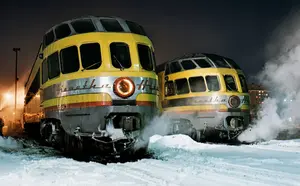
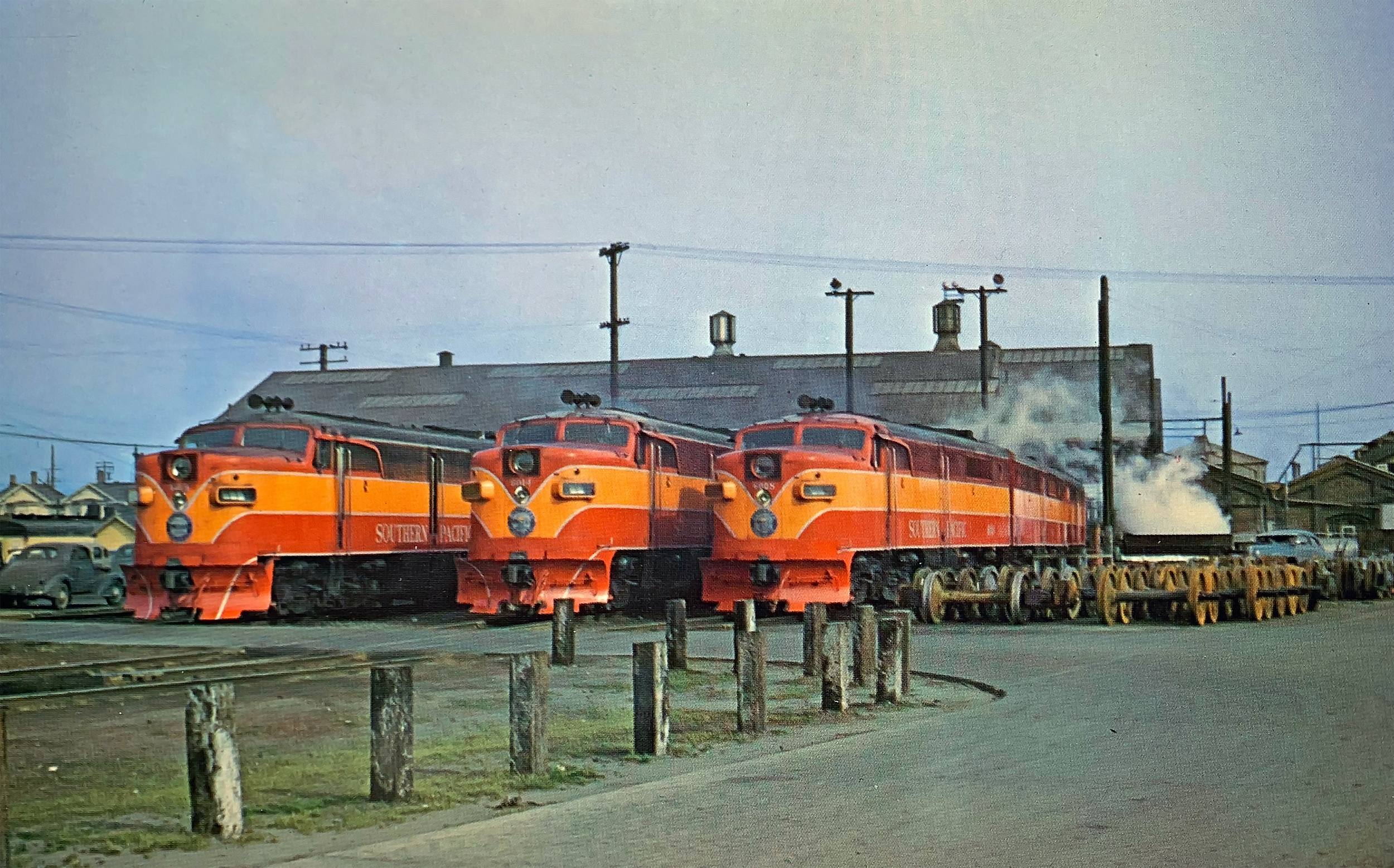 From left to right: Southern Pacific PA-2 #6019, PA-2 #6014, and PA-1 #6008 await their next assignments at the West Oakland Shops in 1952. Stewart Liebman photo. American-Rails.com collection.
History
Over time, it blossomed into the most far-reaching of all the classic American railroads with a network totaling 17,000 miles after its 1988 merger with the Denver & Rio Grande Western.
Alas, poor management in the decades following World War II greatly weakened this proud carrier as neglect and failed mergers saw its acquisition by Union Pacific in 1996. Today, given Southern Pacific's impressive size and scope most of its principal lines remain in regular service.
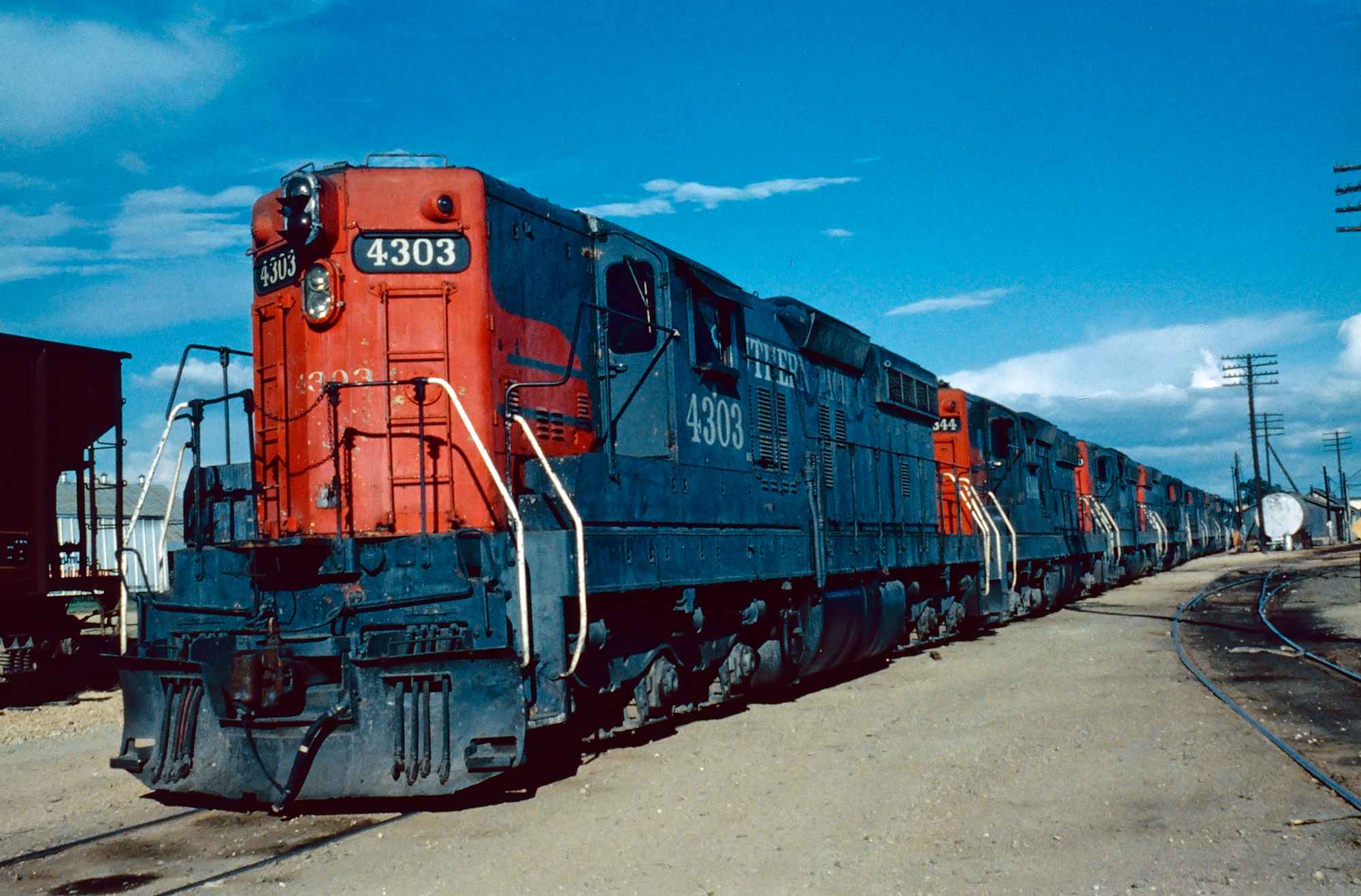 Southern Pacific rebuilt SD9E Cadillacs at Austin, Texas, circa 1982. Mike Bledsoe photo. American-Rails.com
collection.
Southern Pacific rebuilt SD9E Cadillacs at Austin, Texas, circa 1982. Mike Bledsoe photo. American-Rails.com
collection.Central Pacific
The vaunted Southern Pacific name carries a complex history although its immediate heritage can be traced back to the Transcontinental Railroad's completion.
When the Central Pacific (CP) and Union Pacific met on May 10, 1869 at Promontory Summit, Utah the West was opened to new means of economic development and settlement, enabling travelers to take cross-country trips in mere days instead of months.
Following this milestone, CP's "Big Four" maneuvered to dominate Californian trade. Their first task involved opening service beyond Sacramento, directly into Oakland/San Francisco.
Logo
Formation
According to a 1933 piece released by the Southern Pacific Historical & Technical Society entitled, "Historical Outline, Southern Pacific Company, March 1933," the original Southern Pacific Railroad had no ties to either the modern company or the "Big Four."
That corporation's chartering took place on December 2, 1865 and, as Bill Yenne's book, "The History Of The Southern Pacific," notes it was given Congressional authority on July 27, 1866 to establish another transcontinental route from San Francisco to the Colorado River at California's southeastern border. There, it would meet the Atlantic & Pacific Railway building east from St. Louis.
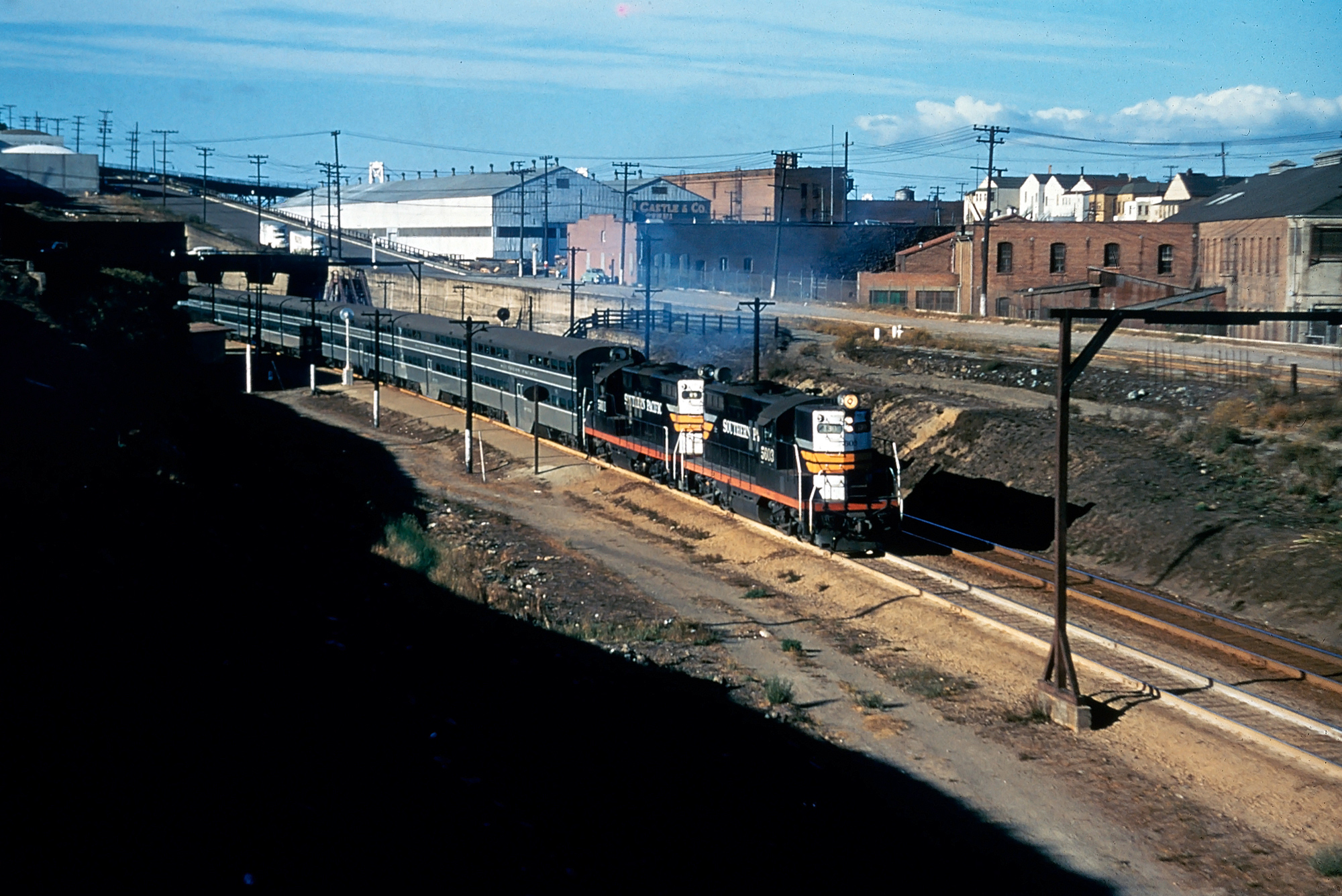 Southern Pacific GP9's #5603 and #5611 lead commuter train #130 (San Francisco - Los Gatos) out of San Francisco, circa 1955. Gordon Glattenberg photo. American-Rails.com collection.
While the project did include some new construction it was greatly aided by the February 4, 1868 acquisition of the San Francisco & San Jose Railroad, which linked its namesake towns.
For a brief time it appeared the "Big Four" might actually have to share the state's transportation services with this independent railroad.
Such an unthinkable scenario proved short-lived, though, when they purchased the original Southern Pacific on September 29, 1869. In a complicated series of corporate shakeups the SP combined operations with CP in 1870 (the former did not officially lease the latter until April 1, 1885).
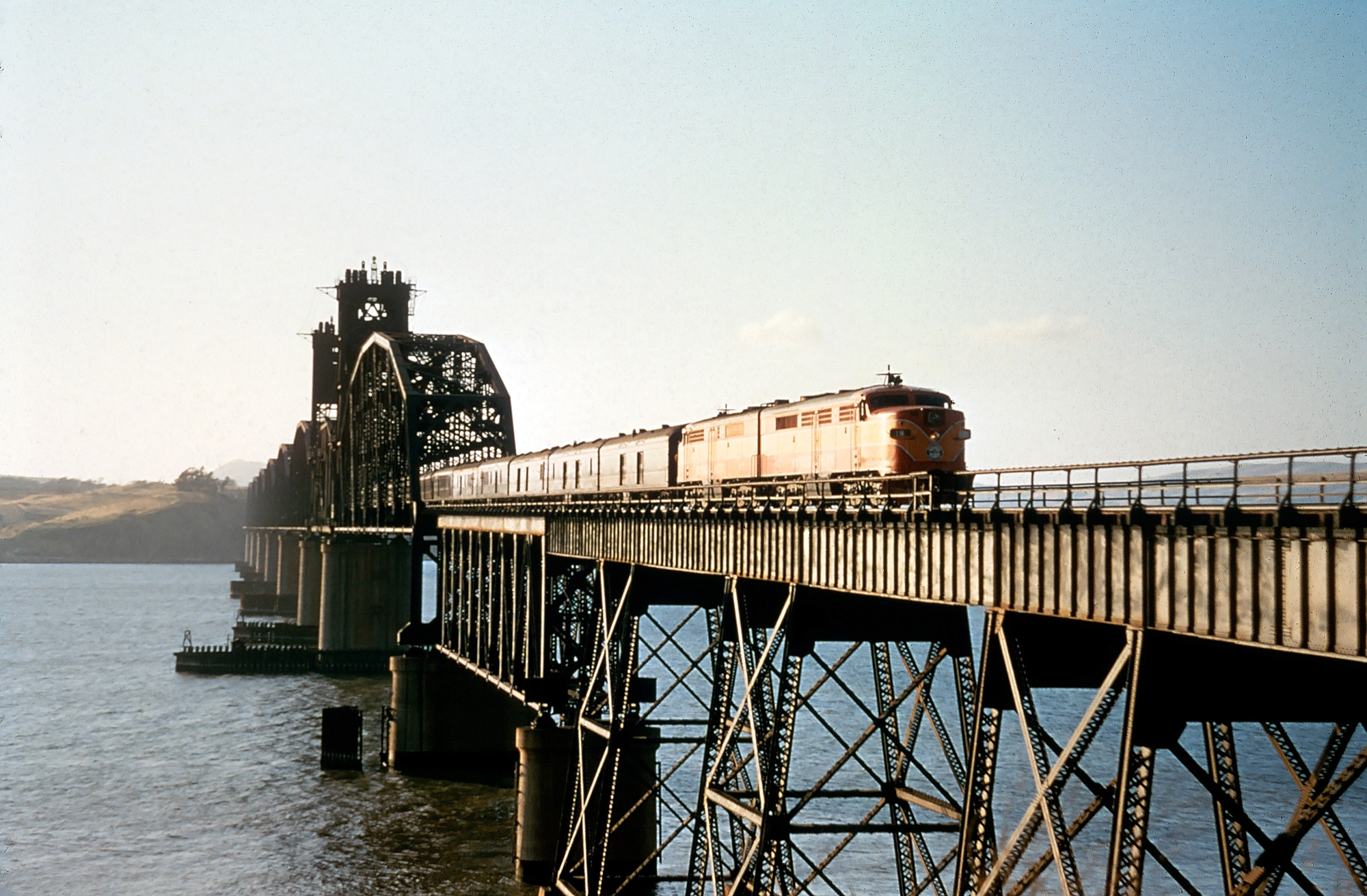 A pair of handsome Southern Pacific PA-2's lead train #19, the southbound "Klamath" (Portland - San Francisco), over the big lift bridge spanning the Carquinez Strait near Martinez, California, circa 1953. Gordon Glattenberg photo. American-Rails.com collection.
On November 11, 1869 the "Big Four" completed an extension from Sacramento to the San Francisco Bay at Oakland through two subsidiaries known as the Western Pacific Railroad (no relation to the well-known WP built decades later) and San Francisco Bay Railroad.
According to Brian Solomon's book, "Southern Pacific Railroad," the group then formed a new Southern Pacific Railroad on October 12, 1870 to obtain the original and others mentioned (including CP).
A further corporate layer was added on August 14, 1884 when the Southern Pacific Company was created in Kentucky to manage all properties under the "Big Four's" direction.
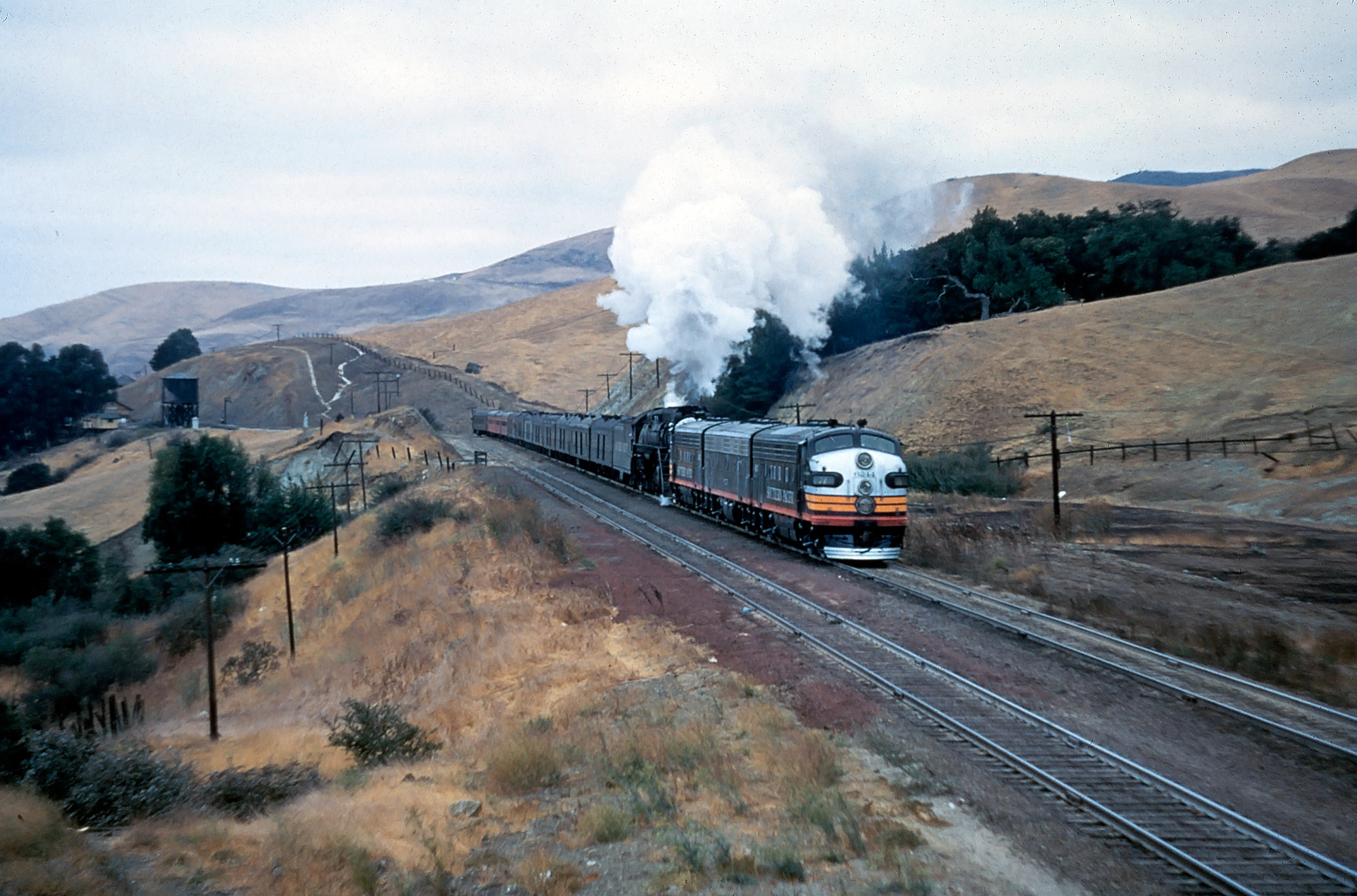 An A-B-A set of Southern Pacific F7's, along with a GS-class 4-8-4, have northbound train #71 at Serrano, California, circa 1955. This largely mail/express run operated the Coast Line between Los Angeles and San Francisco. Gordon Glattenberg photo. American-Rails.com collection.
Expansion
The Southern Pacific began its march out of the Bay Area in March of 1869 when it opened an extension 30 miles south of San Jose to Gilroy.
Beyond, it passed through the San Joaquin Valley reaching Modesto (November, 1870), Fresno (May, 1872), and Bakersfield (November, 1874) before dispatching its first train to Los Angeles (then a town of less than 10,000 residents) on September 5, 1876.
At A Glance
15,039 (1950) 17,340 (1995) |
|
San Francisco - Ogden/Salt Lake City ("Overland Route") San Francisco - San Jose - San Louis Obispo - Los Angeles ("Coast Line") San Francisco - Sacramento - Portland ("Shasta Route") Los Angeles - El Paso - San Antonio - Houston - New Orleans ("Sunset Route") Los Angeles - El Paso - Tucumcari, New Mexico - Chicago ("Golden State Route" via Rock Island) Houston - Dallas/Fort Worth, Dallas/Fort Worth - St. Louis Memphis - Brinkley, Arkansas San Francisco - Fresno - Bakersfield - Los Angeles ("San Joaquin Valley Line") Black Butte, California - Odell Lake, Oregon - Portland ("Cascade Line") Black Butte, California - Ashland, Oregon - Eugene - Portland ("Siskiyou Line") Klamath Falls, Oregon - Fernley, Nevada ("Modoc Line") |
|
Diesel: 2,096 |
|
Freight Cars: 77,401 Passenger Cars: 1,002 |
|
As the work trekked south, surveyors ran into a major problem 32 miles outside of Bakersfield, the Tehachapi Mountains. To tackle this rugged stretch of topography the "Big Four" hired engineer William Hood who designed an impressive route containing eastbound ruling grades (compensated) of only 2.52% while westbound grades (compensated) were an even gentler 1.36%.
The line reached the summit at 4,025 feet although its most endearing feature lay nine miles below where a sweeping loop allowed Hood to keep grades manageable while gaining an additional 77 feet in elevation.
Today, the fabled Tehachapi Loop remains in regular use by both Union Pacific (owner) and BNSF Railway (lessor). After arriving in Los Angeles, the SP expanded in all directions.
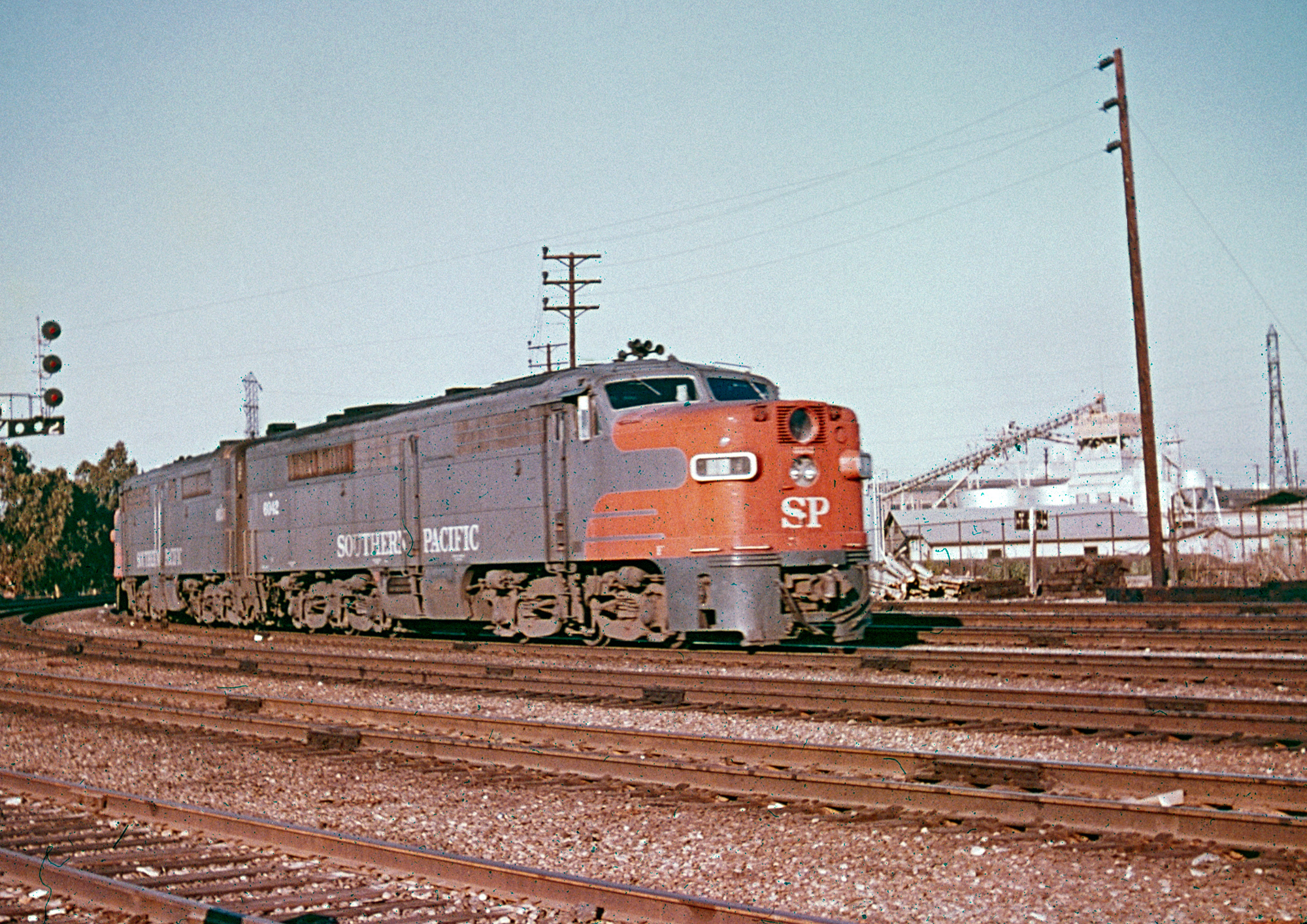 A pair of Southern Pacific PA-2's, led by #6042, are running light as they arrive in Los Angeles during the summer of 1963. Author's collection.
The first decision involved continuing east to the Colorado River at Fort Yuma, Arizona. That extension was completed in May of 1877 and with the Atlantic & Pacific bogged down by financial problems the "Big Four" pressed on after successfully amending their railroad's charter.
It enabled them to reach Texas where the SP would meet the Texas & Pacific Railway (then under Jay Gould's control) at El Paso. After just four years of construction the latter point was reached on May 19, 1881.
With the T&P still 100 miles away Huntington elected to continue building eastward and arrived in Sierra Blanca by November 25th.
This decision greatly angered Gould and the two parties went to court over the matter. It was finally resolved when they signed the "Gould-Huntington Agreement" on November 26, 1881, which gave the T&P trackage rights over the SP from Sierra Blanca to El Paso but also forfeited the former's charter and franchises west of that point (awarded to SP).
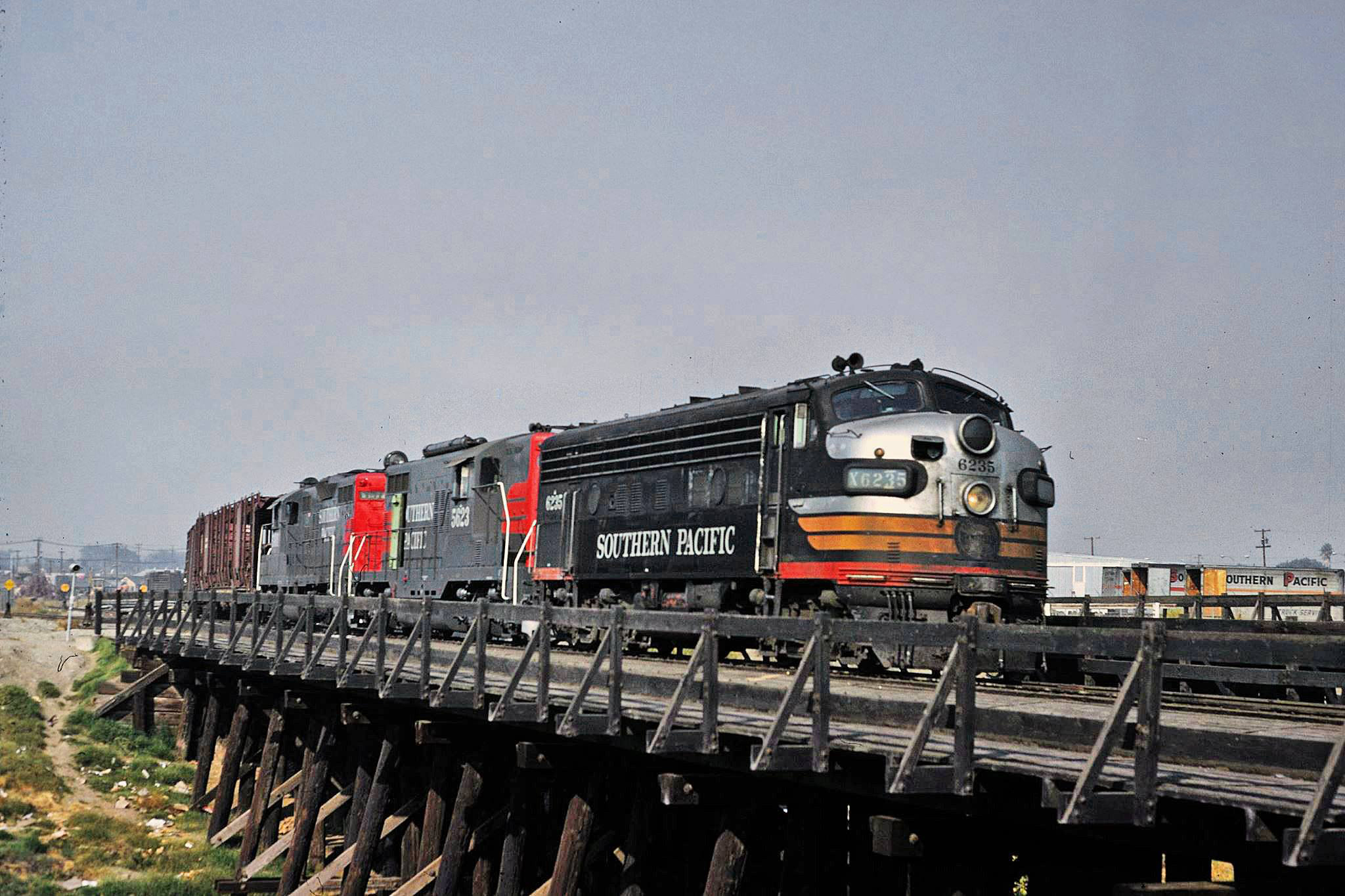 Southern Pacific F7A #6235, still wearing the classic "Black Widow" livery, leads a westbound freight out of San Jose, California during June of 1965. Drew Jacksich photo.
Notable Acquisitions
The speed at which Huntington raced across the Southwest was, indeed, quite impressive. By January 12, 1883 his railroad was complete to Pecos, a location where it met the Galveston, Harrisburg & San Antonio Railway, another Huntington-controlled system that had been building west from San Antonio.
Through this subsidiary, and control of the Louisiana & Texas Railroad & Steamship Company, the SP offered through service from Los Angeles to New Orleans over the newly christened "Sunset Route"
In 1881, Huntington picked up another property known as the Texas & New Orleans Railroad. In 1927, all of SP's subsidiaries in Texas and Louisiana, except for the "Cotton Belt," were operated under the T&NO name.
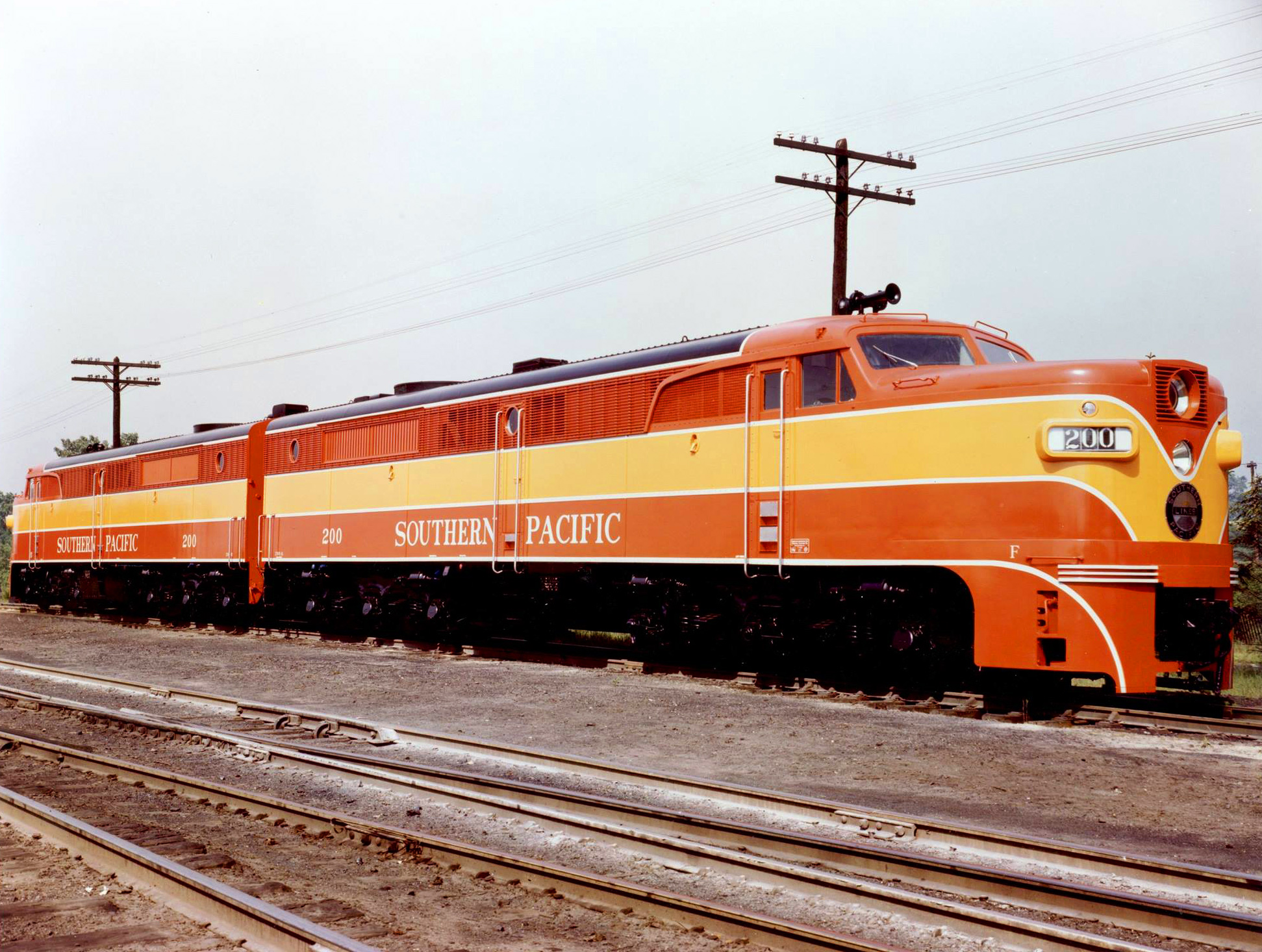 An American Locomotive builder's photo featuring new Texas & New Orleans (Southern Pacific) PA-1's #200-A and #200-B wearing the "Daylight" livery at Schenectady in June, 1949. Warren Calloway collection.
Collis P. Huntington
In 1884 the SP maintained a commanding 4,711-mile network, including all subsidiaries and leased properties.
By then, Collis Huntington's held complete control after the "Big Four" had fragmented:
- Mark Hopkins died on March 29, 1878
- Crocker sold out in 1871 but came back in 1873 as a minority owner until his death on August 14, 1888
- Leland Stanford and Huntington had an increasingly strained relationship resulting in the former handing over the presidency to the latter on February 28, 1890
Throughout the 1880's, Huntington continued growing his empire; not only did he dominate rail service throughout the Golden State but also eyed expansion toward the Puget Sound.
- He would later lose his grip on California when the Atchison, Topeka & Santa Fe's William Barstow Strong outmaneuvered the tycoon and broke up his monopoly. -
The SP accessed Redding in 1872 through a subsidiary known as the California & Oregon Railroad (C&O). This system carried a history dating back to 1865 (acquired by CP in 1870); it was envisioned to connect Marysville, California with Portland, Oregon but only succeeded in doing so with the "Big Four's" financial backing.
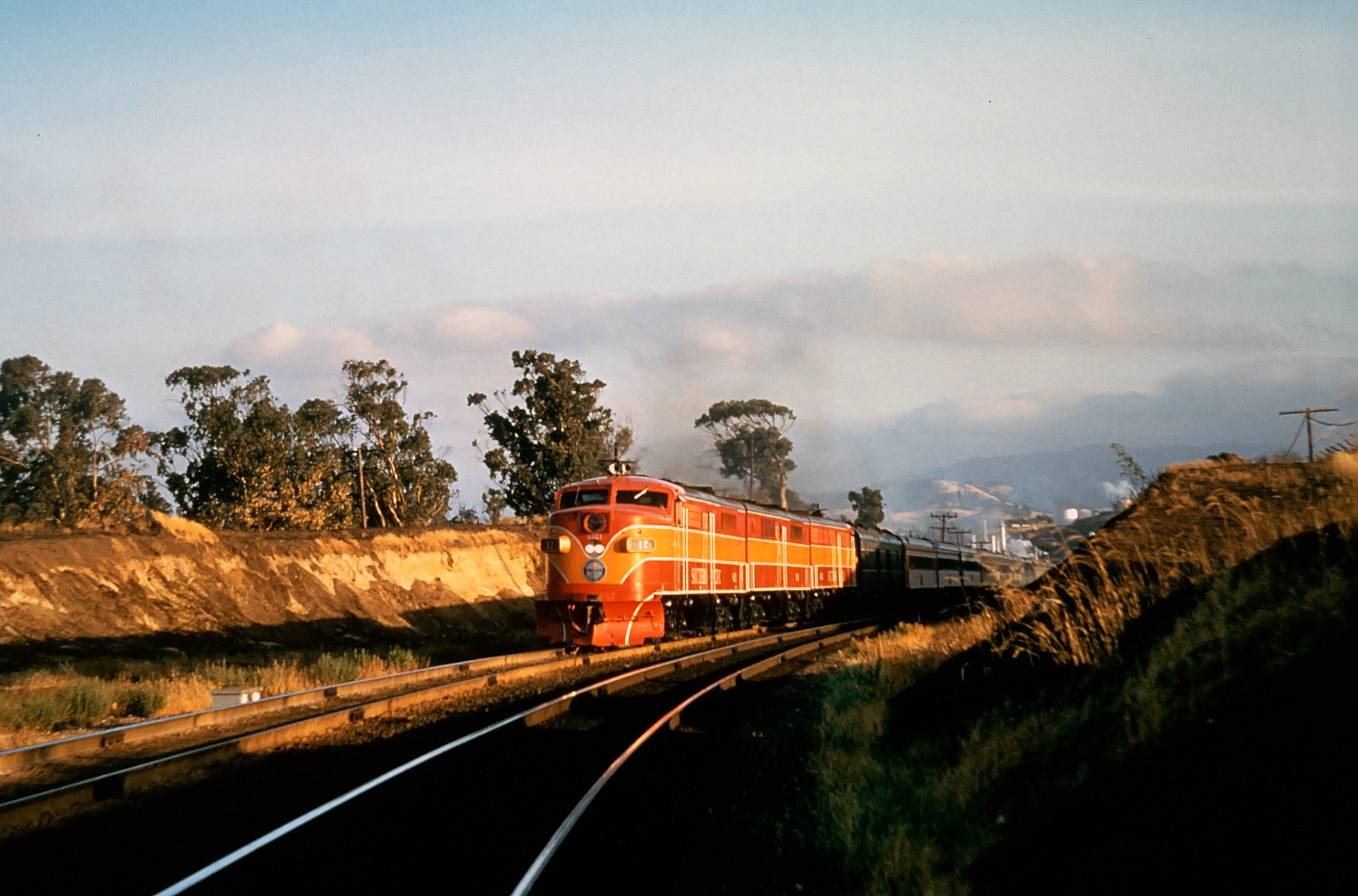 A beautiful Southern Pacific PA-PB-PA set, led by PA-1 #6021, lead train #12, the northbound "Cascade," out of the Bay Area, circa 1956. This service ran the Shasta Route, linking Oakland/San Francisco with Portland, Oregon. Gordon Glattenberg photo. American-Rails.com collection.
After a decade of dormancy, the C&O was extended to Ashland, Oregon in 1887. There it met the similarly-named Oregon & California Railroad (O&C, originally known as the Oregon Central Railroad), led by Henry Villard, which had built south from Portland.
That same year the then-bankrupt O&C was acquired. During a formal last spike ceremony (driven by Charles Crocker) on December 17th the Southern Pacific established a new corridor to Portland, better known as the Siskiyou Line which formed part of its "Shasta Route."
By 1890, SP owned a network of 8,000 route miles and as it continued growing formed the classic system remembered so well today.
In 1901 it completed the fabled "Coast Line," which offered a direct route from San Francisco to Los Angeles, via San Luis Obispo and Santa Barbara.
It was along this corridor, featuring breathtaking scenes of the Pacific Ocean, that SP unveiled its wildly successful Coast Daylight streamliner on March 21, 1937.
Thanks to this train's popularity an entire fleet was launched in the succeeding years with names like the Sacramento Daylight, San Joaquin Daylight, and Shasta Daylight.
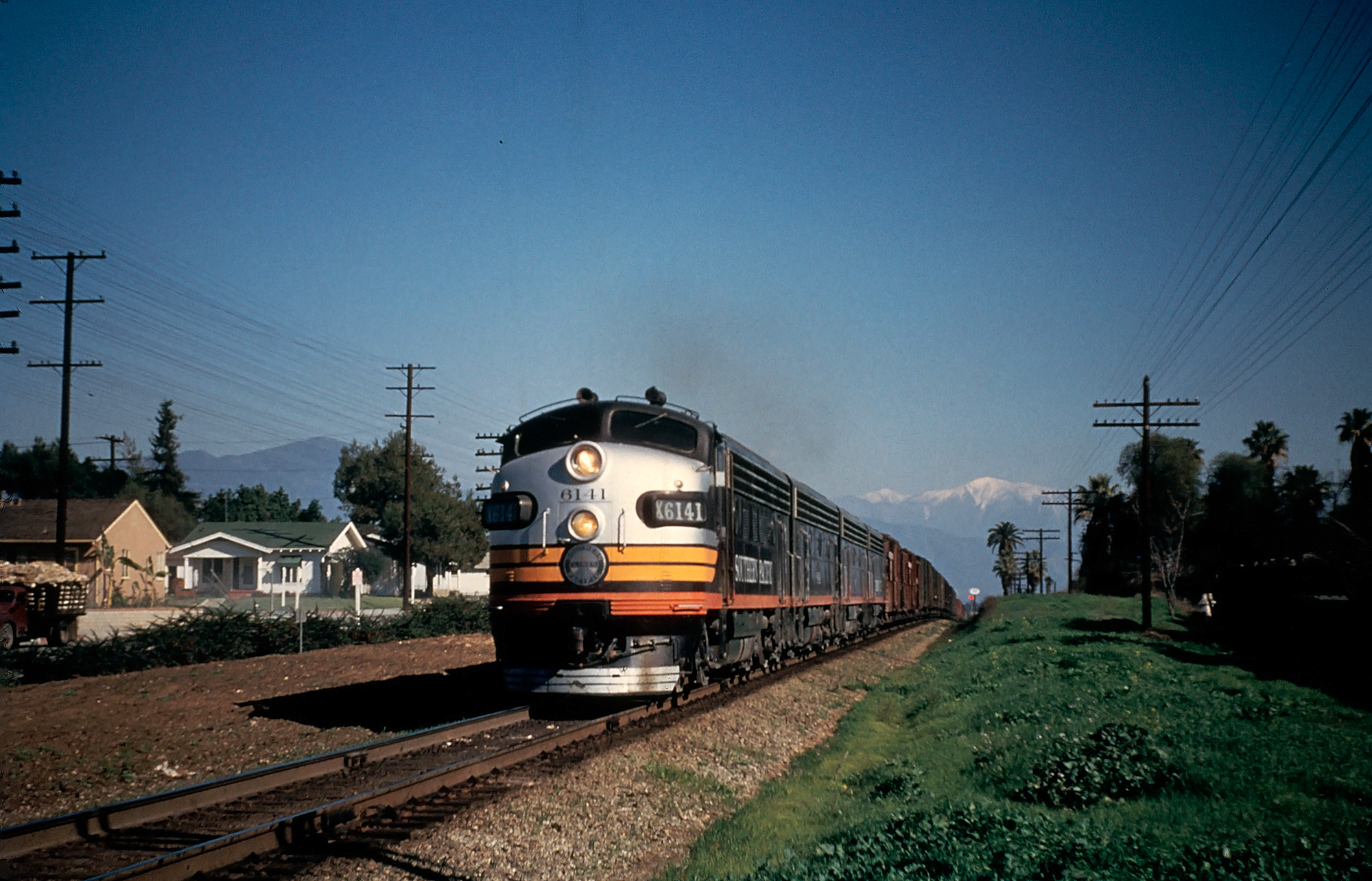 A handsome set of Southern Pacific F7's, led by #6141, lead a westbound freight consist near Pomona, California, circa 1956. Gordon Glattenberg photo. American-Rails.com collection.
Collis Huntington leadership ended with his death on August 13, 1900. He had built an impressive railroad which roughly formed a crescent moon shape extending from Portland, Oregon to New Orleans via California and the American Southwest.
In 1901, another noted mogul, Edward Harriman, acquired a 45% stake in SP; his reign lasted less than a decade when he died on September 9, 1909.
However, during his brief stint he greatly improved the property by funneling millions into rebuilding bridges, double-tracking key sections of main line, and purchasing new locomotives/equipment.
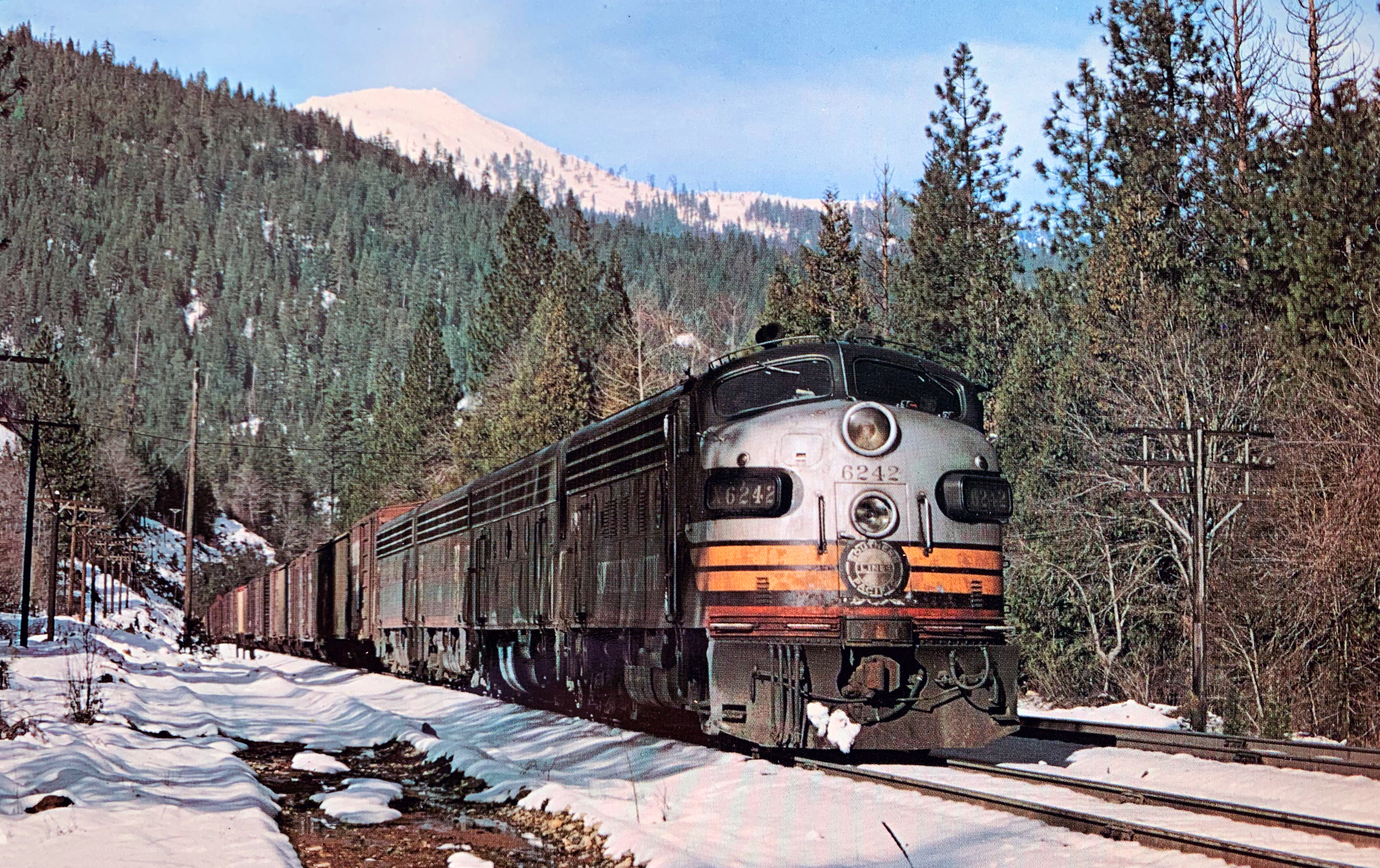 A quartet of Southern Pacific F7's, led by #6242, ease downgrade through the Sacramento River Canyon near Castella, California on January 26, 1964. Tom Gildersleeve photo. Author's collection.
Two of his most noteworthy projects included upgrading the Shasta Route and building the Lucin Cutoff. The former improved SP's Portland gateway by circumventing the steep, circuitous, and grade-riddled (as high as 3.3%) Siskiyou Line.
What was known as the Natron Cutoff, or Cascade Line, began during the Harriman era and headed east/southeast from Eugene.
It passed to the east of Crater Lake and through the Cascade Mountains but required over a decade to finish due to ongoing legal issues surrounding Harriman's ownership of both the Union Pacific and Southern Pacific (the two were separated following a Supreme Court ruling in December of 1912).
There was also the Modoc Line which opened in 1929 at a cost of $16 million; it acted as an inside gateway between southern Oregon and western Nevada.
System Map (1969)
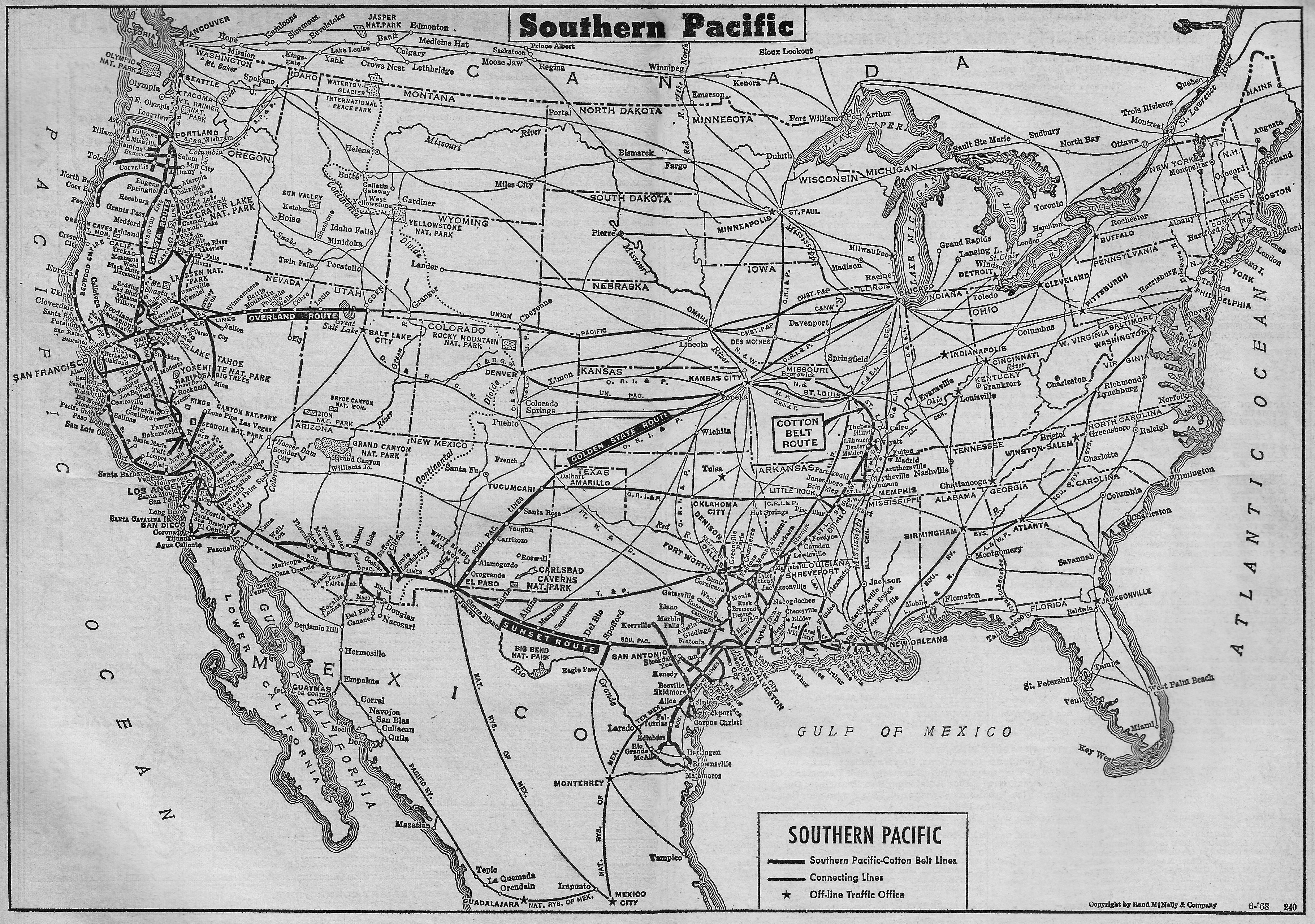
Modern Network
The Natron Cutoff was finally completed in February of 1926 where it reconnected with the Siskiyou Line at Black Butte, California. The original Lucin Cutoff, a combined 16-mile causeway and 12-mile wooden trestle, pierced the center of the Great Salt Lake. It opened in 1903 at a cost of $8.4 million.
This undertaking not only reduced grades by circumventing the lake's northern shore but also reduced 44 miles from the Ogden main line.
Throughout the 1920's the "Espee" continued its expansion program; on October 31, 1924 it purchased the 1,200-mile El Paso & Southwestern Railroad from the Phelps, Dodge Corporation for $64 million and then, nearly a decade later, added the much larger, 1,500-mile St. Louis Southwestern Railway on April 19, 1932.
The EP&SW largely served the same territory as the SP with a main line running from Benson, Arizona to El Paso. However, it did contain one important segment, a north-south line linking El Paso with Tucumcari, New Mexico where it met the Chicago, Rock Island & Pacific (Rock Island).
This interchange proved very important and became part of the railroads' Golden State Route as they worked closely in handling business between Chicago and Los Angeles. The St. Louis Southwestern, better known as the "Cotton Belt," carried even greater importance with lines connecting Texas with St. Louis.
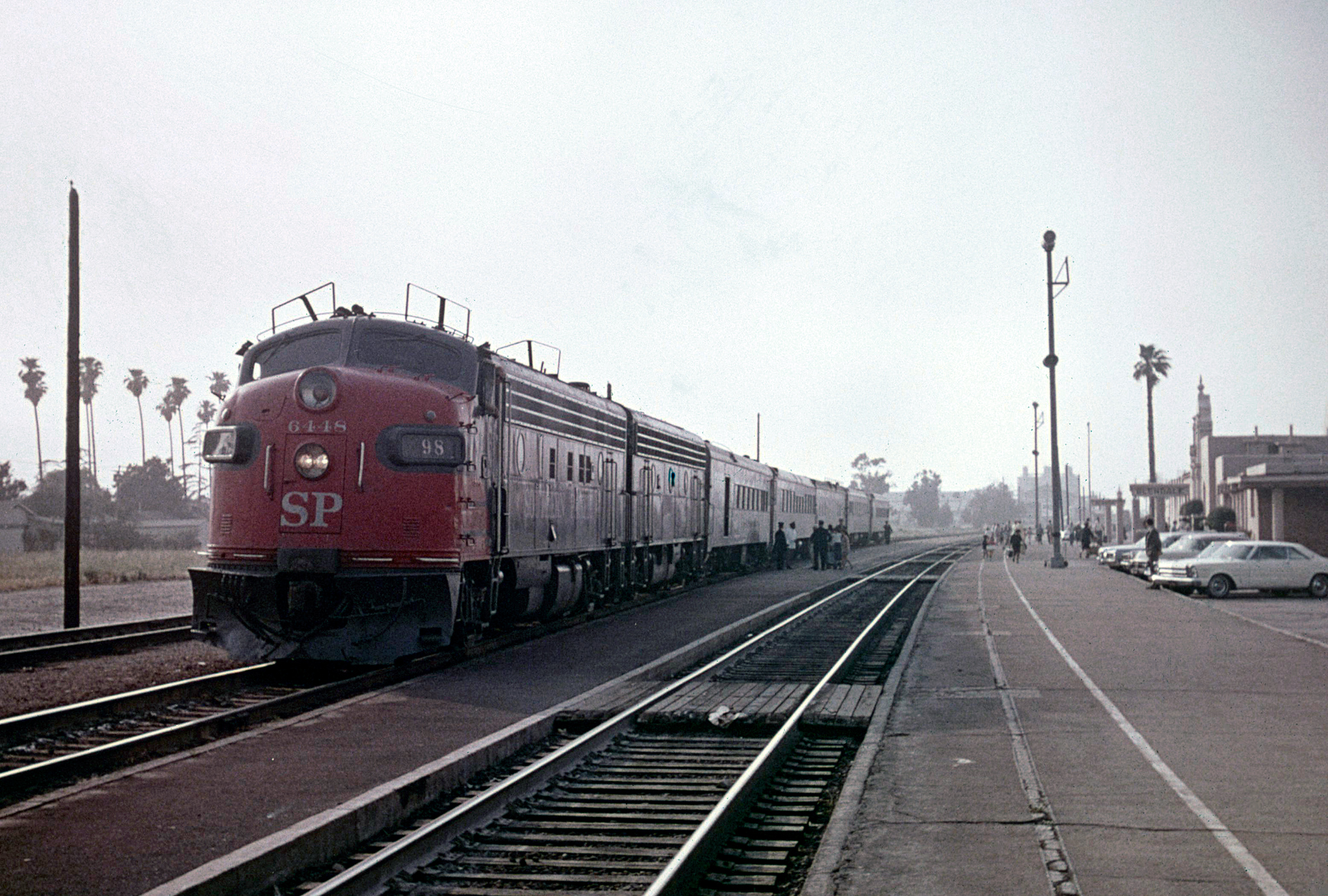 Southern Pacific FP7 #6448 is stopped at Glendale, California with train #98, the eastbound/southbound "Coast Daylight" in May of 1967. American-Rails.com collection.
The Southern Pacific is credited with launching one of the most successful and glamorous streamliners ever put into service when the previously-mentioned Coast Daylight debuted in 1937. Ironically, only two decades later the railroad became disenchanted with these trains.
First, it dropped its beautiful two-tone orange "Daylight" livery in favor of a simplified red/grey scheme and then reduced the fleet until only a few services remained by the time Amtrak began on May 1, 1971.
In the postwar years, SP increasingly turned its attention to freight; it fully dieselized in 1957 and was an early proponent of modernization.
The company was quick to utilize computers and install electronic hump yards (the first computerized hump yards opened in 1973 at West Colton, California) to increase efficiency.
It moved a wide variety of products at this time ranging from lumber, automobiles, steel and chemicals to petroleum, copper, agriculture, and trailer-on-flatcar (TOFC) service (after 1953).
The latter transitioned into container-on-flatcar (COFC), or intermodal, which became a major source of traffic after the 1980's.
To meet this demand, SP purchased its first double-stack containers in 1981. Of particular note was its once highly lucrative perishable business serving California's lush San Joaquin Valley.
In 1886 the railroad developed the first refrigerator car, or reefer, and later worked with Union Pacific to inaugurate Pacific Fruit Express (PFE).
As Mike Schafer notes in his book "Classic American Railroads," by 1962 the two owned some 22,000 reefers operating as part of dedicated time freights.
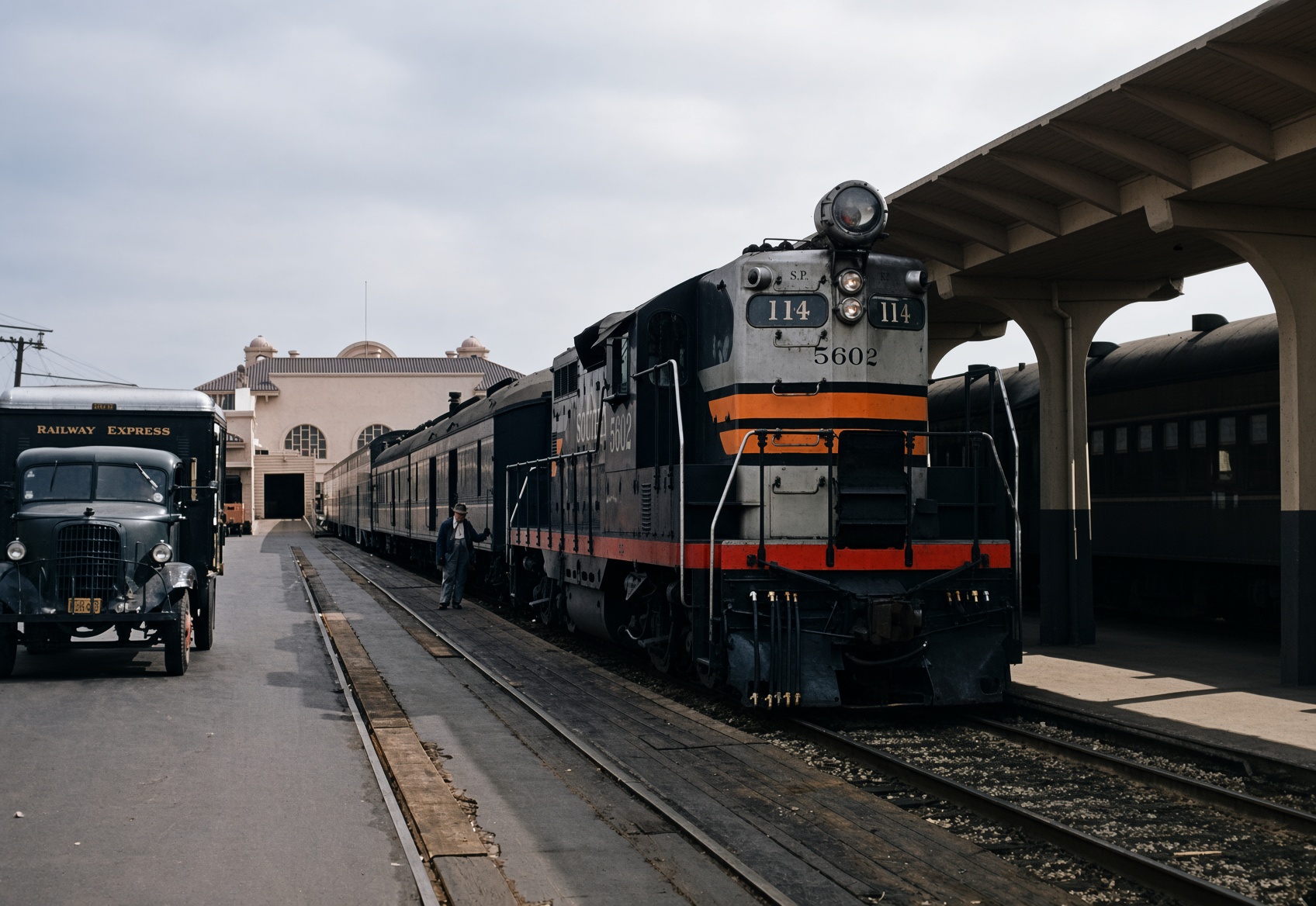 Southern Pacific GP9 #5602 awaits departure from San Francisco's 3rd & Townsend Depot with commuter train #114 in September, 1956. American-Rails.com collection.
For all of the railroad’s historic wealth and prosperity (it even weathered the Great Depression without experiencing bankruptcy) traffic pattern shifts, coupled with poor management, proved costly. Donald J. Russell, who took the helm on January 1, 1952, was the company's last great leader.
He expected a well-run and well-maintained railroad on the cutting edge of innovation. However, as Don Hofsommer points out in his article, "Not Only A Railroad, But An Empire: How SP Went From Mighty Octopus To Tarnished Suitor," from the March, 1998 issue of Trains Magazine, following his departure SP's fortunes took a turn for the worse.
On May 17, 1972, Benjamin F. Biaggini succeeded Russell. He was brought in for a singular purpose, diversification. With much of the industry struggling after the 1950's many turned to holding companies as a means of expanding their portfolios to escape the transportation sector's cyclical nature.
While financial difficulties were not being experienced at the time its board nevertheless felt the plan was important for long term growth.
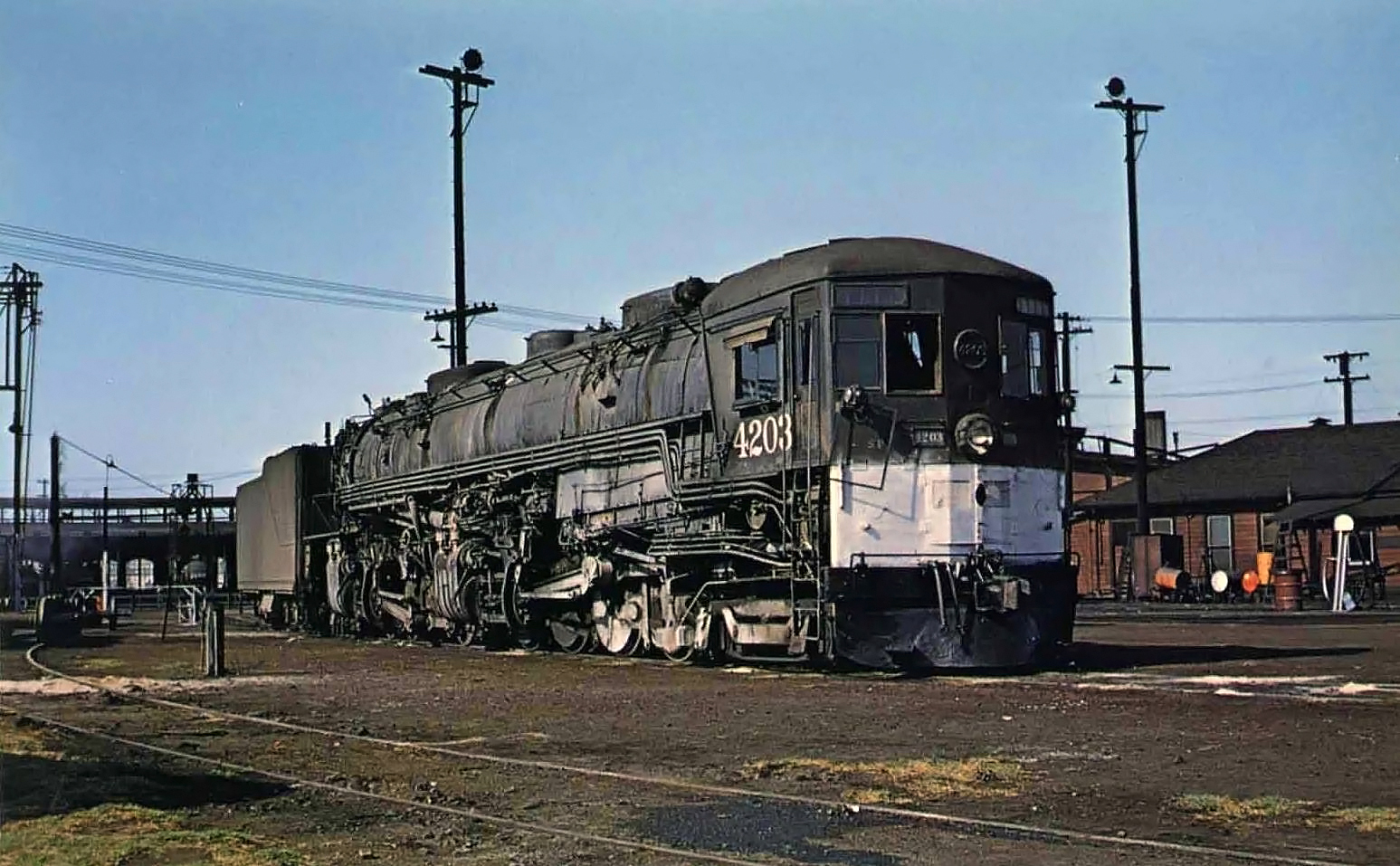 Southern Pacific 4-8-8-2 "Cab Forward" #4203 (AC-8) is seen here between assignments in West Oakland, California on September 22, 1955. Harold Stewart photo.
Southern Pacific Communications Company
In 1969 a new Southern Pacific Company was born as a holding company for the railroad (Southern Pacific Transportation Company), the new Southern Pacific Communications Company (SPCC), and the SP's lesser subsidiaries.
The SPCC was created for public use, most notably as a telephone provider, but its history can be traced back much, much further. It was originally born from a great need by the railroad to provide its own efficient and reliable means of communication within its vast, 15,000-mile network.
According to Mr. Yenne's book, by 1953 Southern Pacific had developed the largest private communications system in the world. What began as a general telegraph/telephone line system eventually developed into an intricate, reliable, and highly technological network (which included microwave) that covered 500,000 channel miles with a 99.96% daily reliability rate.
The system could be used for direct communication as well as facsimile transmission, telemetering, dispatching, CTC, VHF radio, and car identification.
In 1973, the railroad began marketing the Southern Pacific Communications Company to the general public. As it grew and became profitable it was sold to General Telephone & Electronics (GTE) in 1982 for $740 million. Today, this
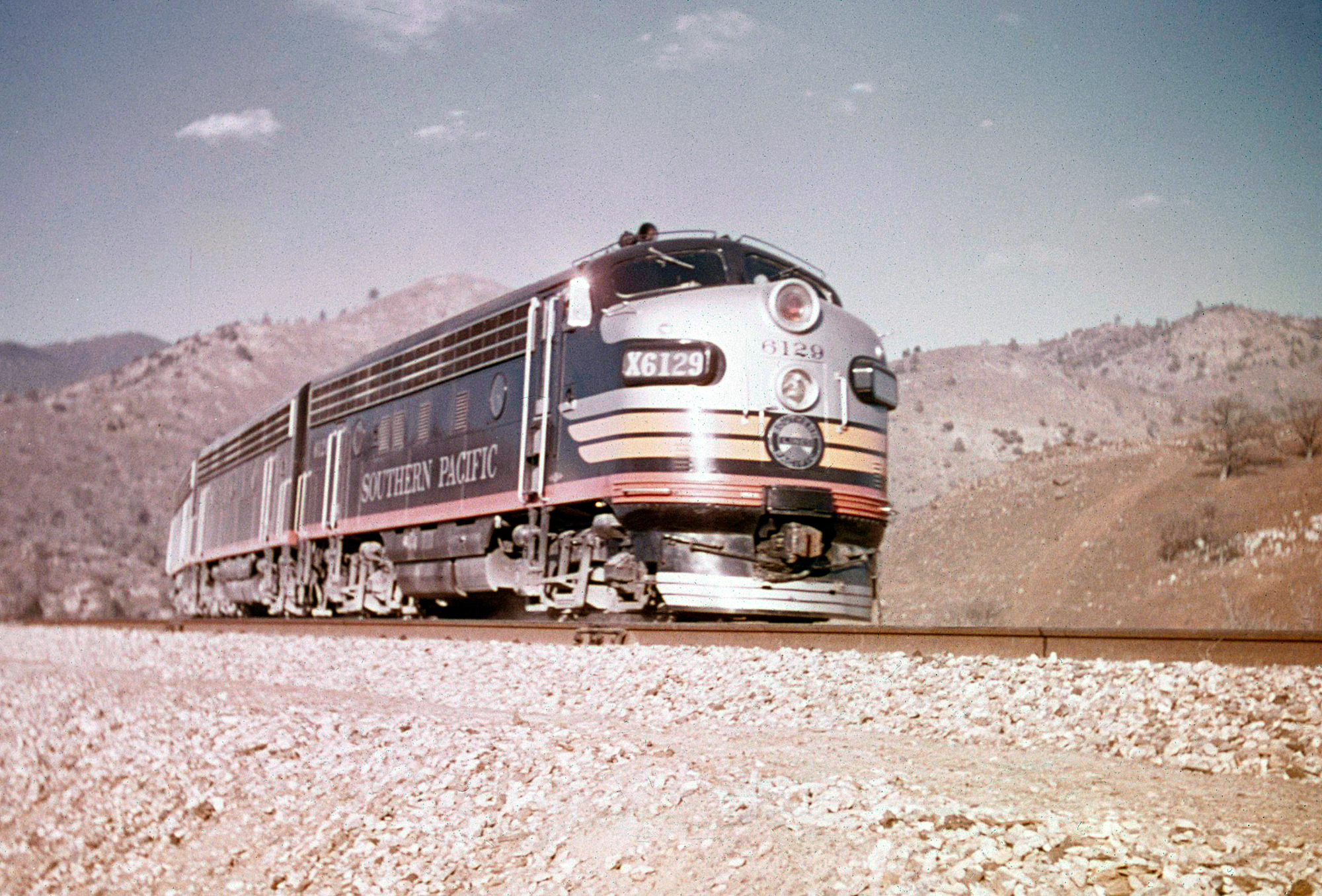 Southern Pacific F7A #6129 leads an eastbound freight near Bakersfield, California during the 1950s. American-Rails.com collection.
In doing so, the railroad was neglected, a common theme from the holding company era. As service rapidly declined and the country shifted from a manufacturing base to services, business evaporated.
Its once profitable automotive traffic and San Francisco industrial base disappeared as plants either closed or moved overseas.
SP's perishable losses were a direct result of poor service, both of its own making and the disaster unfolding back east where Penn Central's collapse was being felt nationwide. Farmers could ill-afford to lose their cash crops and, as a result, quickly abandoned trains for trucks.
The SP's once sprawling network of branch lines and spurs throughout the valley, seemingly reaching every farm and field, had largely been abandoned by the 1980's.
In barely a decade one of the industry's stars, carrying a network of 15,039 route miles (including the Cotton Belt), was desperately trying to avoid bankruptcy.
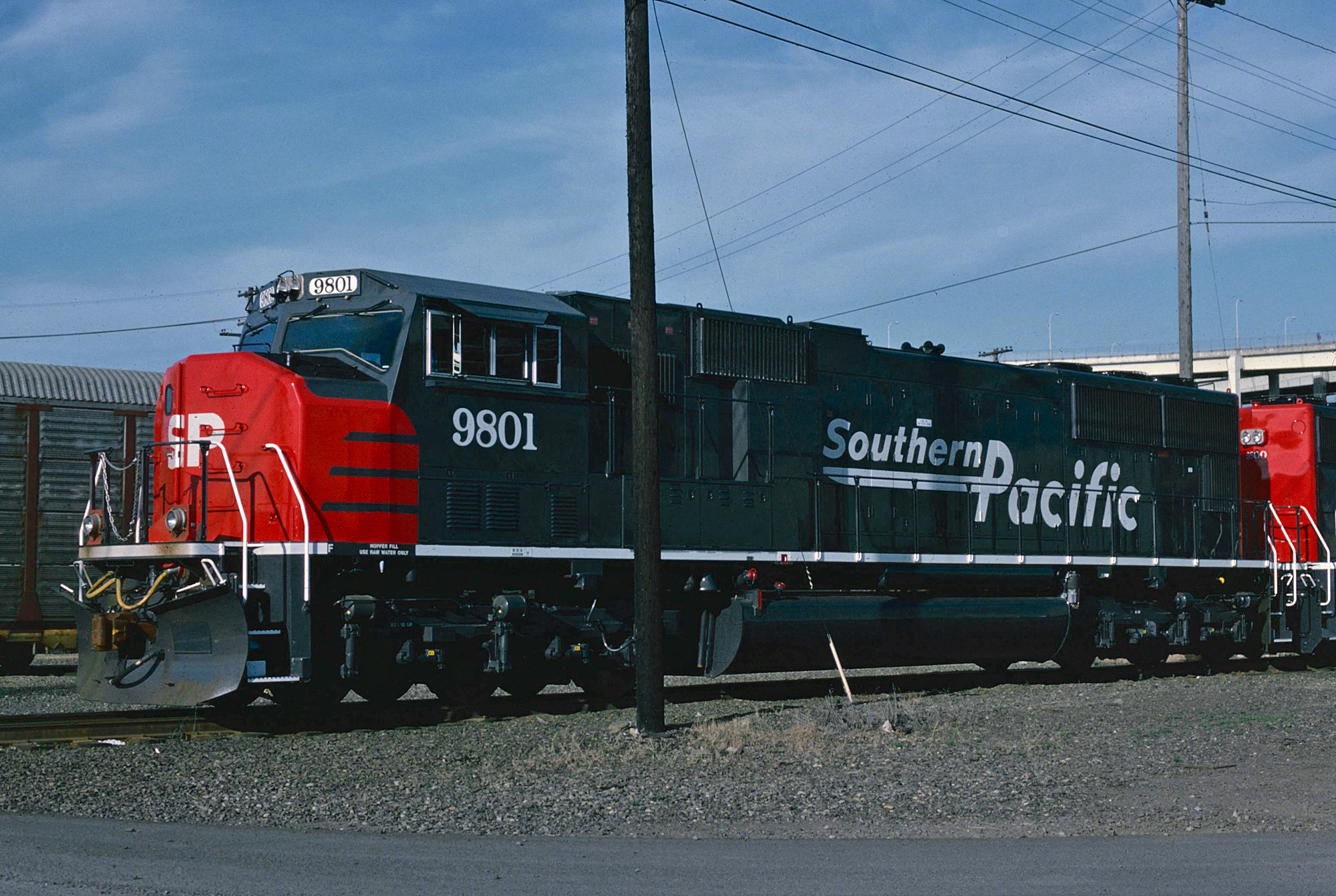 Southern Pacific SD70M #9801, just two months old, was photographed here by Keith Ardinger in Portland, Oregon on June 30, 1994. American-Rails.com collection.
To do so, Southern Pacific sought merger with a stronger carrier. It found one in the powerful and world-renowned Santa Fe.
Steve Glischinski notes in his book, "Santa Fe Railway," the Atchison, Topeka & Santa Fe and SP announced on May 15, 1980 they would become one to form the Southern Pacific & Santa Fe Railway.
Within months these talks ended but were renewed just three years later on September 27, 1983. In these latest discussions a merger was approved, which created the Santa Fe Southern Pacific Corporation.
 Southern Pacific SD40R #7347, wearing a special livery for the 1984 Summer Olympic Games, works freight service over Cajon Pass in February, 1985. Karl Miller photo.
Passenger Trains
Argonaut: (Los Angeles - New Orleans)
Cascade: (Oakland - Portland)
City of San Francisco: Union Pacific's streamliner forwarded by the SP to Oakland, California.
The Daylight Fleet: (San Francisco - Los Angeles)
Del Monte: (San Francisco - Monterey)
Golden State: (Los Angeles - Chicago via Tucumcari in conjunction with the Rock Island)
Imperial: Operated between Los Angeles and Chicago in conjunction with the Rock Island.
Lark: (Oakland/San Francisco - Los Angeles via San Luis Obispo)
Owl: (San Francisco - Los Angeles)
Sacramento Daylight: (Sacramento - Los Angeles)
San Francisco Overland: Until 1955 operated in conjunction with UP and C&NW between Los Angeles and Chicago. Afterward operated only west to St. Louis via the Wabash Railroad.
San Joaquin Daylight: (Oakland - Los Angeles via Bakersfield)
Shasta Daylight: (Oakland - Portland)
Starlight: (San Francisco - Los Angeles)
Sunbeam/Hustler: (Houston - Dallas)
Sunset Limited: (Originally San Francisco - New Olreans, later Los Angeles - New Orleans)
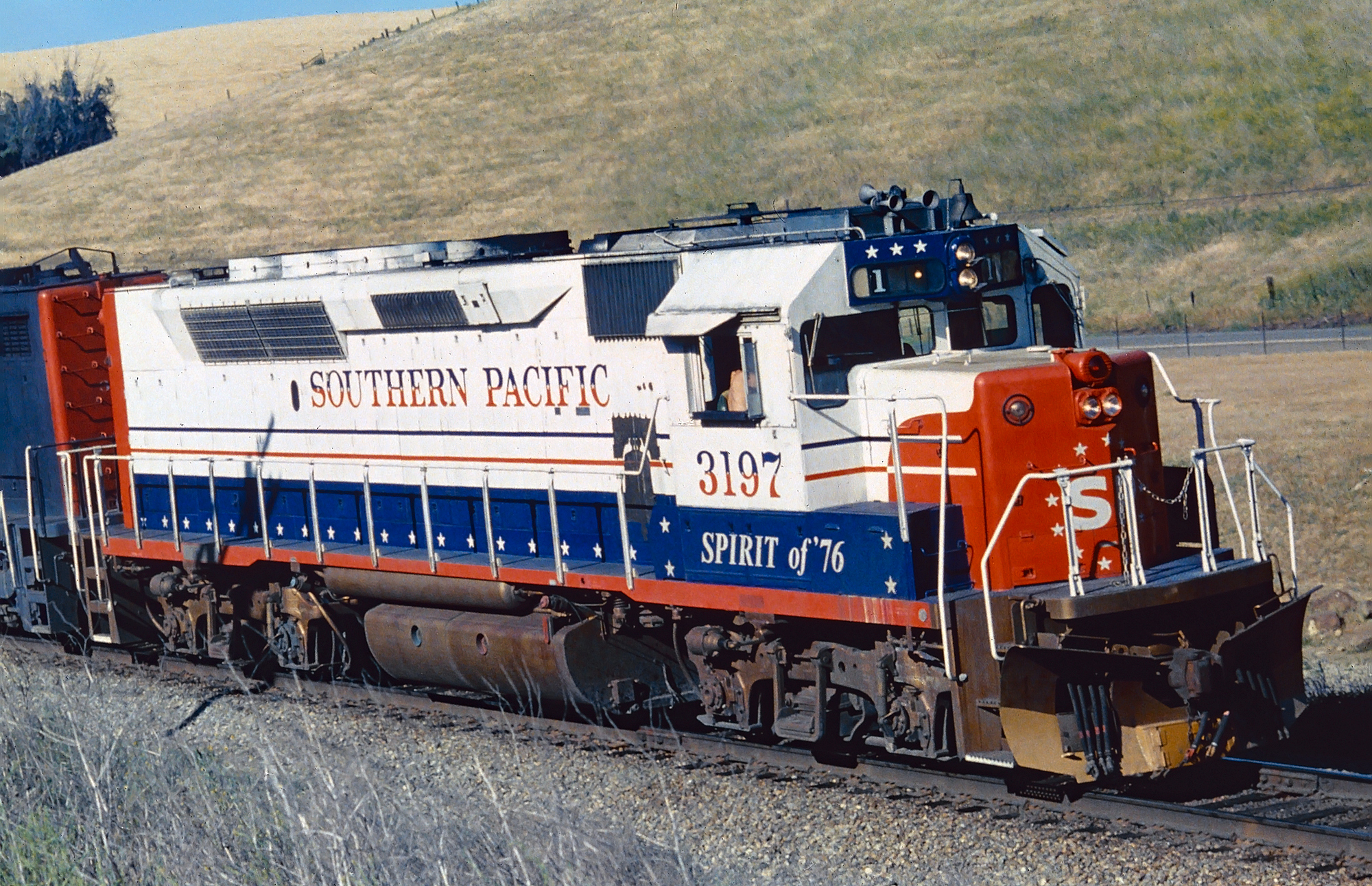 Southern Pacific GP40P-2 #3197, wearing its Bicentennial livery, is seen here in service on Altamont Pass, California, circa 1978. Gary Perrazo photo. American-Rails.com collection.
While the two railroads remained separate their holding companies (Santa Fe Industries and Southern Pacific Company) were joined on December 23, 1983.
In a stunning defeat, the Interstate Commerce Commission announced on July 24, 1986 that it had denied the marriage on monopolistic grounds.
The stillborn railroad had even adopted a new livery of red and yellow (dubbed the "Kodachrome" scheme), which had been applied to some locomotives and equipment. Railfans facetiously dubbed it "Shouldn't Paint So Fast."
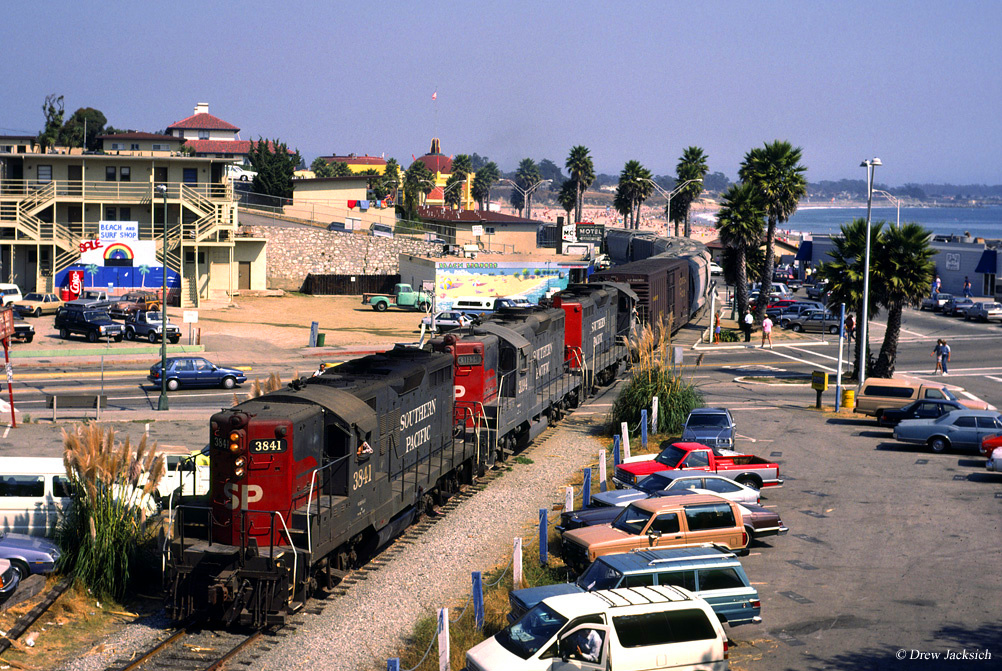 During the late Southern Pacific era a trio of GP9s, led by #3841, roll along Beach Street in Santa Cruz, California with the Santa Cruz Local headed for the nearby yard during September of 1987. Drew Jacksich photo.
Diesel Roster
American Locomotive Company
| Model Type | Road Number | Date Built | Quantity |
|---|---|---|---|
| S1 | 10 (T&NO), 1017-1020 | 1941 | 5 |
| S2 | 30-71 (T&NO), 89-94 (T&NO), 1300-1309, 1330-1370, 1386-1392, 1426-1441 | 1941-1950 | 122 |
| S4 | 95-104 (T&NO), 1464-1485, 1514-1528, 1551-1567 | 1951-1955 | 64 |
| PA-1 | 200A-205A (T&NO), 200B-205B (T&NO), 6005A-6010A, 6005C-6010C | 1948-1949 | 24 |
| HH-660 | 1001-1003 | 1939 | 3 |
| S3 | 1023-1032 | 1951 | 10 |
| S6 | 1033-1090, 4634-4645 | 1955-1956 | 70 |
| C415 | 2400-2409 | 1966 | 10 |
| RSD15 | 4816-4818 | 1959 | 3 |
| C628 | 4845-4869 | 1965 | 25 |
| RSD5 | 5294-5307, 5336-5339, 5445-5448, 5494-5507 | 1953-1956 | 36 |
| RS11 | 5723-5729, 5845-5871 | 1956-1959 | 34 |
| PB-2 | 5918-5924 | 1950-1953 | 7 |
| PB-1 | 6005B-6010B | 1948-1949 | 6 |
| PA-2 | 6019-6045, 6900-6905 | 1950-1953 | 33 |
| RSD12 | 7000-7020 | 1961 | 21 |
| RS32 | 7300-7309 | 1962 | 10 |
| C630 | 7800-7814 | 1966 | 15 |
| C643 | 9018-9020 | 1964 | 3 |
Baldwin Locomotive Works
| Model Type | Road Number | Date Built | Quantity |
|---|---|---|---|
| S12 | 105-107 (T&NO), 1442-1463, 1492-1513, 1539-1550 | 1951-1953 | 59 |
| AS416 | 177-184 (T&NO), 5228-5278 | 1950-1952 | 59 |
| DRS-6-6-1500 (A) | 187-190 (T&NO), 5203-5226 | 1949-1950 | 28 |
| VO-660 | 1021-1022 | 1941 | 2 |
| VO-1000 | 1320-1329, 1371-1385 | 1941-1944 | 25 |
| DS-4-4-1000 | 1393-1402 | 1948 | 10 |
| DRS-6-6-1500 (B) | 5227 | 1950 | 1 |
| DRS-6-4-1500 | 5200-5202 | 1948 | 3 |
Electro-Motive Corporation/Electro-Motive Division
| Model Type | Road Number | Date Built | Quantity |
|---|---|---|---|
| E2A | SF1 | 1937 | 1 |
| E2B | SF2-SF3 | 1937 | 2 |
| E6A | SF4 | 1941 | 1 |
| E6B | SF5-SF6 | 1941 | 2 |
| SW1 | 11 (T&NO), 1000, 1004-1016 | 1939-1941 | 15 |
| SW8 | 12-16 (T&NO), 4604-4623 | 1953-1954 | 25 |
| NW2 | 72-88 (T&NO), 1310-1319, 1403-1425 | 1941-1949 | 40 |
| SW9 | 108-112 (T&NO) | 1953 | 5 |
| SW1200 | 113-118 (T&NO), 123-128 (T&NO), 1597-1606 | 1954-1965 | 22 |
| GP9 | 240-249 (T&NO), 280-283 (T&NO), 400-410 (T&NO), 411-458 (T&NO), 5600-5719, 5730-5844, 5872-5891 | 1954-1959 | 318 |
| F7A | 338-381 (T&NO), 6140A-6169A, 6140D-6169D, 6240-6423, 6440-6445 | 1949-1953 | 288 |
| F7B | 538-553, 6140B-6169B, 6140C-6169C, 8140-8303 | 1949-1953 | 240 |
| E7A | 907A, 6000A-6004A | 1946-1947 | 6 |
| E7B | 908B-909B, 6000B-6004B, 6000C-6004C | 1946-1947 | 12 |
| SW1500 | 2450-2480, 2493-2510, 2523-2578, 2591-2689 | 1967-1969 | 204 |
| MP15DC | 2690-2701 | 1974-1975 | 12 |
| MP15AC | 2702-2731, 2736-2759 | 1975 | 54 |
| SD38-2 | 2971-2976 | 1973 | 6 |
| GP40P-2 | 3197-3199 | 1974 | 3 |
| SDP45 | 3200-3209 | 1967 | 10 |
| TR6 | 4600-4700 (Cow-Calf), 4601-4603 (Cow), 4701-4703 (Calf) | 1950-1951 | 8 |
| SW900 | 4624-4633 | 1954 | 10 |
| GP38-2 | 4800-4844 (Second) | 1980 | 45 |
| SD35 | 4816-4844 (First) | 1963-1965 | 29 |
| SD7 | 5279-5293, 5308-5335 (First) | 1952-1953 | 43 |
| SD39 | 5300-5325 (Second) | 1968 | 26 |
| SD9 | 5340-5444, 5449-5493 | 1954-1956 | 150 |
| E8A | 6018 | 1950 | 1 |
| E9A | 6046-6054 | 1954 | 9 |
| F3A | 6100A-6139A, 6100D-6139D | 1947-1949 | 280 |
| F3B | 6100B-6139B, 6100C-6139C | 1947-1949 | 280 |
| FP7 | 6446-6461 | 1953 | 16 |
| GP20 | 7200-7237 (First) | 1960-1962 | 38 |
| GP40X | 7200-7201, 7230-7231 (Second) | 1978 | 4 |
| GP30 | 7400-7407 | 1963 | 8 |
| GP35 | 7408-7484, 7700-7782 | 1963-1965 | 160 |
| GP40-2 | 7608-7627, 7640-7677 | 1978-1984 | 58 |
| SD40T-2 | 8230-8391, 8489-8573 | 1974-1979 | 247 |
| DD35 | 8400-8402 (First) | 1964 | 3 |
| SD40 | 8400-8488 (Second) | 1966 | 89 |
| SD45 | 8800-8963, 8982-9051, 9069-9151 | 1966-1970 | 348 |
| SD45T-2 | 9166-9313, 9344-9370 | 1972-1975 | 175 |
| SD45X | 9500-9505 | 1970-1971 | 6 |
| GP60 | 9600-9619, 9715-9794 | 1988-1994 | 100 |
| SD70M | 9800-9824 | 1994 | 25 |
Fairbanks Morse
| Model Type | Road Number | Date Built | Quantity |
|---|---|---|---|
| H12-44 | 1486-1491, 1529-1596 | 1952-1957 | 74 |
| H24-66 (Train Master) | 4802-4815 | 1953-1954 | 14 |
General Electric
| Model Type | Road Number | Date Built | Quantity |
|---|---|---|---|
| 50-Tonner (Narrow-Gauge) | 1 | 1954 | 1 |
| AC4400CW | 100-378 | 1995 | 279 |
| 70-Tonner | 5100-5120 (First) | 1949-1955 | 21 |
| B23-7 | 5100-5114 (Second) | 1980 | 15 |
| U28B | 7025-7028 | 1966 | 4 |
| U28C | 7150-7159 | 1966 | 10 |
| U25B | 7500-7567 | 1962-1966 | 68 |
| B36-7 | 7754-7769 | 1984 | 16 |
| B30-7 | 7800-7883 | 1978-1979 | 84 |
| U30C | 7900-7936 | 1968-1969 | 37 |
| B39-8 | 8000-8039 | 1987 | 40 |
| C44-9W | 8100-8200 | 1994 | 101 |
| U50 | 8500-8502 | 1964 | 3 |
| U33C | 8585-8796 | 1969-1975 | 212 |
Steam Roster
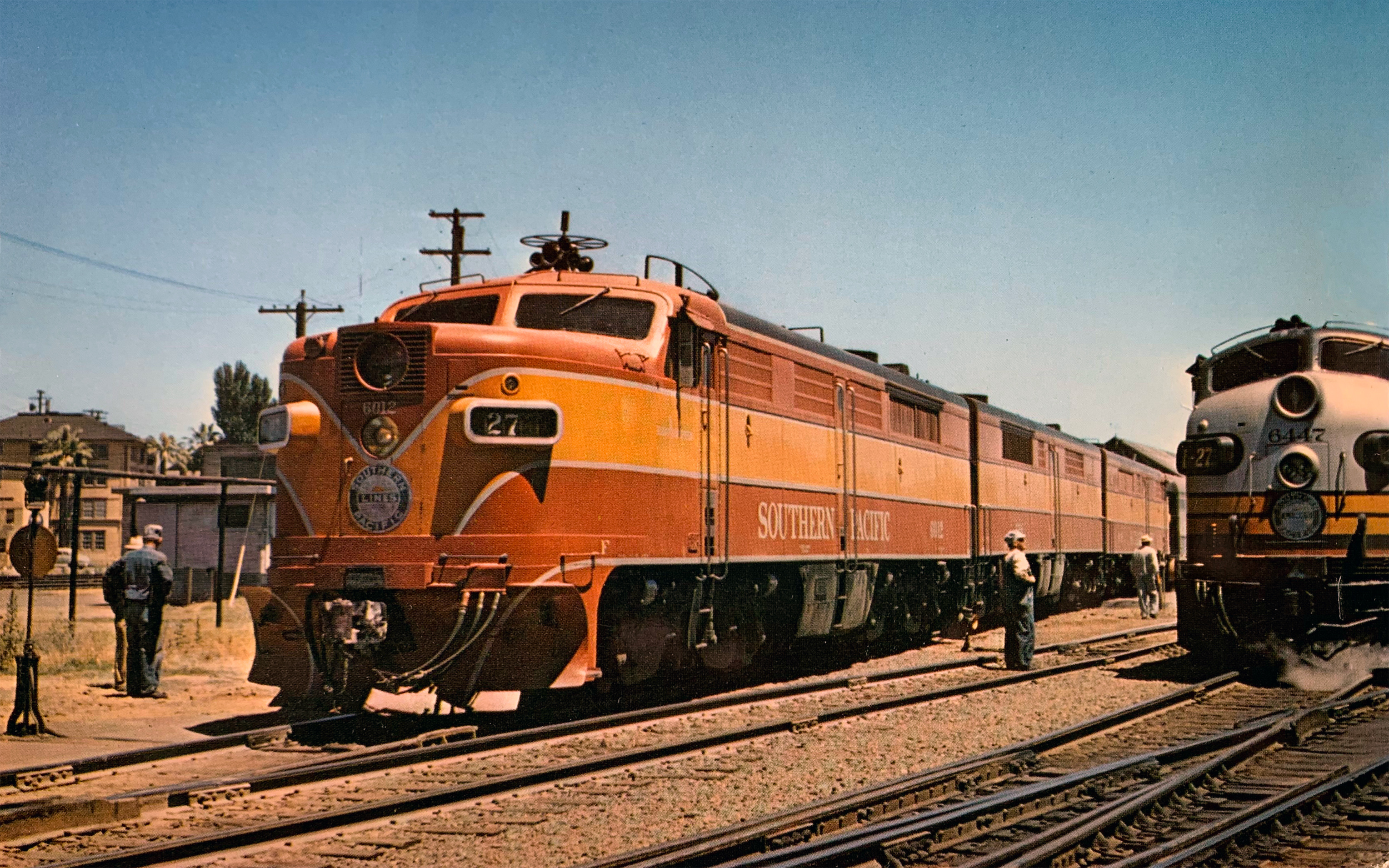 Southern Pacific PA-1 #6012 (built as #6008-C) is paused at Sacramento, California with train #27, the westbound "San Francisco Overland," in 1957. Harold Elmore photo. Author's collection.
Rio Grande Industries Takeover
Despite this setback, the SP did enjoy one bright spot that decade; in 1980 it acquired the bankrupt Rock Island's Golden State Route from Tucumcari to St. Louis, via Kansas City, operated by subsidiary Cotton Belt.
A few years later Southern Pacific finally found a partner when Rio Grande Industries, parent to the Denver & Rio Grande Western (Rio Grande) purchased the railroad in 1988.
Interestingly, in a nearly unheard of decision, Rio Grande elected to use the much more prominent Southern Pacific name instead of its own. Combined, the two railroads formed a 17,340 mile system.
A mere seven years later, in 1995, Union Pacific announced it would acquire the entire Southern Pacific as a counter-move to the Burlington Northern and Santa Fe merger.
The union was approved by the new Surface Transportation Board (successor to the Interstate Commerce Commission) and a much larger Union Pacific came to be on September 11, 1996.
SP was so large that UP encountered a logistical nightmare that nearly resulted in total gridlock as yards clogged, transit times greatly increased, and operating ratios soared.
Unlike the Penn Central disaster, though, UP managed to work out the kinks. Today, Southern Pacific's legacy lives on in its main lines and Amtrak's operation of its former passenger services.
Union Pacific also paid homage to several predecessors in 2005, including SP, by painting one of its new EMD SD70ACe locomotives into a version of the railroad’s famous Daylight passenger livery; it was numbered 1996 in honor of the year the railroad joined UP's system.
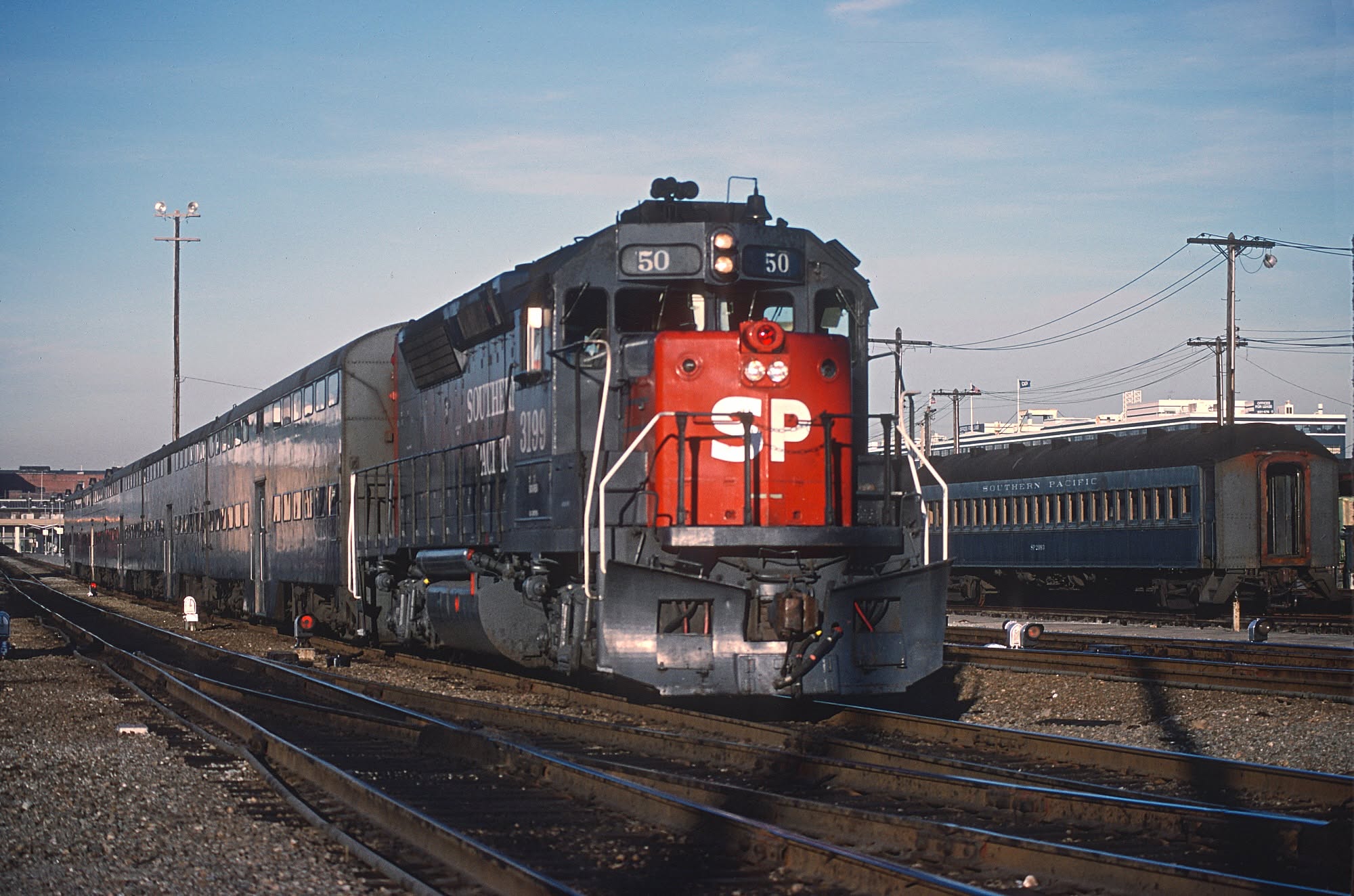 Southern Pacific GP40P-2 #3199 with commuter train 50 at the 4th and Townsend Terminal in San Francisco in November, 1984. Roger Puta photo.
 A tired and worn Southern F7A #6303, still clad in the road's venerable Black Widow livery, leads a perfect A-B-B-A set of covered wagons across Stockton Avenue in San Jose, California during August of 1966. Drew Jacksich photo.
More Reading
Recent Articles


-
Canadian National Railway: Map, Logo, History, Photos
Sep 16, 26 12:27 AM
 Canadian National—name Dec 20 1918, incorporated June 6 1919, Grand Trunk Jan 20 1923. Crown corporation, IPO Nov 17 1995. IC, Wisconsin Central, BC Rail, EJ&E. Class I, mark CN.
 -
Buffalo, Rochester and Pittsburgh Railway: "Safety and Service"
Sep 16, 26 12:12 AM
 Buffalo, Rochester & Pittsburgh—Rochester & State Line 1869, BR&P March 12 1887. Pennsylvania coal to Buffalo and Rochester. B&O January 1 1932. All-time steam roster, LL 2-6-6-2s, XX…
 -
Buffalo Creek & Gauley Railroad: Map, Roster, Logo, Photos
Sep 15, 26 11:55 PM
 Buffalo Creek & Gauley—Elk River Coal & Lumber, April 1 1904, Dundon–Widen. Last all-steam WV coal road, February 27 1965. All-time steam roster, #4 Baldwin 59472, Majestic and Elk River diesels…
 -
Buffalo and Susquehanna Railroad: Map & History
Sep 15, 26 11:42 PM
 Buffalo & Susquehanna—Goodyear hemlock railroad, Sinnemahoning Valley December 14 1885, 1893 merger, coal to Sagamore, Buffalo extension, bankruptcy May 6 1910, B&O 1932, WAG 1956.
 -
WMSR Allegheny Mountain Dinner Train (2026): Dates & Tickets
Sep 15, 26 11:36 PM
 2026 Western Maryland Scenic Allegheny Mountain Dinner Train—Cumberland, 3 hours, 21+, Saturday 7 p.m. Confirm on wmsr.com.
 -
Boston and Albany Railroad: Map & History
Sep 15, 26 11:28 PM
 Boston & Albany Railroad—Boston & Worcester June 23 1831, Western Railroad across the Berkshires, merger 1867–70. NYC 99-year lease July 1 1900. Berkshires, New England States, CSX and MBTA today.
 -
Grand Bellevue Dinner Train (2026): Portsmouth, Rhode Island
Sep 15, 26 11:14 PM
 2026 Grand Bellevue Rail Dining in Portsmouth, RI—2.5-hour seated dinner on Narragansett Bay. Fall/winter TBA after Aug. 29. Confirm on thegrandbell.com.
 -
The "John Bull": The C&A's First Locomotive (1831)
Sep 15, 26 11:01 PM
 John Bull locomotive—Stephenson Planet-type 0-4-0, 1831. Dripps assembly, 4-2-0 rebuild, cowcatcher. Specs, Camden & Amboy career, Smithsonian 1884, 1981 steam-up, 1939 replica.
 -
Napa Valley Wine Train Dining (2026): Lunch, Dinner & Vista Dome
Sep 15, 26 10:56 PM
 2026 Napa Valley Wine Train dining—downtown Napa, 36-mile round trip, gourmet lunch and dinner, Vista Dome. Confirm packages on winetrain.com.
 -
My Old Kentucky Dinner Train (2026): Dates, Tickets & What to Expect
Sep 15, 26 10:50 PM
 2026 My Old Kentucky Dinner Train in Bardstown—2.5 hours, 35-mile round trip, four-course dinner from $116. Confirm on kydinnertrain.com.
 -
LaSalle Street Station: One Of Chicago's Great Terminals
Sep 15, 26 10:42 PM
 LaSalle Street Station—Rock Island October 10, 1852. Frost & Granger July 1, 1903. 20th Century Limited, Rockets, Golden State. Headhouse razed 1981. Metra Rock Island District today.
 -
Charlie Russell Chew Choo (2026): Montana Dinner Train from Lewistown
Sep 15, 26 10:39 PM
 2026 Charlie Russell Chew Choo dinner train—Hanover/Lewistown, 4.5 hours, 56-mile round trip, prime rib. Adult $151. Remaining listed dates sold out. Confirm on montanadinnertrain.com.
 -
Central Pacific Railroad: Map, History, Facts, Logo
Sep 15, 26 10:30 PM
 Central Pacific—Judah, Big Four, June 28 1861. Sierra, Chinese labor, Donner Summit Tunnel. Ten-mile day April 28 1869. Promontory May 10. Southern Pacific lease April 1 1885. Dissolved June 30 1959…
 -
Bessemer & Lake Erie Railroad: "The Bessemer Road"
Sep 15, 26 05:20 PM
 Bessemer & Lake Erie—Bear Creek 1865, Carnegie 1897, U.S. Steel 1901. Ore south from Conneaut, coal north. 2-10-4s, Missabe sister road. CN May 10, 2004. Complete corporate history.
 -
Bangor and Aroostook Railroad: "Serving Northern Maine"
Sep 15, 26 05:05 PM
 Bangor & Aroostook—chartered February 13, 1891, first trains January 1, 1894. Potatoes, paper, Searsport, State of Maine reefers. MM&A 2003, Lac-Mégantic 2013, CP 2020, CPKC today. Complete co…
 -
Baltimore & Ohio Chicago Terminal Railroad: Map and History
Sep 15, 26 03:11 PM
 B&OCT—formed January 6, 1910 to buy Chicago Terminal Transfer. Grand Central, Barr Yard, 78 route-miles. Assigned B&O steam. Complete diesel roster. CSX paper subsidiary, mark BOCT.
 -
The "Alphabet Route" (Railroad): Photos and History
Sep 15, 26 02:53 PM
 Alphabet Route—eight railroads, not one company. P&WV to Connellsville February 11, 1931. Alpha Jets Chicago/St. Louis–New York/Boston. NKP, W&LE, P&WV, WM, Reading, CNJ, L&HR, New Hav…
 -
Milwaukee Road Livestock Operations: Cattle, Dakotas & Montana
Sep 15, 26 02:36 PM
 Milwaukee Road livestock traffic—Dakota and Montana cattle, Iowa hogs, Chicago markets, 28-hour law, head-end stock cars. By 1974 mostly Montana. Rick Burn’s Helena speech. Operations history, not the…
 -
Spirit of Jasper Ride & Dine (2026): Season Pause
Sep 15, 26 02:29 PM
 Spirit of Jasper Ride & Dine in Jasper, Indiana—seated meal on board. Operator: not running public trains for 2026. Depot remains open as a rental. Confirm on spiritofjaspertrain.com.
 -
South Carolina Canal & Rail Road Company: Map and History
Sep 15, 26 01:59 PM
 South Carolina Canal & Rail Road—chartered December 19, 1827. Best Friend of Charleston, 136 miles Charleston–Hamburg October 1833, Aiken inclined plane. South Carolina Railroad 1844, Southern 189…
 -
The Practice of Double-Heading: The Steam Era
Sep 15, 26 01:43 PM
 Doubleheading—two locomotives on the point, each with its own steam crew. Not a rear helper, not diesel MU. How it worked, PRR 1877, mountain grades, and what MU ended.
 -
Mohawk and Hudson Railroad: Map, Pictures, Locomotives
Sep 15, 26 01:20 PM
 Mohawk & Hudson Railroad—New York’s first railroad, chartered April 17, 1826. DeWitt Clinton, inclined planes, Albany & Schenectady 1847, first New York Central May 17, 1853. Complete corporat…
 -
Essex Clipper Dinner Train (2026): Dates, Tickets & What to Expect
Sep 15, 26 01:09 PM
 2026 Essex Clipper Dinner Train in Essex, CT—2.5 hours, four-course meal $129.99, 18+. Fall dates through Oct. 25. Confirm on essexsteamtrain.com.
 -
Camden & Amboy Railroad: Map, History, Photos
Sep 15, 26 12:53 PM
 Camden & Amboy Railroad—chartered February 4, 1830. Joint Companies monopoly with the Delaware & Raritan Canal, John Bull, T-rail. United New Jersey 1872, PRR 999-year lease 1871. Complete corpora…
 -
Cafe Lafayette Dinner Train (2026): Dates, Tickets & What to Expect
Sep 15, 26 12:47 PM
2026 Cafe Lafayette Dinner Train in North Woodstock, NH—2 hours, 20 miles, five-course meal from $125. May–October. Confirm on nhdinnertrain.com. -
Christmas Train Ride Locations (2026): A Complete Guide
Sep 15, 26 10:47 AM
 2026 Christmas train rides by state—Santa, North Pole Express, and holiday trains. Not Polar Express. State guides and product pages. Confirm dates on each railroad.
 -
Baltimore & Ohio Railroad: Linking 13 Great States With The Nation
Sep 15, 26 10:22 AM
 Baltimore & Ohio Railroad—first U.S. common carrier, chartered February 28, 1827. Wheeling 1853, Chicago 1874, C&O control 1963, Chessie 1973, into CSX April 30, 1987. Complete corporate history.
 -
Delaware & Hudson Railway: The Bridge Line
Sep 15, 26 09:59 AM
 Delaware & Hudson Railway—Wurts brothers canal 1823, gravity railroad 1829, Stourbridge Lion, Bridge Line to Montreal. Guilford 1984, CP 1991, NS south line 2015, CPKC north.
 -
Delaware & Hudson Diesel Roster (All-Time)
Sep 15, 26 12:17 AM
 All-time Delaware & Hudson diesel roster—Alco S-2s through C-628s and PA-4s, GE U-boats, Baldwin RF-16s, EMD SD45s and GP38-2/GP39-2s. Serials, dates, dispositions.
 -
Granite Railway, Our Country's First Railroad
Sep 14, 26 11:28 PM
 Granite Railway of Quincy, Massachusetts—chartered March 4, 1826, opened October 7, 1826. Gridley Bryant, 5-foot gauge, horses, Bunker Hill Monument stone. First commercial U.S. railroad.
 -
Milwaukee Road Skytop Lounges: History, Specs & Floor Plans
Sep 14, 26 11:09 PM
 Milwaukee Road Skytop observation cars—Brooks Stevens, 1948. Four Rapids parlor-lounges from Milwaukee Shops, six Creek sleeper-lounges from Pullman-Standard. Floor plans, roster, preservation.
 -
West Virginia Christmas Train Rides (2026): A Complete Guide
Sep 14, 26 11:02 PM
2026 West Virginia Christmas trains—Potomac Eagle North Pole Express in Romney and Christmas at Cass. Not Polar Express. Elkins Polar is not listed for 2026. -
Railroads Of Today: Class I Map, PSR & the 2026 Industry
Sep 14, 26 10:30 PM
 U.S. freight rail in 2026—six Class I railroads on a nearly 140,000-mile network. PSR as everyday practice, how the STB works, traffic mix, short lines and regionals.
 -
Railroad History (USA): Timeline, Facts & How the Network Was Built
Sep 14, 26 10:03 PM
 Full U.S. railroad history hub—origins and inventors, Golden Age peak mileage, Civil War and transcontinental, streamliners, ICC regulation, Penn Central and Conrail, Staggers Act, PSR, and today’s Cl…
 -
Railroads In The 2020s: CPKC, East Palestine & the UP–NS Case
Sep 14, 26 09:51 PM
 U.S. railroads 2020–2026—Class I mileage 91,773 in 2020. COVID traffic drop, CPKC April 14 2023, East Palestine Feb. 3 2023, UP–NS $85 billion case still before the STB.
 -
Railroads In The 2010s: PSR, Coal’s Decline & Positive Train Control
Sep 14, 26 03:51 PM
 U.S. railroads 2010–2020—Class I mileage 95,573 to 91,773. Buffett closed BNSF Feb. 12 2010, Harrison at CP June 29 2012 and CSX 2017, PTC deadline Dec. 31 2018.
 -
Virginia Christmas Train Rides (2026): A Complete Guide
Sep 14, 26 03:46 PM
 2026 Virginia Christmas trains—Virginia Scenic Railway Santa Express from Staunton, about 60 minutes. Confirm dates. Not Polar Express.
 -
MARC Train: Maryland Commuter Rail History, Lines & Roster
Sep 14, 26 01:16 PM
 MARC Train history—Maryland Rail Commuter 1984, B&O and PRR corridors, Penn/Camden/Brunswick lines, Silver Spring 1996, all-time locomotive roster.
 -
Railroads In The 2000s: Merger Freeze, Wisconsin Central & Buffett
Sep 13, 26 07:57 AM
 U.S. railroads 2000–2010—Class I mileage 99,250 to 95,573. STB merger freeze March 17 2000, CN–WC Oct. 9 2001, BNSF Railway Jan. 24 2005, Buffett Nov. 3 2009.
 -
Railroads In The 1990s: Mega-Mergers, Conrail’s Split & the STB
Sep 13, 26 12:13 AM
 U.S. railroads 1990–2000—Class I mileage 119,758 to 99,250. BNSF Sept. 22 1995, UP–SP Sept. 11 1996, Conrail split June 1 1999, ICC Termination Dec. 29 1995.
 -
Railroads In The 1980s: Staggers, Mega-Mergers & Conrail’s IPO
Sep 12, 26 11:12 PM
 U.S. railroads 1980–1990—Class I mileage 164,822 to 119,758. Staggers Oct. 14 1980, CSX and Norfolk Southern, UP–Missouri Pacific–Western Pacific, Conrail IPO March 26 1987.
 -
Wabash Class O-1 4-8-4s: History, Roster & Specifications
Sep 12, 26 11:01 PM
 Wabash Class O-1 4-8-4s—Baldwin 1930–31, twenty-five engines 2900–2924. Fast freight, complete roster, specifications. None preserved.
 -
Staggers Rail Act of 1980: Statute, Contract Rates & the ICC
Sep 10, 26 11:23 PM
 Staggers Rail Act, Pub. L. 96-448, signed October 14, 1980. Harley Staggers, S.1946, contract rates, 180% variable-cost test, abandonments, short lines.
 -
Rock Island E8A 652: Bicentennial Independence Paint & History
Sep 10, 26 10:42 PM
 Rock Island E8A 652—EMD March 1952, serial 15199. 20th Century Railroad Club Independence bicentennial scheme, Peoria and Quad Cities Rockets, Midland Railway, Manly Junction Museum.
 -
Vermont Christmas Train Rides (2026): A Complete Guide
Sep 10, 26 10:37 PM
2026 Vermont Christmas trains—Okemo Valley Holiday Express from Chester Depot Dec. 19–20. Polar is Burlington Dec. 5–6 only. -
Railroads In The 1970s: Penn Central, Amtrak & Conrail
Sep 10, 26 10:18 AM
 U.S. railroads 1970–1980—196,479 miles at the decade’s start. Penn Central bankruptcy June 21 1970, Amtrak May 1 1971, 3R/4R Acts, Conrail April 1 1976, Rock Island 1975, Milwaukee 1977.
 -
Railroads In The 1960s: Mergers, Passenger Collapse & Penn Central
Sep 10, 26 10:03 AM
U.S. railroads 1960–1970—207,334 to 196,479 miles. Erie Lackawanna 1960, C&O–B&O 1963, N&W–Nickel Plate 1964, SCL 1967, Penn Central Feb. 1 1968. -
South Carolina Christmas Train Rides (2026): A Complete Guide
Sep 10, 26 08:36 AM
 2026 South Carolina Christmas trains—South Carolina Railroad Museum Santa Train in Winnsboro. Confirm December dates. Not Polar Express. Drop light-festival padding.
 -
Steam Locomotive Feedwater Heaters: Elesco, Coffin & Worthington
Sep 10, 26 08:29 AM
 Steam locomotive feedwater heaters—open Worthington vs closed Elesco and Coffin. How they work, how to identify them on a smokebox, and why not every engine had one.
 -
Oregon Christmas Train Rides (2026): A Complete Guide
Sep 10, 26 08:22 AM
2026 Oregon Christmas trains—Portland Holiday Express, Garibaldi Candy Cane Express, Sumpter Valley Christmas Trains Dec. 11–13. Polar is Mount Hood.



%20out%20of%20San%20Francisco%2C%20circa%201955.%20%20Gordon%20Glattenberg%20photo.%20%20American-Rails.com%20collection.)
%2C%20over%20the%20big%20lift%20bridge%20spanning%20the%20Carquinez%20Strait%20near%20Martinez%2C%20California%2C%20circa%201953.%20Gordon%20Glattenberg%20photo.%20American-Rails.com%20collection.)


%20is%20paused%20at%20Sacramento%2C%20California%20with%20train%20%2327%2C%20the%20westbound%20%22San%20Francisco%20Overland%2C%22%20in%201957.%20%20Harold%20Elmore%20photo.%20%20Author's%20collection.)