Steam Locomotives (USA): History, Types, Whyte Notation & Builders
Last revised: August 13, 2026
By: Adam Burns
Steam locomotives are impressive, captivating, ingenious, complex, and dangerous devices all wrapped within a single frame. Nothing else in railroading has ever been quite as alluring. They drove the American industrial machine, yet their origins are English—Richard Trevithick and Andrew Vivian’s 1802 patent, Stephenson’s modern railroad, then American experiments from Colonel John Stevens’s 1826 “Steam Waggon” through Tom Thumb, the Stourbridge Lion, and a century of growth that ended in Super Power and articulated giants.
American designs became the most powerful steam engines ever built: 2-6-6-6 Alleghenies, 4-6-6-4 Challengers, 4-8-8-4 Big Boys, and a fleet of 4-8-4s and Berkshires that still draw crowds when under steam. This hub covers invention and early U.S. service, how a steam locomotive works, Super Power and the late peak, Whyte types and builders, why diesel replaced steam so fast, and where the fire still burns today—with directories into American-Rails.com type and locomotive profiles.
On this page: At a glance · Origins · America’s first engines · How steam works · Whyte notation · Super Power & giants · Types & builders · Key terms · Why steam vanished · Steam today · Related reading

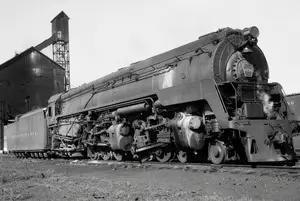
Southern Pacific 4-8-8-2 #4287 (AC-12) totes a few gondolas of scrap metal and a caboose through the yard in Colton, California during 1953. American-Rails.com collection.
At a Glance
| Topic | Notes |
|---|---|
| First locomotive to operate in the U.S. (often cited) | Stourbridge Lion trials on Delaware & Hudson trackage, August 8, 1829 |
| Early American-built experiments / revenue | Tom Thumb (B&O, 1830); Best Friend of Charleston (revenue passenger service, Dec. 1830) |
| Common thermodynamic families | Simple expansion; compound expansion; Mallet compounds |
| Locomotives built by major U.S. manufacturers (Alco, Baldwin, Lima + predecessors), 1831–1956 | About 153,310 (AR research table) |
| American Locomotive Company (+ predecessors) | ~75,000 |
| Baldwin Locomotive Works (+ predecessors) | ~70,541 |
| Lima Locomotive Works | ~7,769 |
| Most built by a single railroad (shop production) | Pennsylvania Railroad ~6,873; N&W ~295 (home-built tradition) |
| Super Power turning point | Lima 2-8-4 concept, 1925 (William E. Woodard / A-1 demonstrator lineage) |
| Class I steam essentially gone | ~1960 (rapid postwar dieselization after 1945) |
| Living steam | Museums, tourist roads, mainline excursions; UP steam program (incl. Big Boy #4014) |
Production figures are order-of-magnitude research totals used on this site; individual sources vary. Prefer builder and railroad records for precision.
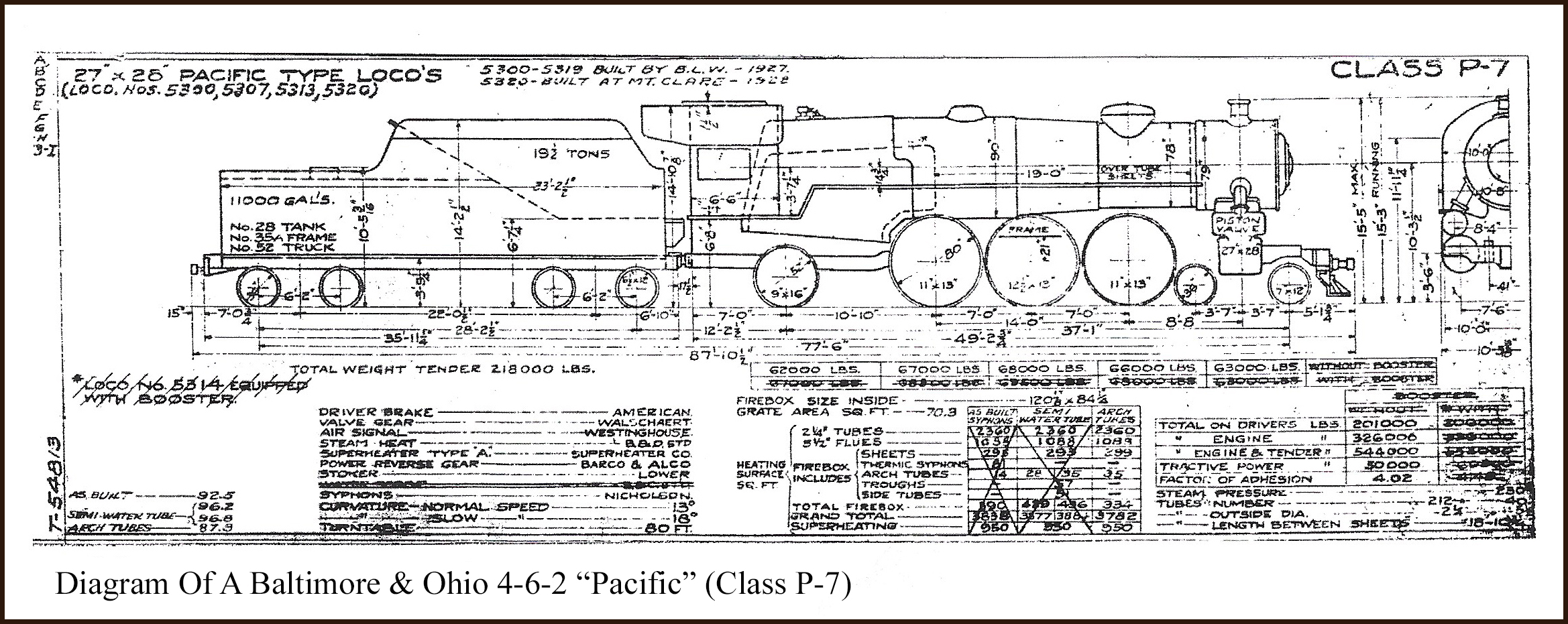
Steam locomotive diagram of a Baltimore & Ohio 4-6-2 Pacific (Class P-7)—hand-drawn schematics typical of the steam era. American-Rails.com collection.
Origins: Rails, Steam Engines & Stephenson
The steam engine long predates railroads. Mike Del Vecchio (Railroads Across America) notes early English coal railways with wooden rails and sleepers from about 1630. Iron rails appear at Whitehaven, Cumberland, about 1740; William Jessop’s flanged-wheel advance is dated 1789 (Loughborough, Leicestershire). Thomas Newcomen’s engine (patent era 1705) was improved by James Watt (1769), who saw that expanding steam was more powerful than Newcomen’s condensing approach. Watt’s technology fed steamboats; in America, Colonel John Stevens used related ideas and later turned to rail.
Richard Trevithick and Andrew Vivian patented a steam locomotive design in 1802; a Trevithick machine worked iron-ore tramway service at Merthyr Tydfil, South Wales, in 1804. George Stephenson (born June 9, 1781, near Newcastle) improved early practice; his 1814 Blücher and later work led to the Stockton & Darlington Railway, authorized 1821 and opened September 27, 1825, when Stephenson’s 0-4-0 Locomotion hauled a long train on opening day. Brian Solomon (The Majesty of Big Steam) emphasizes that S&D combined coal traffic with public service ambition.
The machine that fixed modern internals is often the Rocket of Robert Stephenson & Company—a joint father-and-son effort that won the Rainhill Trials on the Liverpool & Manchester Railway in October 1829 (top speed about 29 mph in the trials). Solomon notes the modern essentials: horizontal fire-tube boiler, forced draft from exhaust steam, and direct linkage from piston to drivers.
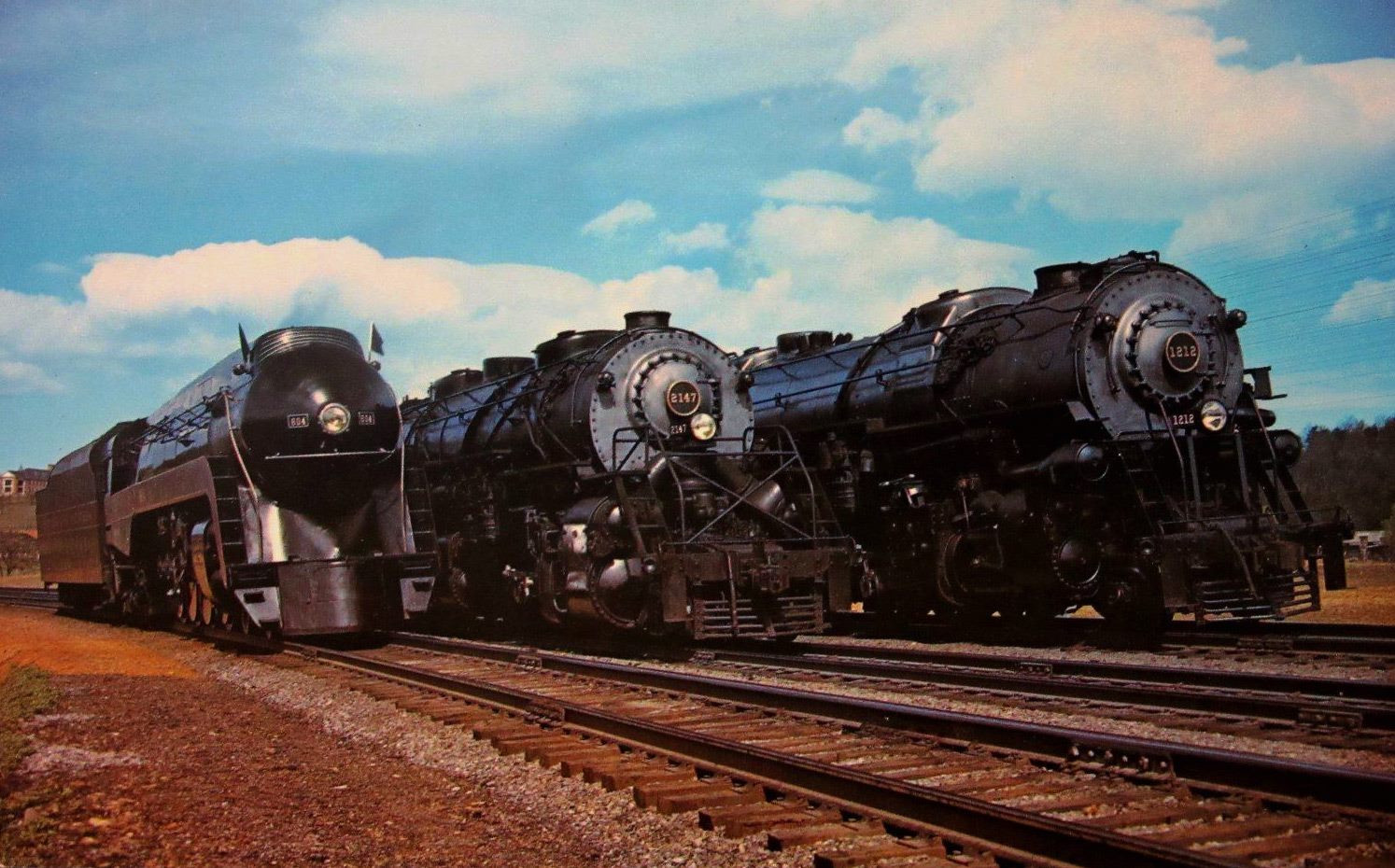
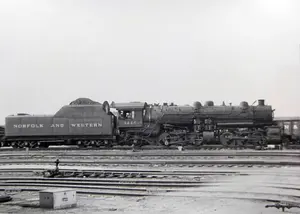
N&W publicity photo, circa 1943: 4-8-4 #604 (J), 2-8-8-2 #2147 (Y-6), and 2-6-6-4 #1212 (A) at Shaffers Crossing, Roanoke. American-Rails.com collection.
Steam Comes to the United States
Stevens chartered the New Jersey Railroad Company in 1815 (built later; PRR family story) and demonstrated his Steam Waggon on a circular track at Hoboken in 1826. Practical American steam on rails is usually dated from the Delaware & Hudson Canal Company’s import of English engines. Chief engineer John B. Jervis wanted locomotives for the gravity road’s easier grades. With Horatio Allen’s help in England (1828), he ordered one Stephenson machine (America) and three from Foster, Rastrick of Stourbridge. America arrived in New York January 15, 1829; the Stourbridge Lion on May 13. After New York demonstrations, only the Lion reached D&H property for trials on August 8, 1829—first steam locomotive operation commonly credited in the United States. It proved too heavy for the track, languished, and was scrapped in 1870 (Jim Shaughnessy, Delaware & Hudson).
On August 28, 1830, Peter Cooper’s Tom Thumb raced a horse on the Baltimore & Ohio—lost the race, proved the idea, never became a long-lived revenue engine (scrapped 1834; B&O Museum replica from the 1927 Fair of the Iron Horse). South Carolina Canal & Rail Road’s Best Friend of Charleston is the classic early American-built revenue passenger locomotive (Christmas Day 1830 service lore). Other pioneers—DeWitt Clinton, John Bull—fill the early roster on this site.
Through the nineteenth century the 4-4-0 American became the continent’s most recognizable type (Solomon). Modest wheelbase and adequate boiler made it a jack-of-all-trades. Later Whyte types—4-6-0, 2-8-0, 4-4-2, 2-8-2, and the Super Power generation—answered heavier trains and higher speeds.
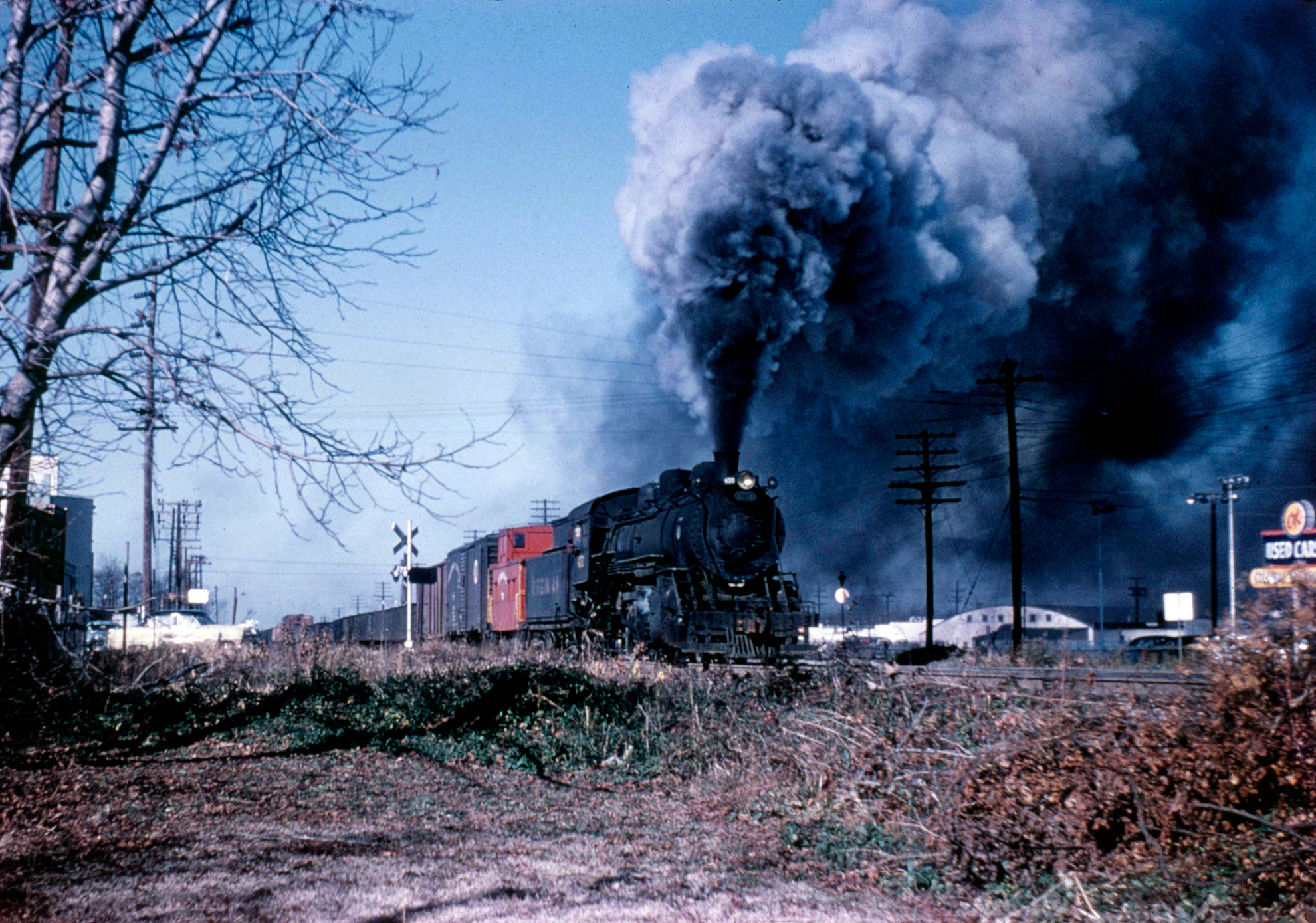
Virginian Railway 2-8-2 #430 (Class MB) in local service at Norfolk, Virginia, December 1954. H. Reid photo. American-Rails.com collection.
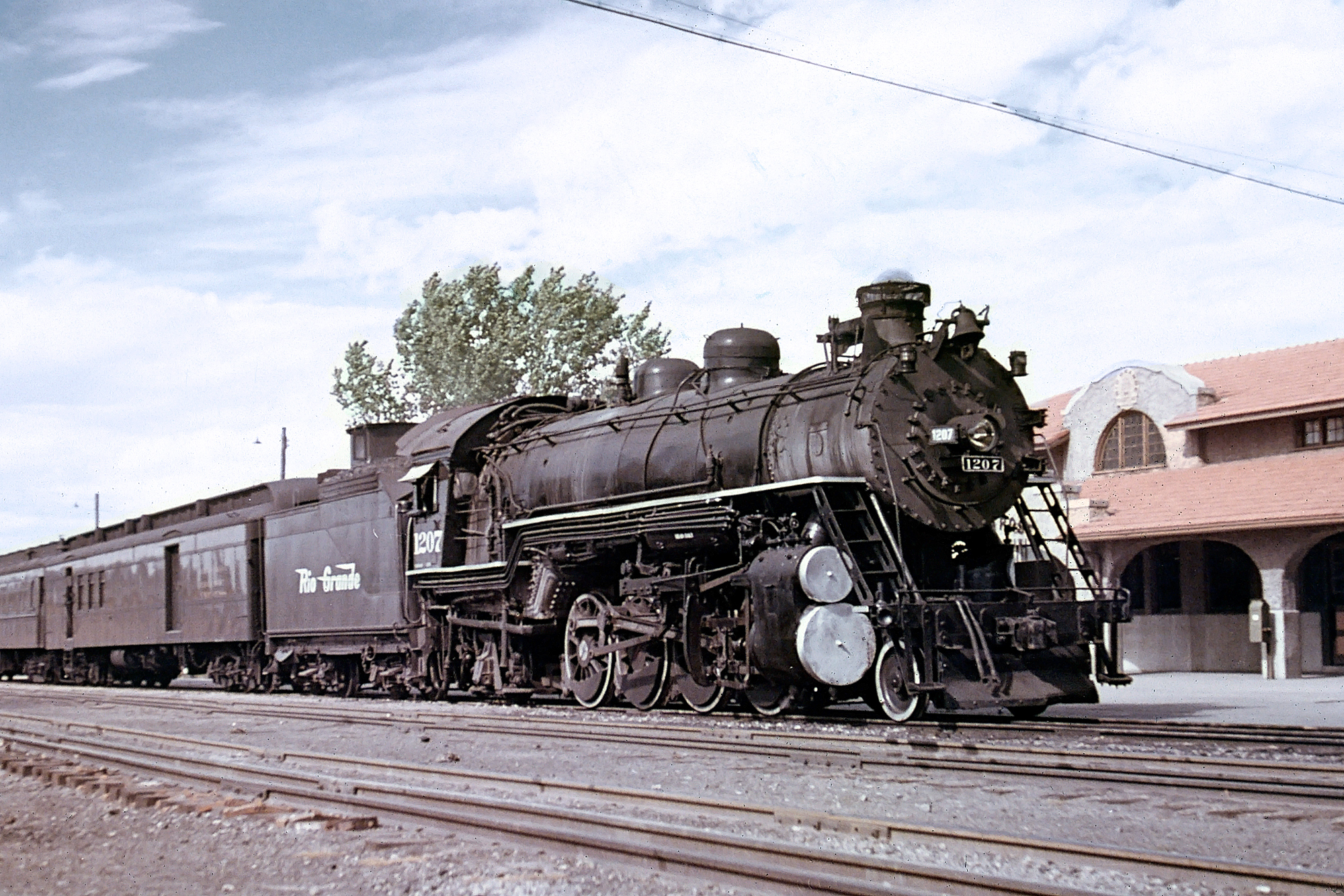
Rio Grande 2-8-2 #1207 at Montrose, Colorado, September 21, 1946. Robert LeMassena photo. American-Rails.com collection.
How a Steam Locomotive Works
The machine is basic in principle and intricate in practice. Fuel (wood, then coal, later oil on many roads) burns in the firebox. Hot gas passes through boiler tubes (flues), heating surrounding water into steam. Steam enters the cylinders, expands against pistons, and drives rods that turn the drivers. Exhaust and smoke leave through the smokebox and stack. Superheaters, feedwater heaters, better valve gear, roller bearings, and improved counterbalancing made twentieth-century engines far more efficient than their Civil War ancestors without simply adding weight (Solomon on steel, welding, and casting advances).
From 1900 through World War II was steam’s operational zenith on American freights and passenger trains. After that, diesel-electrics won on availability and system cost—see Why steam vanished and the diesel hub.
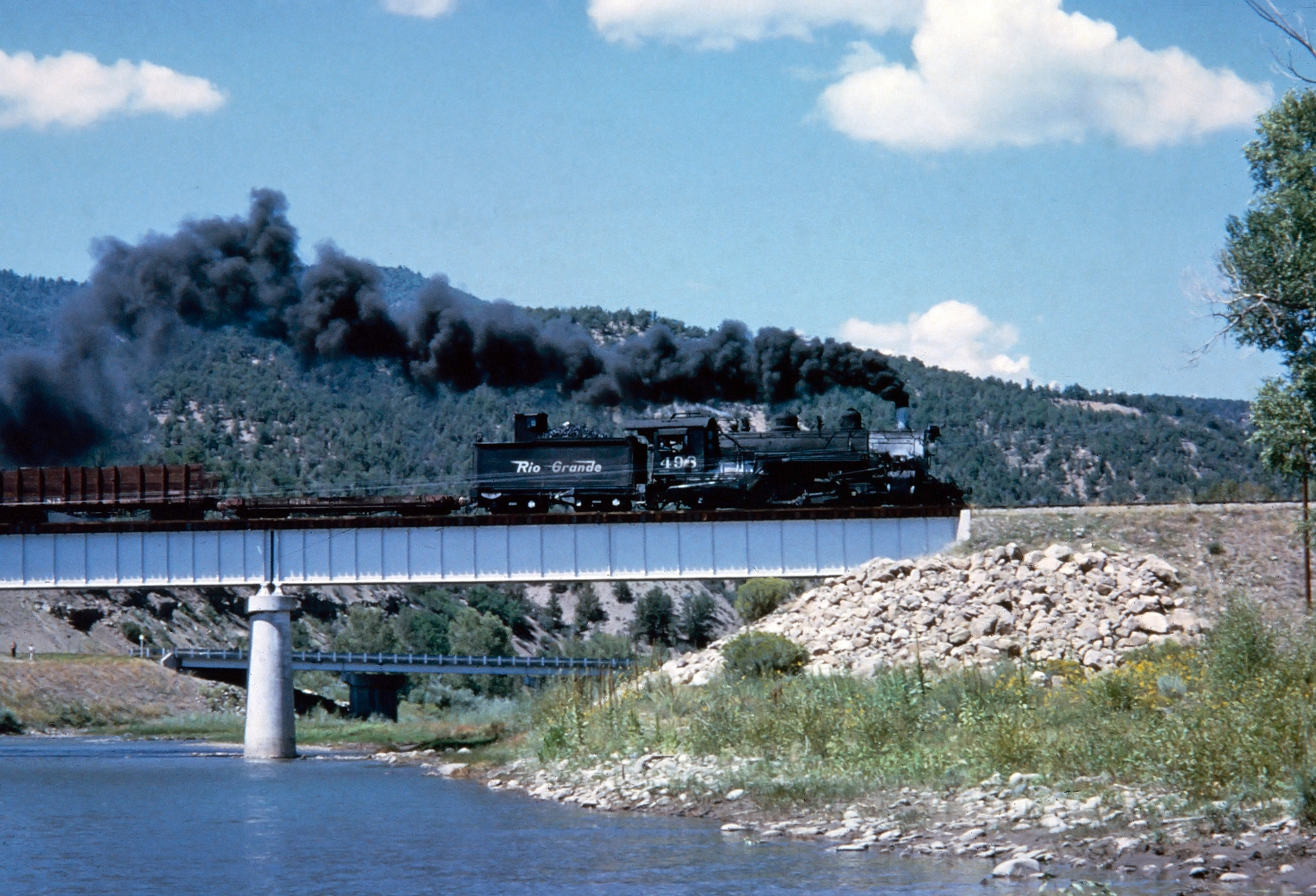
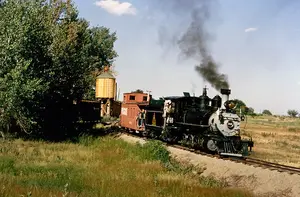
Rio Grande 2-8-2 #498 (K-37) eastbound out of Durango on the narrow-gauge San Juan Extension, summer 1968, near the end of freight operations. American-Rails.com collection.
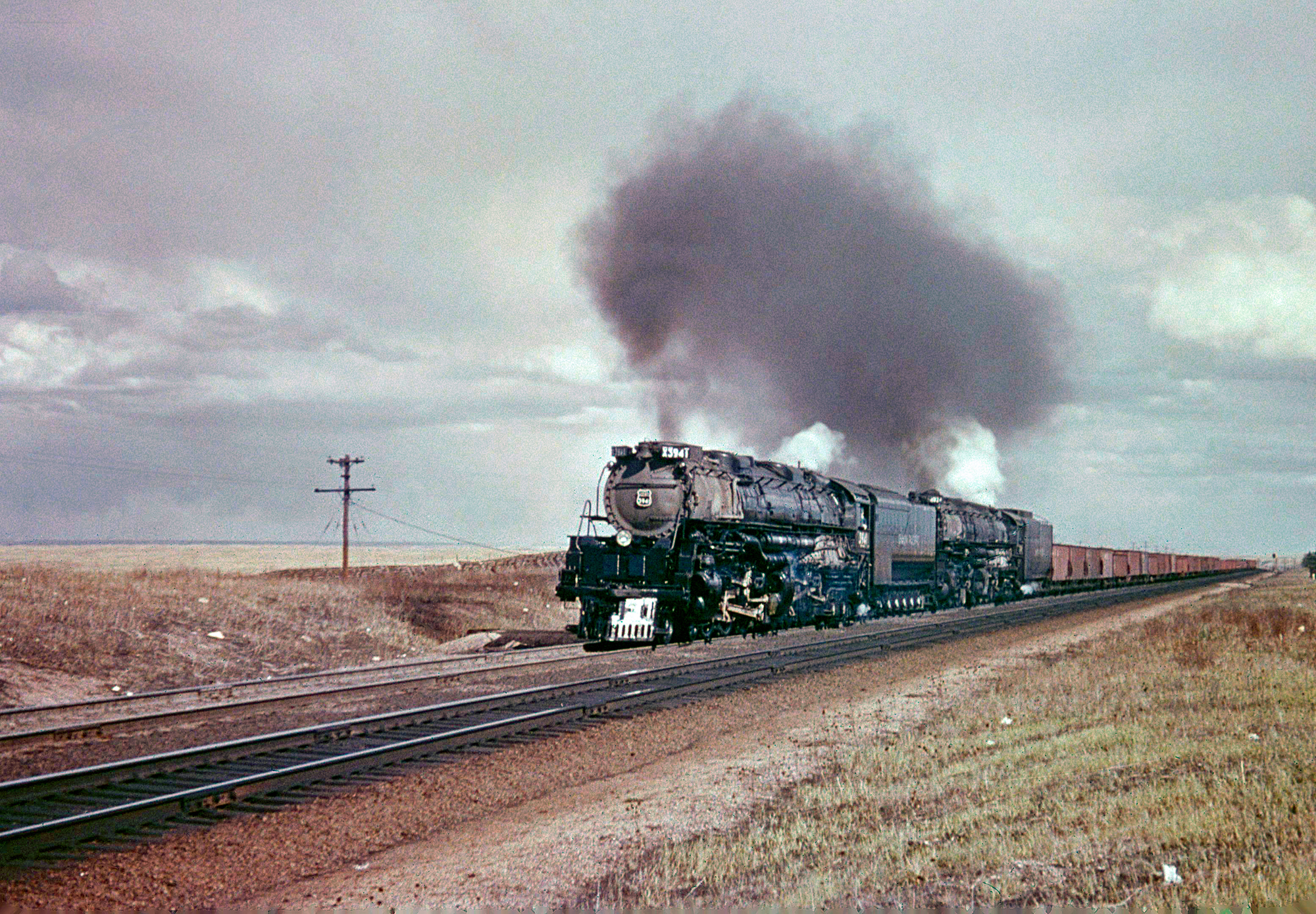
Union Pacific 4-6-6-4 #3941 and 4-8-8-4 #4024 double-head through Borie, Wyoming, May 14, 1953. Bob Collins photo. American-Rails.com collection.
Whyte Notation
Frederick Methvan Whyte’s system classifies steam locomotives by wheel arrangement: leading trucks, drivers, trailing trucks. A 4-6-2 Pacific has four leading wheels, six drivers, and two trailing wheels. Articulateds stack engine units (e.g., 4-8-8-4 Big Boy: four-wheel lead truck, two eight-coupled engines, four-wheel trailing truck). American roads also used class letters (N&W J, A, Y; PRR K4s) that sit alongside Whyte names such as Northern, Hudson, Mikado, and Berkshire.
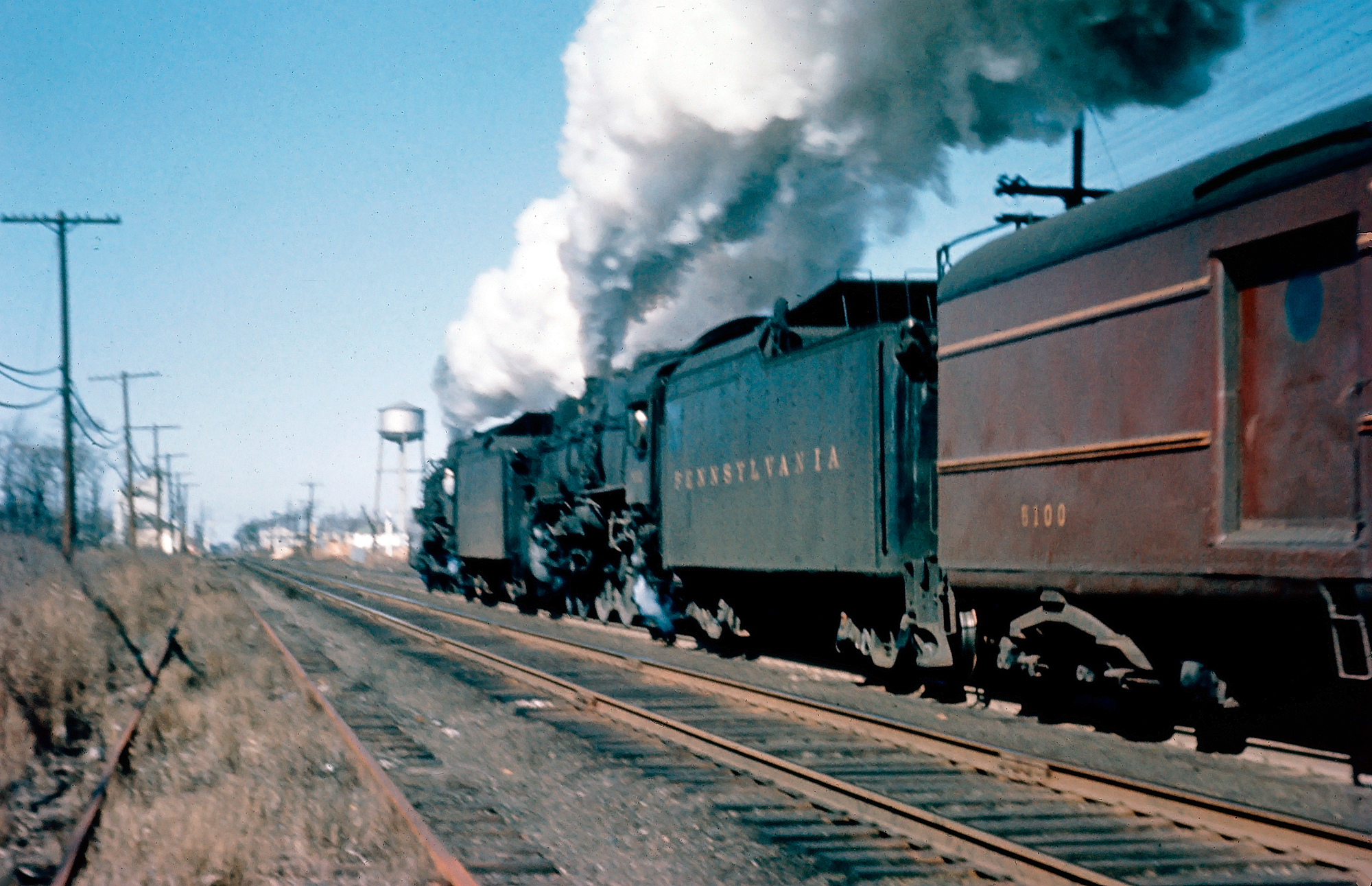
Pennsylvania K4s Pacifics double-head on the New York & Long Branch at Bay Head Junction, New Jersey, circa 1949. Meyer Pearlman photo. American-Rails.com collection.
The Peak: Super Power and Articulated Giants
American steam design peaked in the final three decades of the steam era. Where British practice often chased thermal refinement, American engineers chased sustained horsepower and heavy trains. The turning point was Lima Locomotive Works’ Super Power concept of 1925 under William E. Woodard: a much larger firebox carried on a four-wheel trailing truck, producing steam for high horsepower at speed rather than only starting tractive effort. The 2-8-4 Berkshire demonstrator lineage (including famous Berkshire Mountain tests against 2-8-2s) spread the idea; Baldwin and Alco adopted similar principles. New arrangements followed quickly: 2-8-4, 4-8-4 Northern, 2-10-4 Texas, and simple articulateds such as 2-8-8-4 Yellowstone, 2-6-6-4, 4-6-6-4 Challenger, and 4-8-8-4 Big Boy.
Compound Mallets (Anatole Mallet) had already enlarged locomotives after about 1905 with two engines under one boiler—high-pressure rear, low-pressure front on exhaust steam. Later American practice often preferred simple expansion on both engines for speed and maintenance. Special solutions included Southern Pacific cab-forwards (crew ahead of smoke in Sierra tunnels and sheds) and oil-burning western practice.
The Big Three steam builders—Baldwin, Alco, and Lima—plus railroad shops (especially PRR and N&W) defined the fleet. All three commercial builders exited the locomotive business as diesels took over (Alco lingered into diesels; steam production ended mid-century).
Directories: Types, Builders & Famous Engines
Jump into detailed American-Rails.com profiles. This map preserves the research catalog from the long-running steam hub.
Pioneering Designs
- Best Friend Of Charleston
- DeWitt Clinton
- John Bull
- Stephenson's Planet
- Stephenson's Rocket
- Stourbridge Lion
- Tom Thumb
Wheel Arrangements & Types
- Alleghenies (2-6-6-6)
- American Type (4-4-0)
- Atlantics (4-4-2)
- Berkshires (2-8-4)
- Big Boys (4-8-8-4)
- Camelbacks
- Cab Forwards
- Challengers (4-6-6-4)
- Consolidations (2-8-0)
- Decapods (2-10-0)
- Geared Designs (overview)
- Climaxes
- Heislers
- Shays
- Hudsons (4-6-4)
- Mallets
- Mikados (2-8-2)
- Moguls (2-6-0)
- Mountains (4-8-2)
- Northerns (4-8-4)
- Pacifics (4-6-2)
- Santa Fes (2-10-2)
- Ten-wheelers (4-6-0)
- Texas Types (2-10-4)
- Twelve Wheelers / Mastodons (4-8-0)
- Yellowstones (2-8-8-4)
- 2-6-6-2
- 2-6-6-4
- Chesapeakes (2-8-8-2)
- Consolidation Mallet (2-8-8-0)
- Southern Pacific/Overland 4-10-2
- Union Pacific 4-12-2
Manufacturers
- American Locomotive Company (Alco)
- Baldwin Locomotive Works
- Davenport Locomotive Works
- H.K. Porter Company
- Lima Locomotive Works
- Vulcan Iron Works
Famous Locomotives & Programs
- Bessemer & Lake Erie #643
- Burlington #4960
- Burlington #5632
- Chesapeake & Ohio #614
- Chesapeake & Ohio #1309
- The General
- Great Western Railway #90
- Jawn Henry
- Nickel Plate Road #759
- Nickel Plate Road #765
- Norfolk & Western #611
- N&W J Class overview
- Pennsylvania #1361
- Reading #2100
- Reading #2102
- Southern #630
- Southern #722
- Southern #4501
- American Freedom Train
- Iron Horse Rambles
- Chessie Steam Special
- 21st Century Steam Program
Components & Valve Gear
- Feedwater Heater
- Firebox
- Baker Valve Gear
- Stephenson Valve Gear
- Walschaerts Valve Gear
- Elephant Ears / Smoke Deflectors
Key Steam Terms (Selected)
A full shop glossary could fill a book. These are terms readers meet most often on this site and in steam literature. For the complete list—about thirty definitions including geared types, duplex-drive, thermic syphons, and more—see the dedicated steam locomotive terms glossary.
| Term | Meaning |
|---|---|
| Articulated | Two (or more) engine units under one boiler; e.g., 2-8-8-4, 4-6-6-4 |
| Mallet | Articulated compound: high-pressure rear engine, low-pressure front on exhaust steam (U.S. pronunciation often “MAL-ley”) |
| Simple expansion | Steam used once in the cylinders at boiler pressure (vs. compound) |
| Superheater | Coils that raise steam temperature for roughly 25–30% more power for the same boiler effort |
| Feedwater heater | Warms water before it enters the boiler—saves fuel and thermal shock |
| Backhead | Rear of the firebox in the cab; mounting face for many controls |
| Cab-forward | Cab at the front (classic SP oil-burners in the Sierras) |
| Camelback | Engineer’s cab astride the boiler; fireman at the rear (to ~1927 builds) |
| Shay / Heisler / Climax | Geared logging/industrial locomotives for steep, rough track |
| Pop valve | Safety/pressure-relief valve on the boiler |
| Smoke deflector (“elephant ears”) | Plates that lift smoke clear of the cab for vision |
| Quartered drivers | Left and right cranks 90° apart so the engine cannot lock with both sides at dead center |
Full steam terms glossary (all definitions) · Component pages: firebox · feedwater heater · Walschaerts · Baker · Stephenson valve gear.
Why Steam Disappeared So Quickly
The shift from steam to diesel-electric power was one of the fastest complete technology replacements in industrial history. In 1945 steam still handled most Class I train-miles; by about 1960 it had essentially vanished from regular Class I service. Even many railroaders who expected decades of coexistence were surprised.
Availability led the list. A diesel could stay out for days with short fuel and inspection stops. Steam needed water, ash handling, boiler washouts, and heavy shopping. One diesel often replaced two or three steam locomotives in practical utilization. Crew costs reinforced the change: multiple diesel units under one cab crew versus a full crew on each steam engine in a multi-unit helper district. Fuel and maintenance favored diesels once total cost per drawbar-horsepower-hour was counted—even when coal looked cheap per BTU. Steam demanded coaling stations, water tanks, ash pits, roundhouses, and boiler shops that diesels largely eliminated.
Postwar conditions accelerated the process: worn steam fleets after World War II, strong freight demand, and builders ready to sell EMD F-units, Geeps, Alco road-switchers, and later GE products. For the diesel side of the story—FT demonstrator, builders, model map—see diesel locomotives.
Preserved steam continues to draw crowds decades after regular Class I service ended. American-Rails.com collection.
Steam in the 21st Century
Regular Class I steam ended in the late 1950s and early 1960s, but the technology never vanished from public life. Museums, tourist railroads, and private owners restored static engines to operation. Mainline excursion programs—Reading Iron Horse Rambles, Chessie Steam Special, American Freedom Train, Southern and Norfolk Southern steam eras, and Union Pacific’s long-running steam team—kept big engines on the road. Profiles of those programs and engines live in the directory above.
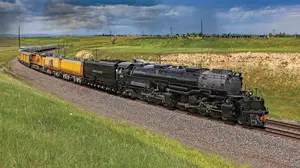
Recent decades have seen high-profile restorations of large power. Union Pacific’s return of 4-8-8-4 #4014 (restored and back under steam in 2019) made Big Boy a national ambassador again, including major tour mileage in subsequent seasons. Other roads and nonprofits cycle engines such as N&W #611, Nickel Plate #765, C&O #614 / #1309, and many smaller tourist engines through operating seasons when budgets and FRA compliance allow. Always confirm current operating status—boilers and running gear are expensive, and schedules change.
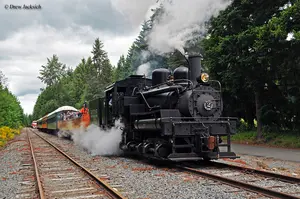
Tourist railroads from Strasburg to Cass to Durango keep steam in weekly service for visitors. That living fleet is why the machine still defines “railroad” for much of the public sixty-plus years after diesels took the freights.
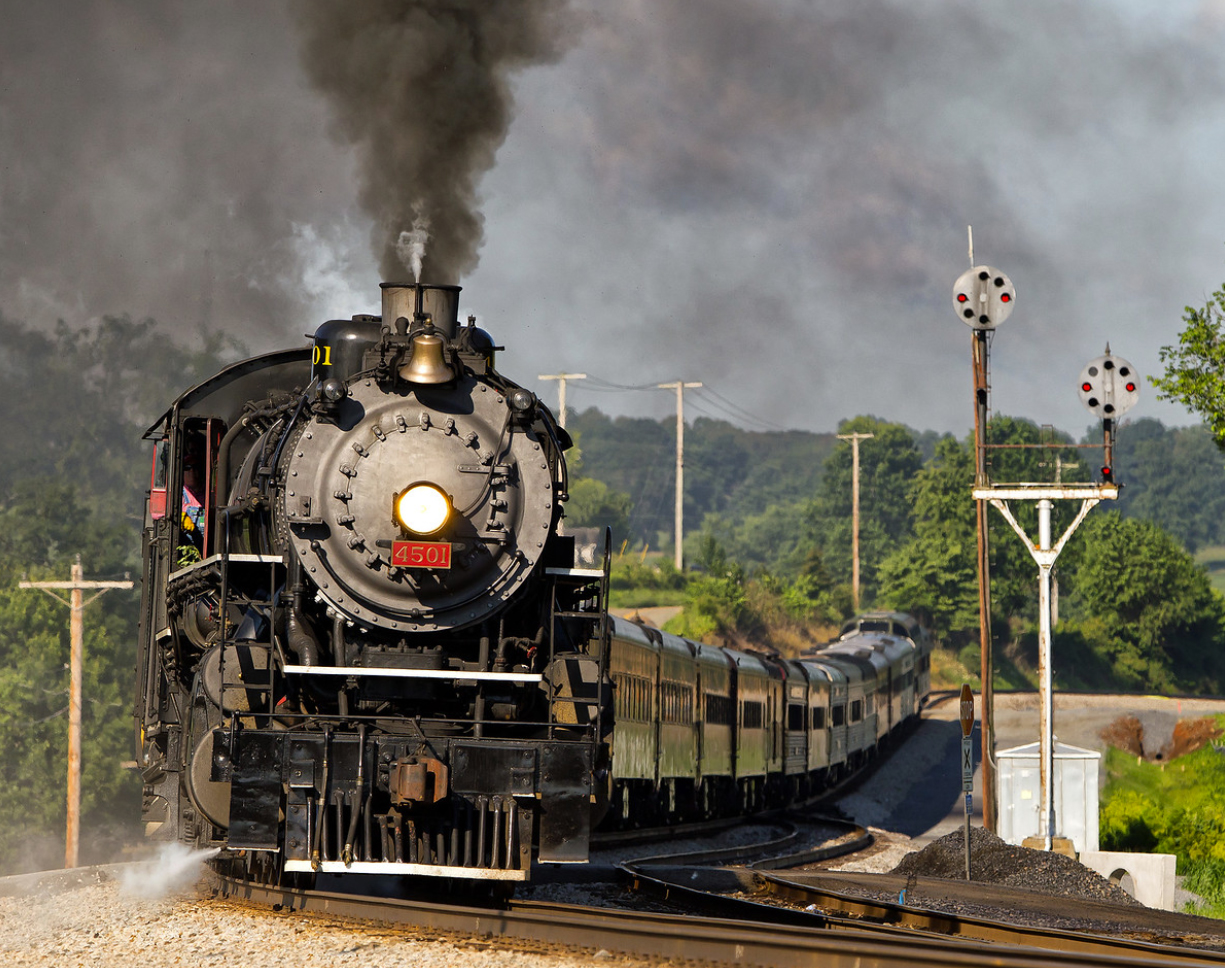
Heritage steam operations keep fire, water, and iron in public view. In this scene, Southern 2-8-2 #4501 leads a Norfolk Southern excursion at Glade Spring, Virginia. Loyd Lowry photo.
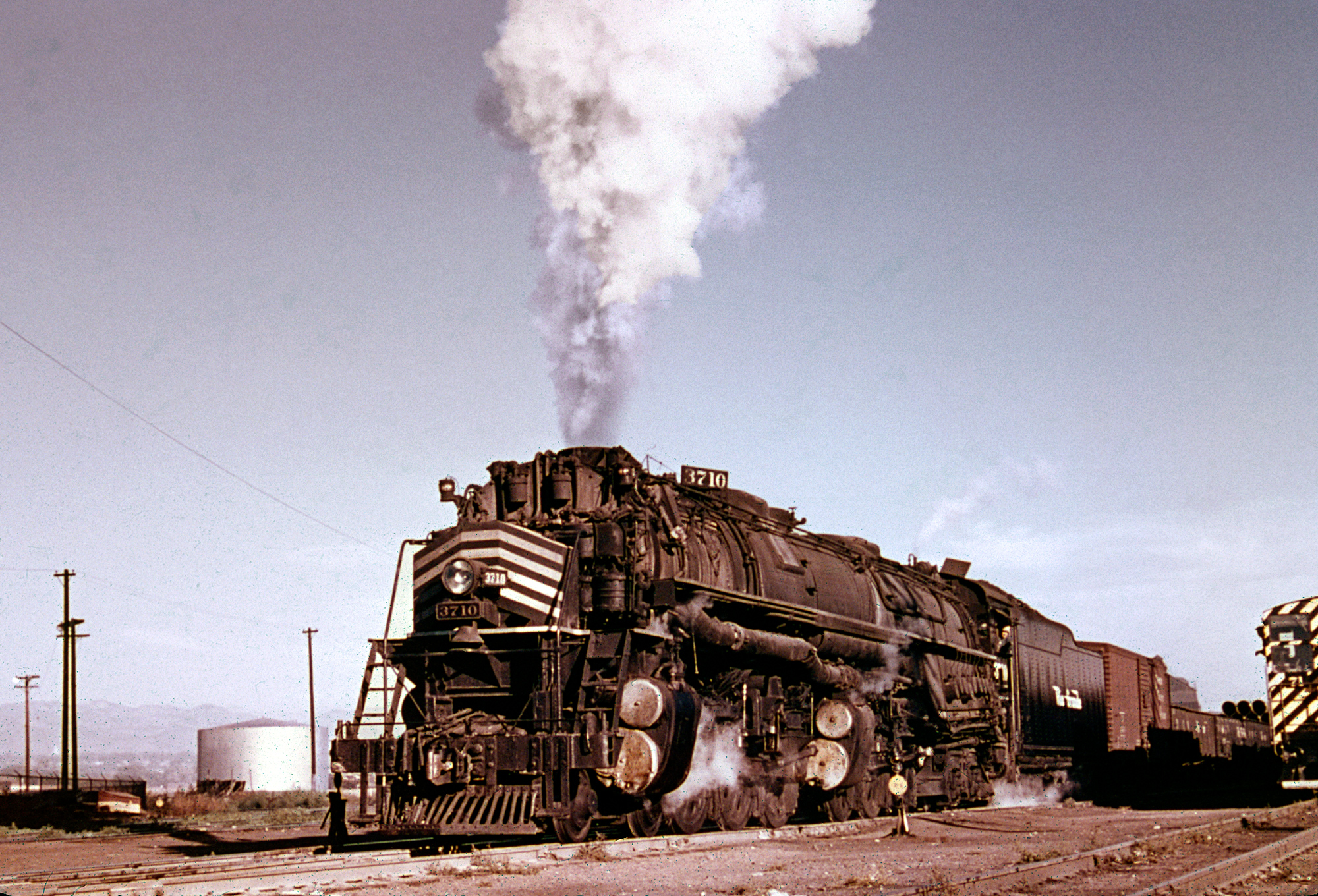
Rio Grande 4-6-6-4 #3710 steams out of Burnham Yard in Denver; 1955. Robert LeMassena photo. American-Rails.com collection.
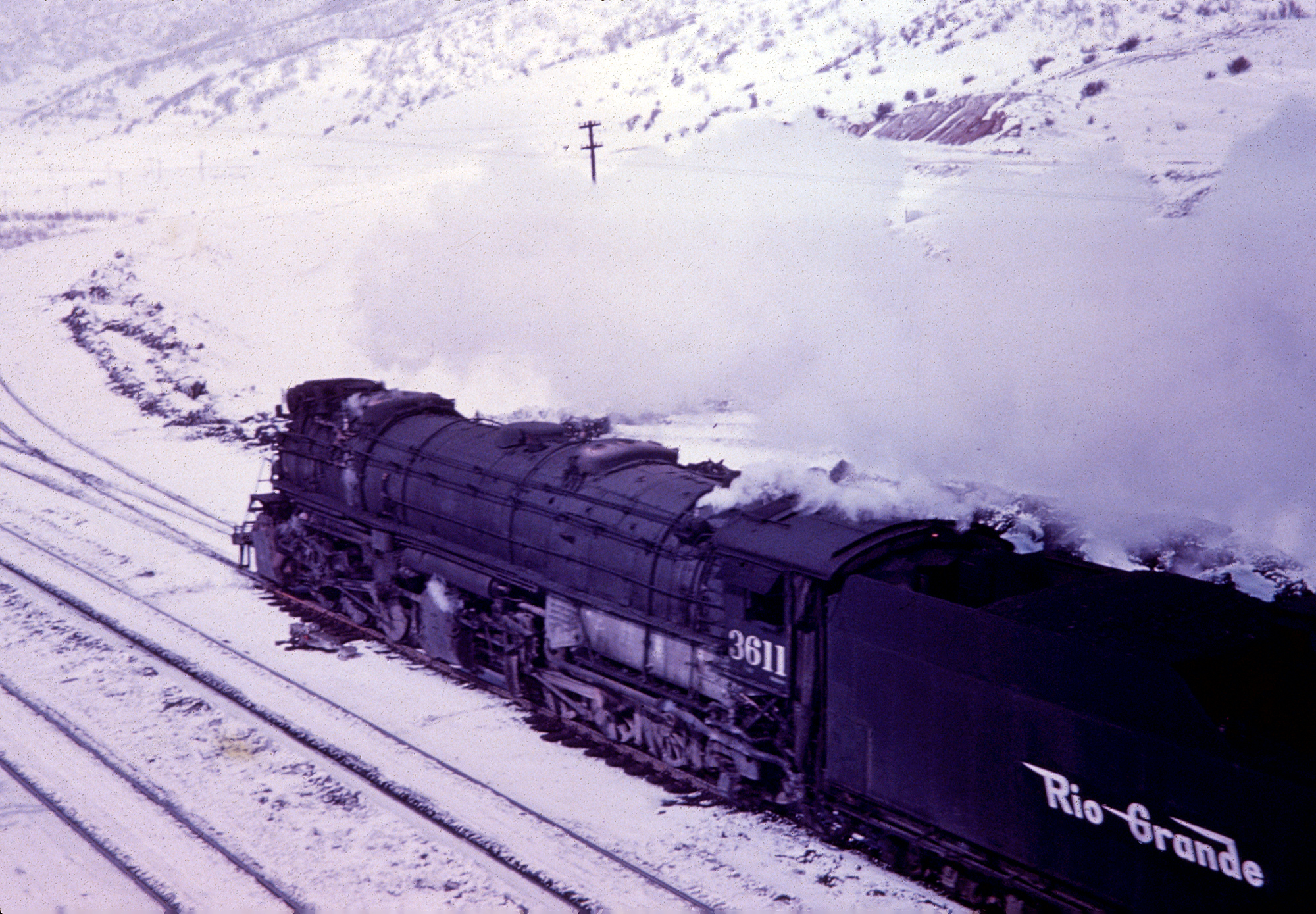
From branch locals to mountain freights, steam was the universal American motive power for generations. Here, Rio Grande 2-8-8-2 #3611 (L-132) works its way over Soldier Summit (Utah) during the 1950s. Ed Olsen photo. American-Rails.com collection.
Related Reading on American-Rails.com
- Locomotive history hub · Diesel locomotives · Electric locomotives
- Steam locomotive terms glossary · Railroad glossary (sitewide)
- Cowcatcher / pilot · Streamliners · Railroad history
- Fireman · Engineer history · N&W J Class
- Tourist trains (where most people ride steam today) · Home
Sources
- Solomon, Brian. The Majesty of Big Steam; related steam and builder studies
- Del Vecchio, Mike. Railroads Across America
- Shaughnessy, Jim. Delaware & Hudson: Bridge Line to New England and Canada (Stourbridge Lion)
- Stephenson / Rainhill / Stockton & Darlington secondary literature as summarized in Solomon and standard histories
- Lima Super Power / Woodard 2-8-4 development accounts (Berkshire tests, 1925)
- American-Rails.com production-stat research table (Alco / Baldwin / Lima totals; railroad shop builds)
- Builder and preservation literature on dieselization pace (1945–1960) and modern excursion steam
- American-Rails.com type, builder, and individual locomotive profiles linked in the directories
Revised August 2026 retaining core research on English origins, American firsts, operation, Whyte types, builders, production scale, and living steam. Full definitions moved to the steam terms leaf; directories of types, famous engines, and components preserved from the long-running American-Rails.com steam map.
Recent Articles


-
Massachusetts Railroad Museums (2026): A Complete Guide
Oct 08, 26 12:08 AM
 Massachusetts railroad museums—Berkshire Scenic at Lenox, Shelburne Falls trolley No. 10, Edaville, Chatham’s 1887 depot, and Lowell. Confirm hours on each site.
 -
Clinchfield Steam Roster (Post 1900)
Oct 07, 26 12:09 PM
 Clinchfield steam since 1900. Fifteen H-4 Consolidations, K-1 Mikados, M-2 and M-3 Mallets, L-class 2-8-8-2s, eighteen Challengers. Class grid after Drury. Last steam April 16, 1954.
 -
Clinchfield Diesel Roster (All-Time)
Oct 07, 26 12:05 PM
 Clinchfield diesel roster, all-time. F3A 800, FP7 200, the F7s, GP7s, 25 SD40s, 18 SD45-2s, seven U36Cs, and the Family Lines hoods. Serials and EMD order numbers.
 -
Clinchfield Railroad: Map, Steam Locomotives, Roster, Logo
Oct 07, 26 12:02 PM
 Clinchfield Railroad, Elkhorn City to Spartanburg. George L. Carter, the Carolina, Clinchfield & Ohio, the 1924 lease, coal, the loops, and CSX. Steam and diesel rosters are companion pages.
 -
Kentucky Railroad Museums (2026): A Complete Guide
Oct 07, 26 11:39 AM
 Kentucky railroad museums—the Kentucky Railway Museum, Bowling Green’s L&N depot, Paducah, Versailles, and Covington. Confirm hours on each site.
 -
Kansas Railroad Museums (2026): A Complete Guide
Oct 07, 26 11:26 AM
 Kansas railroad museums—Santa Fe 3768 at Wichita, Santa Fe 132 in Topeka, the Great Overland Station, and Abilene. Confirm hours on each site.
 -
Cincinnati, New Orleans and Texas Pacific Diesel Roster (All-Time)
Oct 07, 26 10:38 AM
 All-time diesel roster of Southern locomotives lettered for the Cincinnati, New Orleans and Texas Pacific. Serials, order numbers, and builder dates.
 -
Cincinnati, New Orleans and Texas Pacific Railway
Oct 07, 26 10:31 AM
 Cincinnati, New Orleans and Texas Pacific Railway, incorporated September 8, 1881, to lease Cincinnati’s railroad to Chattanooga. Queen and Crescent route, Rathole, and the 2024 sale to Norfolk Southe…
 -
Indiana Railroad Museums (2026): A Complete Guide
Oct 07, 26 12:26 AM
 Indiana railroad museums—Nickel Plate 765, Elkhart’s New York Central collection, French Lick, Linden’s junction depot, and Haley Tower. Confirm hours on each site.
 -
"Triplex" Steam Locomotive: Specs, History, Photos
Oct 06, 26 11:52 PM
 Erie class P-1 Triplex 2-8-8-8-2s. Three Baldwin compounds, 2603–2605, later 5014–5016, built 1914 and 1916. Matt H. Shay, the 1930 class card, and Virginian XA 700.
 -
Illinois Railroad Museums (2026): A Complete Guide
Oct 06, 26 11:47 PM
 Illinois railroad museums—the Illinois Railway Museum, Monticello, the Pioneer Zephyr, Galesburg’s Burlington 3006, and the depots. Confirm hours on each site.
 -
Iowa Railroad Museums (2026): A Complete Guide
Oct 06, 26 11:41 PM
 Iowa railroad museums—the Union Pacific Railroad Museum, RailsWest, Sioux City, Boone, and the National Hobo Museum in Britt. Confirm hours on each site.
 -
Charleston and Western Carolina Diesel Roster (All-Time)
Oct 06, 26 11:29 PM
 Charleston and Western Carolina diesel roster. Twenty-one GP7s, two SW7s, two SW9s, and six F7As, all built 1950–1952. Serials, order numbers, and ACL and SCL numbers.
 -
Charleston and Western Carolina Railway: Map, History, Timetables
Oct 06, 26 11:18 PM
 Charleston and Western Carolina Railway, incorporated September 16, 1896. Port Royal to Spartanburg, with branches to Anderson and Greenville. Merged into the Atlantic Coast Line on December 31, 1959.
 -
Central of Georgia Steam Roster (Post 1900)
Oct 06, 26 04:00 PM
 Central of Georgia steam since 1900. Cooke Consolidations, Harriman Mikados, 32 Mountains, and eight Lima 4-8-4s. Class grid after Drury. Last steam May 1953.
 -
Central of Georgia Diesel Roster (All-Time)
Oct 06, 26 03:44 PM
 Central of Georgia diesel roster. SW1 No. 1 in 1939, E7s and E8s, nine F3As, 39 RS3s, GP7s through SD35s. Serials and order numbers.
 -
Central of Georgia Railway: Map, Logo, History, Rosters
Oct 06, 26 03:42 PM
 Central of Georgia Railway, from the 1833 Savannah charter to Southern control on June 17, 1963. Map, logos, Nancy Hanks II, and links to the steam and diesel rosters.
 -
Georgia Railroad Museums (2026): A Complete Guide
Oct 06, 26 03:33 PM
Georgia railroad museums—Savannah’s Central shops, Duluth, the General at Kennesaw, the Texas in Atlanta, Tifton, Waycross, and Albany. Confirm hours on each site. -
Florida Railroad Museums (2026): A Complete Guide
Oct 06, 26 03:18 PM
 Florida railroad museums—Boca Raton, Winter Garden, Whitehall, the Gold Coast, Parrish, Fort Myers, Milton, and Plant City. Confirm hours on each site.
 -
Connecticut Railroad Museums (2026): A Complete Guide
Oct 06, 26 01:05 PM
 Connecticut railroad museums—the Shore Line Trolley, East Windsor, the Naugatuck Railroad, Danbury Union Station, Willimantic, and the SoNo tower. Confirm hours on each site.
 -
Colorado Railroad Museums (2026): A Complete Guide
Oct 06, 26 12:47 PM
 Colorado railroad museums—Golden, the Forney’s Big Boy 4005, Pueblo’s Santa Fe 2912, and the depots at Castle Rock, Limon, and Ridgway. Confirm hours on each site.
 -
Atlantic Coast Line Steam Roster (Post 1900)
Oct 06, 26 12:44 PM
 Atlantic Coast Line steam since 1900. Copper Head Ten-Wheelers, 235 P-5 Pacifics, Q-1 Santa Fes, twelve R-1 4-8-4s. Class grid after Drury. Last steam June 30, 1955.
 -
Atlantic Coast Line Diesel Roster (All-Time)
Oct 06, 26 11:57 AM
 Atlantic Coast Line diesel roster. HH660 1900 in 1939, E3s for the Champion, FTs and F2s, GP7s 100–279, GP30s, U25Cs, and the 1967 SCL numbers. Serials and orders.
 -
Atlantic Coast Line Railroad: "Standard Railroad of the South"
Oct 06, 26 11:53 AM
 Atlantic Coast Line, the Standard Railroad of the South. April 21, 1900 to July 1, 1967. Plant System, L&N, Clinchfield, the Champion, and the Seaboard Coast Line merger.
 -
California Railroad Museums (2026): A Complete Guide
Oct 06, 26 09:50 AM
California railroad museums—the California State Railroad Museum, Perris, Portola, Railtown 1897, and the depots that still stand. Confirm hours on each site. -
Arizona Railroad Museums (2026): A Complete Guide
Oct 06, 26 09:46 AM
Arizona railroad museums—the Arizona Railway Museum in Chandler, Southern Pacific 1673 at Tucson, and the McCormick-Stillman park in Scottsdale. -
Arkansas Railroad Museums (2026): A Complete Guide
Oct 06, 26 09:07 AM
 Arkansas railroad museums—Cotton Belt 819 at Pine Bluff, the Fort Smith trolley, the Mammoth Spring depot, and the Eureka Springs railway.
 -
Alabama Railroad Museums (2026): A Complete Guide
Oct 06, 26 09:03 AM
Alabama railroad museums—Heart of Dixie at Calera, the North Alabama museum at Chase, Huntsville’s 1860 depot, and Fort Payne. Confirm hours on each site. -
Pennsylvania Railroad Museums (2026): A Complete Guide
Oct 06, 26 12:09 AM
 Pennsylvania railroad museums—Strasburg, Steamtown, the Horseshoe Curve, the East Broad Top, and the depots and towers in between. Confirm hours on each site.
 -
Maryland Railroad Museums (2026): A Complete Guide
Oct 05, 26 11:53 PM
 Maryland railroad museums—the Baltimore roundhouse, Ellicott City station, Bowie, Gaithersburg’s Buffalo Creek & Gauley 14, and the Western Maryland collections.
 -
Ohio Railroad Museums (2026): A Complete Guide
Oct 05, 26 05:51 PM
 Ohio railroad museums—the Age of Steam Roundhouse, Bellevue, Worthington, Conneaut’s Nickel Plate 755, and the Dennison depot. Confirm hours on each site.
 -
Delaware Railroad Museums (2026): A Complete Guide
Oct 05, 26 02:43 PM
 Delaware railroad museums—Wilmington & Western at Greenbank, the Harrington tower and N5 caboose, Felton's 1868 depot, and the Selbyville station museum.
 -
C&O's M-1 Steam Turbine Locomotives: Specs, Roster, History
Oct 05, 26 12:13 PM
 Chesapeake & Ohio Class M-1 steam-turbine-electrics. Three Baldwin-Westinghouse locomotives, 500–502, built 1947–48 for The Chessie. Specs, the 2-C1+2-C1-B arrangement, and a roster. All scrapped…
 -
N&W 2-6-6-2 Locomotives (Class Z): Specs, Roster, History
Oct 05, 26 11:44 AM
 Norfolk & Western Class Z 2-6-6-2s. One hundred ninety compound Mallets, 1300–1489, from Richmond, Baldwin, and Schenectady, 1912–1918. Diagram specs, the Z-1b rebuilds, Z-2 1399, and a roster. No…
 -
Scenic Train Rides (USA 2026): State Guide to Tourist Railroads
Oct 04, 26 12:17 AM
 Scenic and tourist train rides in all 50 states for 2026. Colorado narrow gauge, Pennsylvania steam, Alaska’s White Pass, and the states with no full-size ride this month. Confirm on the railroad.
 -
Wyoming Scenic Train Rides (2026): A Complete Guide
Oct 03, 26 12:07 AM
 Wyoming has no full-size tourist railroad on the calendar in October 2026. Cheyenne Depot Museum and Douglas Railroad Museum are static. Union Pacific 4014’s posted public trip is a November run to De…
 -
Washington Scenic Train Rides (2026): A Complete Guide
Oct 02, 26 11:53 PM
 Washington tourist trains in 2026—Mount Rainier Scenic at Elbe, the Northwest Railway Museum, and Chehalis-Centralia. Lake Whatcom has no 2026 date on its ticket page.
 -
Wisconsin Scenic Train Rides (2026): A Complete Guide
Oct 02, 26 11:48 PM
 Wisconsin tourist trains in 2026—Wisconsin Great Northern, Osceola & St. Croix Valley, Mid-Continent, East Troy, and the National Railroad Museum.
 -
Pennsylvania Railroad Class Q2 4-4-6-4: Specs, Roster, History
Oct 02, 26 11:28 PM
 Pennsylvania Railroad Class Q2 4-4-6-4 duplexes. Twenty-six engines, 6131 and 6175–6199, Altoona 1944–45. Form 109-J specs, the 7,987 hp test of 6175, and a roster. All scrapped.
 -
Utah Scenic Train Rides (2026): A Complete Guide
Oct 02, 26 11:18 PM
 Utah tourist trains in 2026—Heber Valley Railroad from Heber City. Golden Spike at Promontory is a locomotive demonstration, not a line-haul ride.
 -
South Dakota Scenic Train Rides (2026): A Complete Guide
Oct 02, 26 11:06 PM
 South Dakota’s 2026 scenic train is the Black Hills Central 1880 Train, Hill City to Keystone. Steam is the summer assignment. Confirm the engine.
 -
Oregon Scenic Train Rides (2026): A Complete Guide
Oct 02, 26 11:04 PM
 Oregon tourist trains in 2026—Oregon Coast Scenic from Rockaway Beach, Mount Hood at Hood River, Eagle Cap from Elgin, and the Oregon Rail Heritage Center in Portland.
 -
Oklahoma Scenic Train Rides (2026): A Complete Guide
Oct 02, 26 10:36 PM
Oklahoma has no full-size scenic railroad on an October 2026 calendar. Oklahoma Railway Museum Halloween and Polar trains, the El Reno trolley, and the Heartland Flyer. -
North Dakota Scenic Train Rides (2026): A Complete Guide
Oct 02, 26 01:14 PM
North Dakota has no tourist railroad on a 2026 calendar. Ride Amtrak’s daily Empire Builder. The Fort Lincoln Trolley in Mandan is not a current ticket. -
Nebraska Scenic Train Rides (2026): A Complete Guide
Oct 02, 26 10:11 AM
 Nebraska has no full-size scenic railroad in 2026. The Omaha Zoo Railroad runs weekends through October 4. Ride Amtrak’s California Zephyr across the state.
 -
Missouri Scenic Train Rides (2026): A Complete Guide
Oct 02, 26 09:56 AM
 Missouri tourist trains in 2026—Branson Scenic Railway and the St. Louis, Iron Mountain & Southern at Jackson. Belton has no 2026 schedule posted.
 -
Minnesota Scenic Train Rides (2026): A Complete Guide
Oct 02, 26 09:52 AM
 Minnesota tourist trains in 2026—North Shore Scenic Railroad in Duluth, the Duluth River Train, and the Como-Harriet streetcar.
 -
Kansas Scenic Train Rides (2026): A Complete Guide
Oct 02, 26 09:32 AM
 Kansas tourist trains in 2026—the Abilene & Smoky Valley Railroad. Santa Fe 3415 is in overhaul. Midland Railway at Baldwin City is closed.
 -
Iowa Scenic Train Rides (2026): A Complete Guide
Oct 02, 26 08:41 AM
 Iowa tourist trains in 2026—Boone & Scenic Valley across the Bass Point Creek High Bridge, and Midwest Central’s December North Pole trains
 -
Indiana Scenic Train Rides (2026): A Complete Guide
Oct 02, 26 08:35 AM
 Indiana tourist trains in 2026—French Lick Scenic Railway, Nickel Plate Express, Hoosier Valley, and Hesston. Whitewater Valley is suspended.